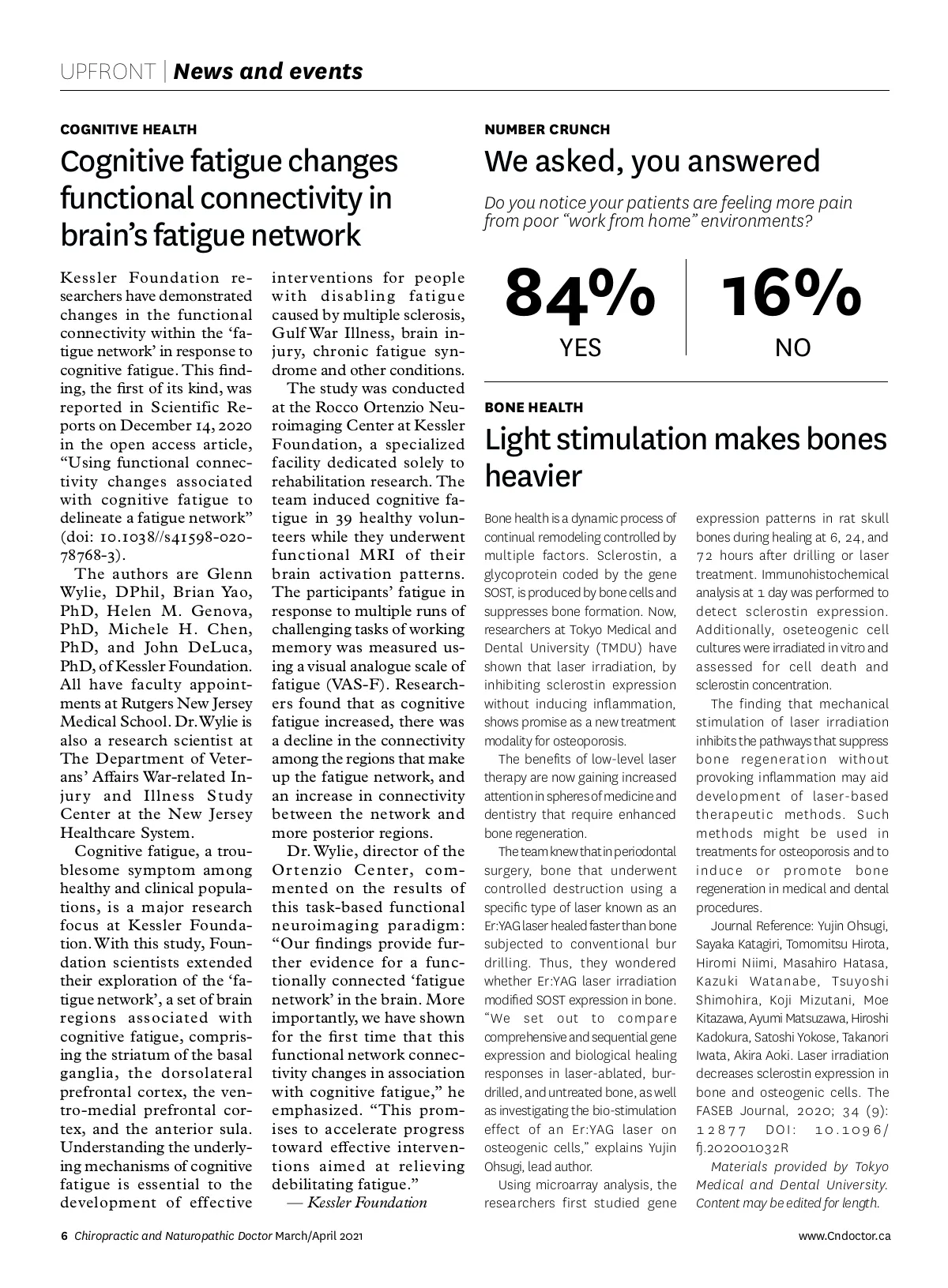
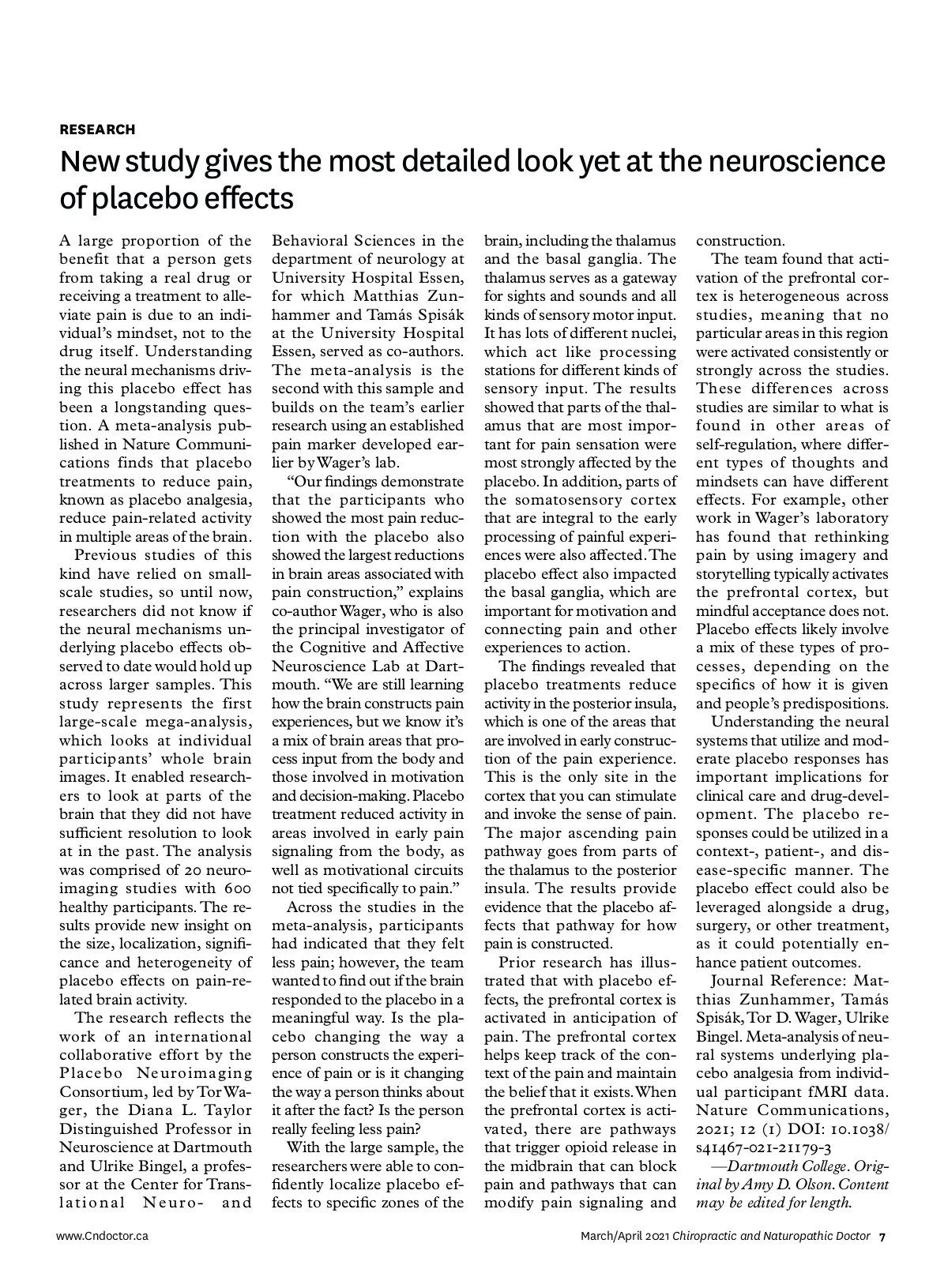
UPFRONT | News and events COGNITIVE HEALTH Cognitive fatigue changes functional connectivity in brain’s fatigue network Kessler Foundation re-searchers have demonstrated changes in the functional connectivity within the ‘fa-tigue network’ in response to cognitive fatigue. This find-ing, the first of its kind, was reported in Scientific Re-ports on December 14, 2020 in the open access article, “Using functional connec-tivity changes associated with cognitive fatigue to delineate a fatigue network” (doi: 10.1038//s41598-020-78768-3). The authors are Glenn Wylie, DPhil, Brian Yao, PhD, Helen M. Genova, PhD, Michele H. Chen, PhD, and John DeLuca, PhD, of Kessler Foundation. All have faculty appoint-ments at Rutgers New Jersey Medical School. Dr. Wylie is also a research scientist at The Department of Veter-ans’ Affairs War-related In-jury and Illness Study Center at the New Jersey Healthcare System. Cognitive fatigue, a trou-blesome symptom among healthy and clinical popula-tions, is a major research focus at Kessler Founda-tion. With this study, Foun-dation scientists extended their exploration of the ‘fa-tigue network’, a set of brain regions associated with cognitive fatigue, compris-ing the striatum of the basal ganglia, the dorsolateral prefrontal cortex, the ven-tro-medial prefrontal cor-tex, and the anterior sula. Understanding the underly-ing mechanisms of cognitive fatigue is essential to the development of effective interventions for people with disabling fatigue caused by multiple sclerosis, Gulf War Illness, brain in-jury, chronic fatigue syn-drome and other conditions. The study was conducted at the Rocco Ortenzio Neu-roimaging Center at Kessler Foundation, a specialized facility dedicated solely to rehabilitation research. The team induced cognitive fa-tigue in 39 healthy volun-teers while they underwent functional MRI of their brain activation patterns. The participants’ fatigue in response to multiple runs of challenging tasks of working memory was measured us-ing a visual analogue scale of fatigue (VAS-F). Research-ers found that as cognitive fatigue increased, there was a decline in the connectivity among the regions that make up the fatigue network, and an increase in connectivity between the network and more posterior regions. Dr. Wylie, director of the Ortenzio Center, com-mented on the results of this task-based functional neuroimaging paradigm: “Our findings provide fur-ther evidence for a func-tionally connected ‘fatigue network’ in the brain. More importantly, we have shown for the first time that this functional network connec-tivity changes in association with cognitive fatigue,” he emphasized. “This prom-ises to accelerate progress toward effective interven-tions aimed at relieving debilitating fatigue.” — Kessler Foundation NUMBER CRUNCH We asked, you answered Do you notice your patients are feeling more pain from poor “work from home” environments? 84% 16% YES NO BONE HEALTH Light stimulation makes bones heavier Bone health is a dynamic process of continual remodeling controlled by multiple factors. Sclerostin, a glycoprotein coded by the gene SOST, is produced by bone cells and suppresses bone formation. Now, researchers at Tokyo Medical and Dental University (TMDU) have shown that laser irradiation, by inhibiting sclerostin expression without inducing inflammation, shows promise as a new treatment modality for osteoporosis. The benefits of low-level laser therapy are now gaining increased attention in spheres of medicine and dentistry that require enhanced bone regeneration. The team knew that in periodontal surgery, bone that underwent controlled destruction using a specific type of laser known as an Er:YAG laser healed faster than bone subjected to conventional bur drilling. Thus, they wondered whether Er:YAG laser irradiation modified SOST expression in bone. “We set out to compare comprehensive and sequential gene expression and biological healing responses in laser-ablated, bur-drilled, and untreated bone, as well as investigating the bio-stimulation effect of an Er:YAG laser on osteogenic cells,” explains Yujin Ohsugi, lead author. Using microarray analysis, the researchers first studied gene expression patterns in rat skull bones during healing at 6, 24, and 72 hours after drilling or laser treatment. Immunohistochemical analysis at 1 day was performed to detect sclerostin expression. Additionally, oseteogenic cell cultures were irradiated in vitro and assessed for cell death and sclerostin concentration. The finding that mechanical stimulation of laser irradiation inhibits the pathways that suppress bone regeneration without provoking inflammation may aid development of laser-based therapeutic methods. Such methods might be used in treatments for osteoporosis and to induce or promote bone regeneration in medical and dental procedures. Journal Reference: Yujin Ohsugi, Sayaka Katagiri, Tomomitsu Hirota, Hiromi Niimi, Masahiro Hatasa, Kazuki Watanabe, Tsuyoshi Shimohira, Koji Mizutani, Moe Kitazawa, Ayumi Matsuzawa, Hiroshi Kadokura, Satoshi Yokose, Takanori Iwata, Akira Aoki. Laser irradiation decreases sclerostin expression in bone and osteogenic cells. The FASEB Journal, 2020; 34 (9): 12877 DOI: 10.1096/ fj.202001032R Materials provided by Tokyo Medical and Dental University. Content may be edited for length. www.Cndoctor.ca 6 Chiropractic and Naturopathic Doctor March/April 2021
Chiropractic + Naturopathic Doctor March/April 2021: Page 6