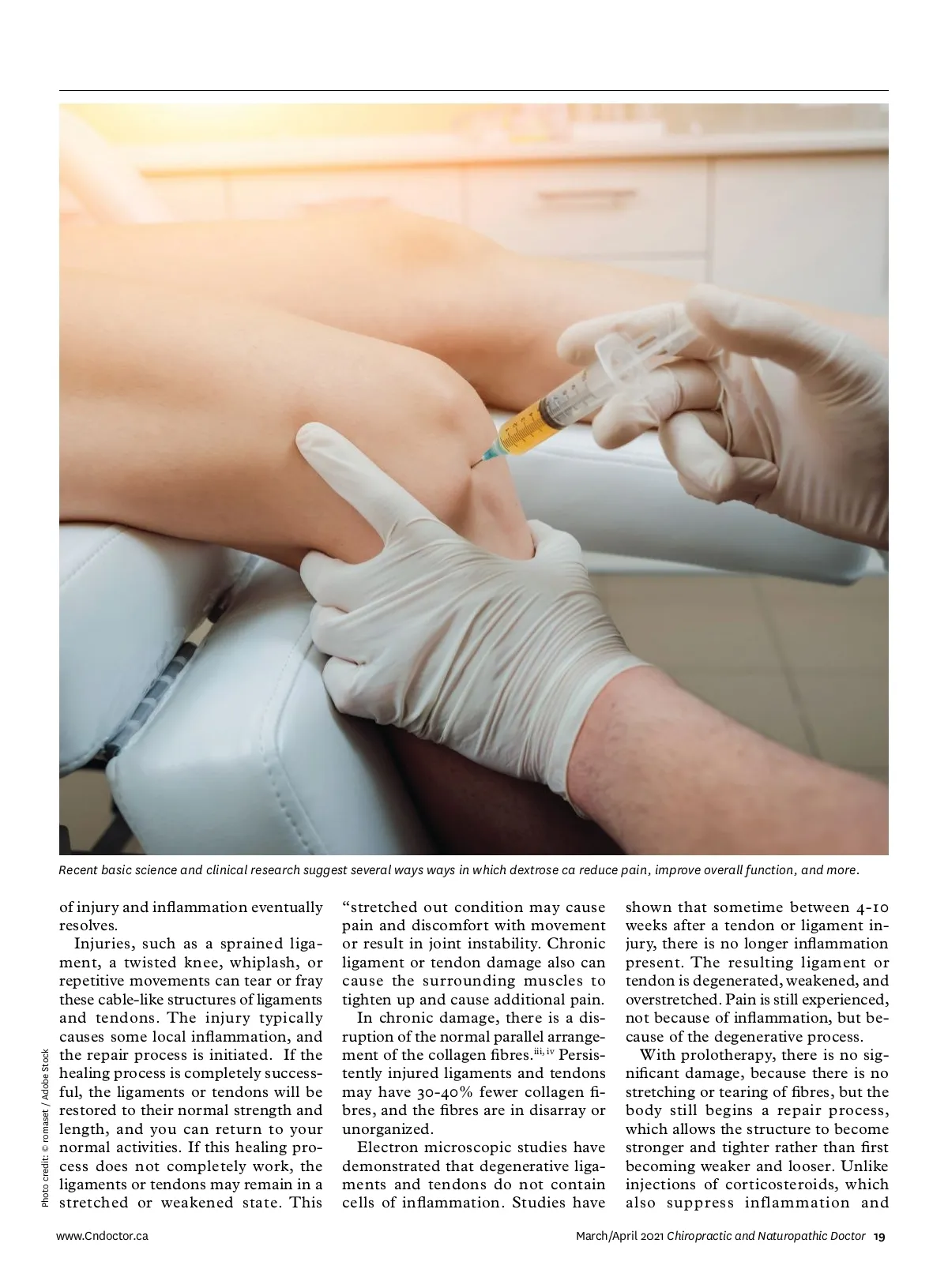
FEATURE PAIN RELIEF REGENERATIVE INJECTION THERAPY The use of dextrose and mannitol injections for the treatment of chronic pain M BY DR. CHRIS SPOONER, ND are not captured in the estimation of burden. ii National organizations have called for new therapies to treat chronic pain, including therapy that addresses the underlying pain pathology. An overar-ching goal is to produce improved non-opioid treatment regimens. The focus is this article is a discus-sion of the evidence base underpin-ning the therapeutic injection of dex-trose, an agent used in several emerging, distinct but related injec-tion-based modalities, prolotherapy and perineural injection therapy. Re-cent basic science and clinical research suggest several ways in which dextrose can reduce pain, improve overall func-tion and restore connective tissue function. Many drugs try to tame inflamma-tion by inhibiting molecular events occurring at the beginning of the im-mune response. However, rather than blocking inflammation in the bud – which may thwart the body’s own at-tempt to heal – a better approach may be to enhance the activity of these natural resolution-promoting com-pounds. The initial inflammatory responses involve the release of compounds known to incite inflammation, leukot-riene B4 (LTB4), followed by prosta-glandin E2 (PGE2) which is the target of NSAIDs. However, this is then followed by the production of an anti-inflammatory compound, lipoxin A4 (LXA4). This results in the reduc-tion of inflammatory cells at the site of injury and inflammation eventually resolves. It turns out that PGE2, thought to incite inflammation, is doing the opposite and initiates the production of the anti-inflammatory LXA4 setting the stage for resolution. usculoskeletal con-ditions are com-mon in men and women of all ages across all socio-de-mographic strata of society. They are the most common cause of severe long-term pain and physical disability and affect hundreds of millions of people around the world. The impact on all aspects of life through pain and by limiting activities of daily living typically by affecting dexterity and mobility. i Many musculoskeletal conditions are nonspecific with no defined tis-sue-based cause and, although they may have a low level of associated disability, they are extremely common. The prevalence of chronic pain and the challenges in treatment have been responsible for an opioid epidemic that has resulted in a national crisis of opioid-related deaths. Other harms associated with treatment, including medication-based interventions (no-tably long-term, corticosteroids, and nonsteroidal and immunosuppressive therapies) and surgical interventions, WHAT IS PROLOTHERAPY? DR. CHRIS SPOONER ND, B.SC. is a North Okanagan naturopathic doctor with 20 years of clinical experience. In his private practice, Paradigm Integrative Medicine, Dr. Spooner works with patients looking for a balanced approach to health care that combines conventional medicine with research informed integrative approaches. Dr. Spooner has advanced certifications through the College of Naturopathic Physicians of B.C., including prescriptive authority. He has been a board member and vice chair of the College of Naturopathic Physicians of British Columbia since 2008. 18 Chiropractic and Naturopathic Doctor March/April 2021 The goal of prolotherapy is to repair weakened or stretched ligaments or tendons or stabilize joint surfaces af-fected by arthritis. Dextrose injection (12.5% to 25% concentration) stimu-lates a brief arachidonic acid (AA) pathway inflammation that involves leukotriene B4 (LTB4), followed by prostaglandin E2 (PGE2). This can seem contradictory as this inflamma-tion is the type of inflammation to which most doctors are referring when they use that word. As noted above, after an injury, the body uses primar-ily AA inflammation to try to repair the damage via the production of an anti-inflammatory compound, lipoxin A4 (LXA4). This results in the reduc-tion of inflammatory cells at the site www.Cndoctor.ca
Chiropractic + Naturopathic Doctor March/April 2021: Page 18