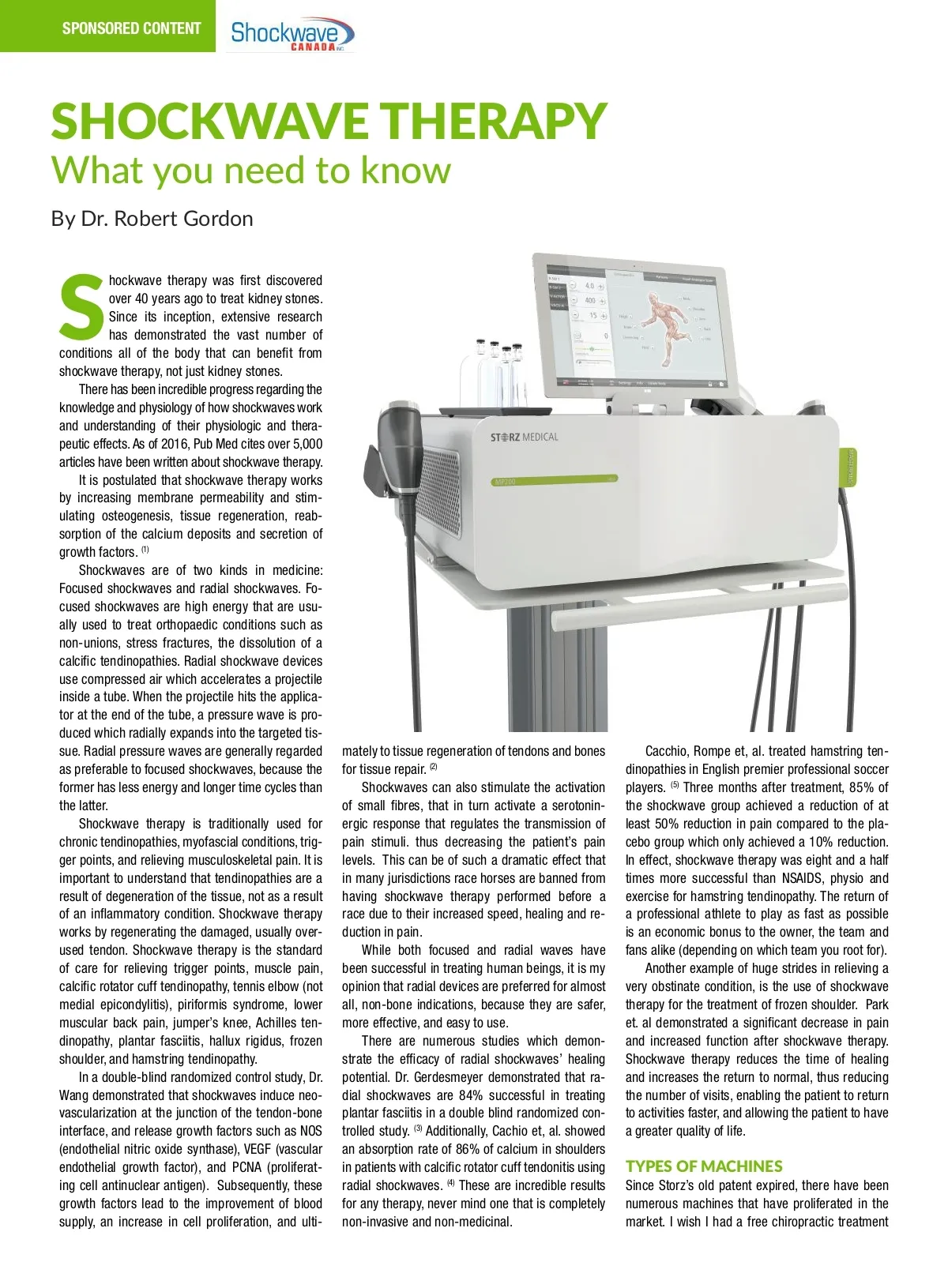
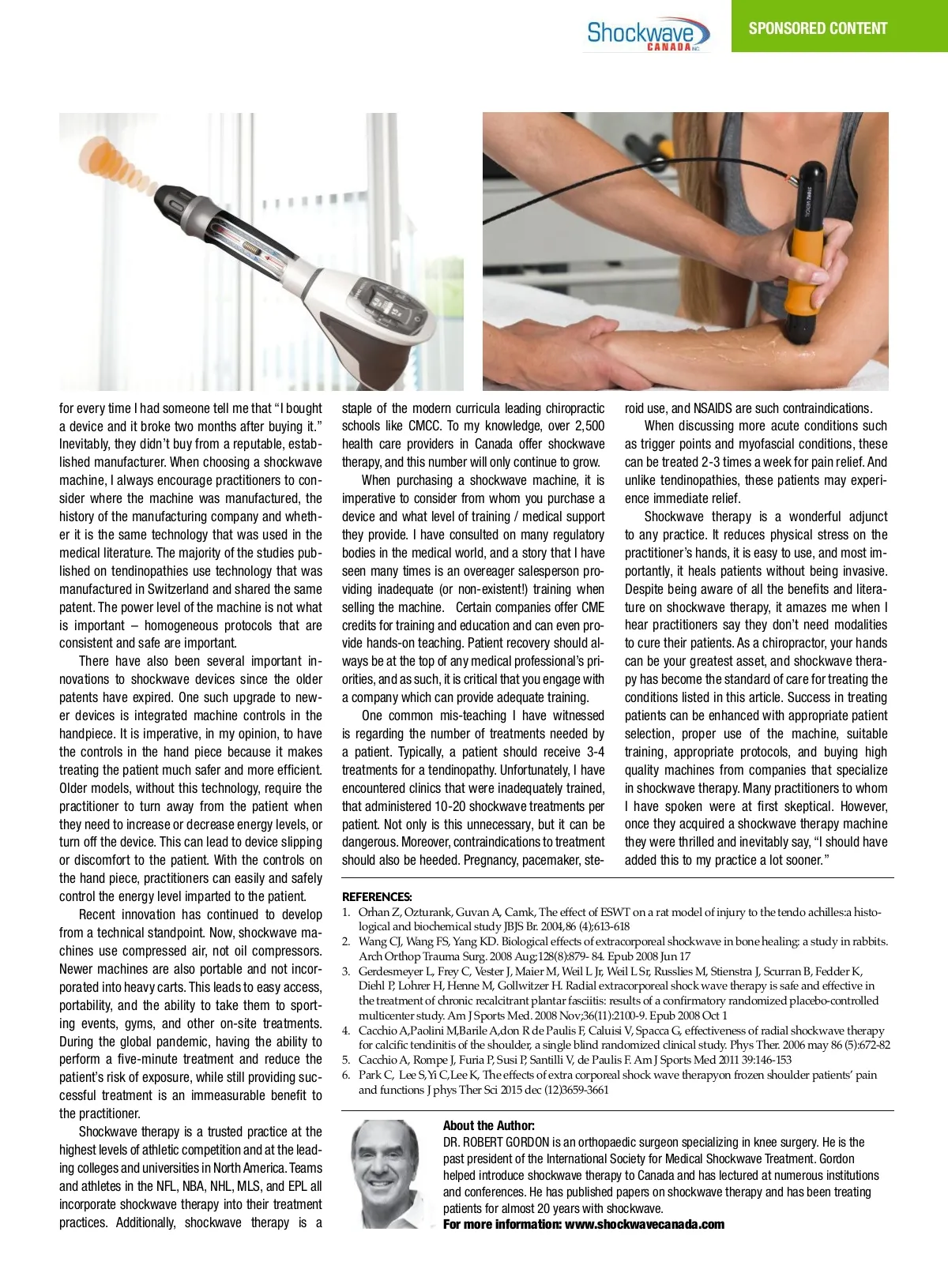
SPONSORED CONTENT for every time I had someone tell me that “I bought a device and it broke two months after buying it.” Inevitably, they didn’t buy from a reputable, estab-lished manufacturer. When choosing a shockwave machine, I always encourage practitioners to con-sider where the machine was manufactured, the history of the manufacturing company and wheth-er it is the same technology that was used in the medical literature. The majority of the studies pub-lished on tendinopathies use technology that was manufactured in Switzerland and shared the same patent. The power level of the machine is not what is important – homogeneous protocols that are consistent and safe are important. There have also been several important in-novations to shockwave devices since the older patents have expired. One such upgrade to new-er devices is integrated machine controls in the handpiece. It is imperative, in my opinion, to have the controls in the hand piece because it makes treating the patient much safer and more efficient. Older models, without this technology, require the practitioner to turn away from the patient when they need to increase or decrease energy levels, or turn off the device. This can lead to device slipping or discomfort to the patient. With the controls on the hand piece, practitioners can easily and safely control the energy level imparted to the patient. Recent innovation has continued to develop from a technical standpoint. Now, shockwave ma-chines use compressed air, not oil compressors. Newer machines are also portable and not incor-porated into heavy carts. This leads to easy access, portability, and the ability to take them to sport-ing events, gyms, and other on-site treatments. During the global pandemic, having the ability to perform a five-minute treatment and reduce the patient’s risk of exposure, while still providing suc-cessful treatment is an immeasurable benefit to the practitioner. Shockwave therapy is a trusted practice at the highest levels of athletic competition and at the lead-ing colleges and universities in North America. Teams and athletes in the NFL, NBA, NHL, MLS, and EPL all incorporate shockwave therapy into their treatment practices. Additionally, shockwave therapy is a staple of the modern curricula leading chiropractic schools like CMCC. To my knowledge, over 2,500 health care providers in Canada offer shockwave therapy, and this number will only continue to grow. When purchasing a shockwave machine, it is imperative to consider from whom you purchase a device and what level of training / medical support they provide. I have consulted on many regulatory bodies in the medical world, and a story that I have seen many times is an overeager salesperson pro-viding inadequate (or non-existent!) training when selling the machine. Certain companies offer CME credits for training and education and can even pro-vide hands-on teaching. Patient recovery should al-ways be at the top of any medical professional’s pri-orities, and as such, it is critical that you engage with a company which can provide adequate training. One common mis-teaching I have witnessed is regarding the number of treatments needed by a patient. Typically, a patient should receive 3-4 treatments for a tendinopathy. Unfortunately, I have encountered clinics that were inadequately trained, that administered 10-20 shockwave treatments per patient. Not only is this unnecessary, but it can be dangerous. Moreover, contraindications to treatment should also be heeded. Pregnancy, pacemaker, ste-roid use, and NSAIDS are such contraindications. When discussing more acute conditions such as trigger points and myofascial conditions, these can be treated 2-3 times a week for pain relief. And unlike tendinopathies, these patients may experi-ence immediate relief. Shockwave therapy is a wonderful adjunct to any practice. It reduces physical stress on the practitioner’s hands, it is easy to use, and most im-portantly, it heals patients without being invasive. Despite being aware of all the benefits and litera-ture on shockwave therapy, it amazes me when I hear practitioners say they don’t need modalities to cure their patients. As a chiropractor, your hands can be your greatest asset, and shockwave thera-py has become the standard of care for treating the conditions listed in this article. Success in treating patients can be enhanced with appropriate patient selection, proper use of the machine, suitable training, appropriate protocols, and buying high quality machines from companies that specialize in shockwave therapy. Many practitioners to whom I have spoken were at first skeptical. However, once they acquired a shockwave therapy machine they were thrilled and inevitably say, “I should have added this to my practice a lot sooner.” REFERENCES: 1. Orhan Z, Ozturank, Guvan A, Camk, The effect of ESWT on a rat model of injury to the tendo achilles:a histo -logical and biochemical study JBJS Br. 2004,86 (4);613-618 2. Wang CJ, Wang FS, Yang KD. Biological effects of extracorporeal shockwave in bone healing: a study in rabbits. Arch Orthop Trauma Surg. 2008 Aug;128(8):879-84. Epub 2008 Jun 17 3. Gerdesmeyer L, Frey C, Vester J, Maier M, Weil L Jr, Weil L Sr, Russlies M, Stienstra J, Scurran B, Fedder K, Diehl P, Lohrer H, Henne M, Gollwitzer H. Radial extracorporeal shock wave therapy is safe and effective in the treatment of chronic recalcitrant plantar fasciitis: results of a confirmatory randomized placebo-controlled multicenter study. Am J Sports Med. 2008 Nov;36(11):2100-9. Epub 2008 Oct 1 4. Cacchio A,Paolini M,Barile A,don R de Paulis F, Caluisi V, Spacca G, effectiveness of radial shockwave therapy for calcific tendinitis of the shoulder, a single blind randomized clinical study. Phys Ther. 2006 may 86 (5):672-82 5. Cacchio A, Rompe J, Furia P, Susi P, Santilli V, de Paulis F. Am J Sports Med 2011 39:146-153 6. Park C, Lee S,Yi C,Lee K, The effects of extra corporeal shock wave therapyon frozen shoulder patients’ pain and functions J phys Ther Sci 2015 dec (12)3659-3661 About the Author: DR. ROBERT GORDON is an orthopaedic surgeon specializing in knee surgery. He is the past president of the International Society for Medical Shockwave Treatment. Gordon helped introduce shockwave therapy to Canada and has lectured at numerous institutions and conferences. He has published papers on shockwave therapy and has been treating patients for almost 20 years with shockwave. For more information: www.shockwavecanada.com
Chiropractic + Naturopathic Doctor March/April 2021: Page 17