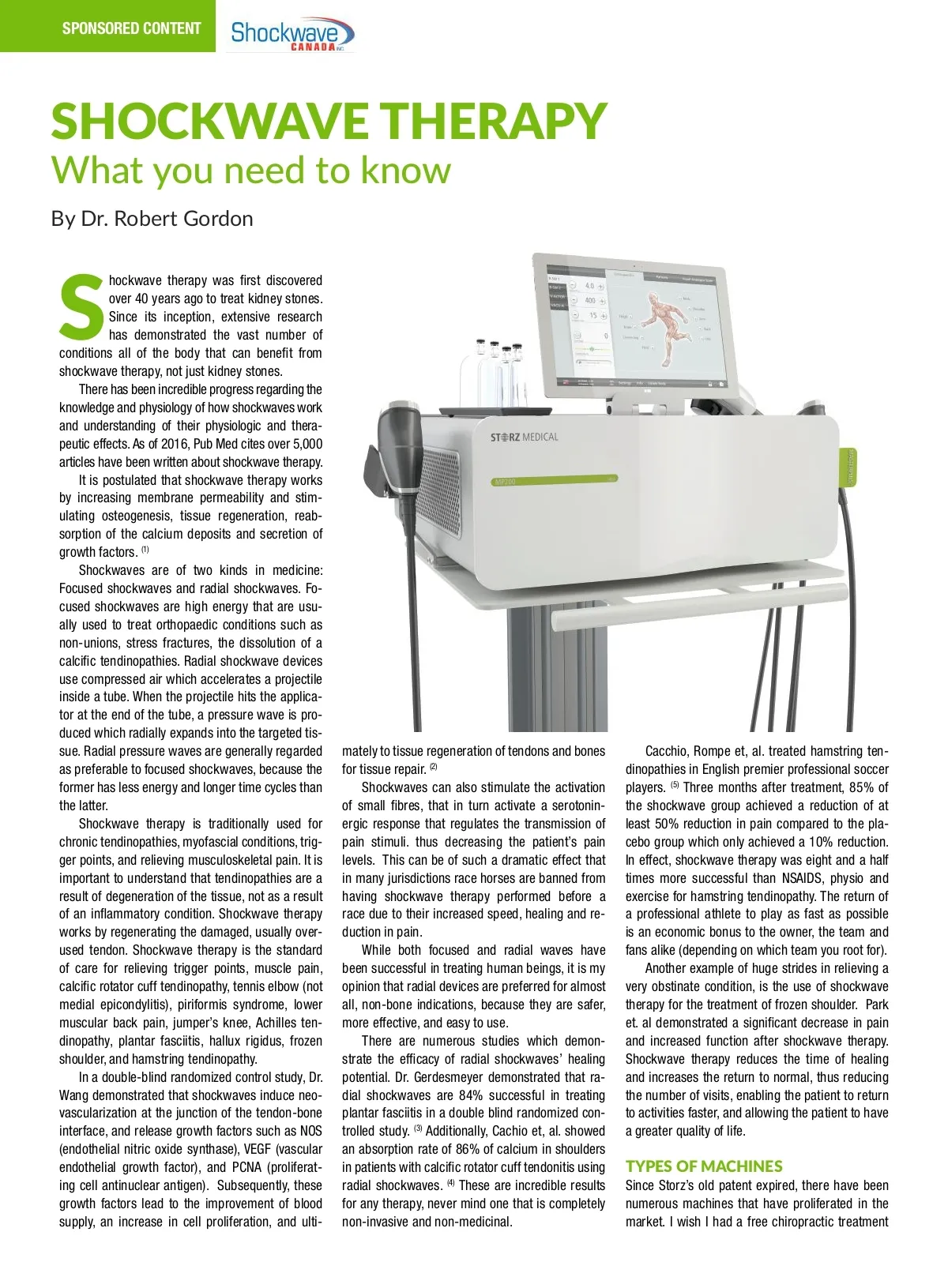
SPONSORED CONTENT SHOCKWAVE THERAPY What you need to know By Dr. Robert Gordon S hockwave therapy was first discovered over 40 years ago to treat kidney stones. Since its inception, extensive research has demonstrated the vast number of conditions all of the body that can benefit from shockwave therapy, not just kidney stones. There has been incredible progress regarding the knowledge and physiology of how shockwaves work and understanding of their physiologic and thera-peutic effects. As of 2016, Pub Med cites over 5,000 articles have been written about shockwave therapy. It is postulated that shockwave therapy works by increasing membrane permeability and stim-ulating osteogenesis, tissue regeneration, reab-sorption of the calcium deposits and secretion of growth factors. (1) Shockwaves are of two kinds in medicine: Focused shockwaves and radial shockwaves. Fo-cused shockwaves are high energy that are usu-ally used to treat orthopaedic conditions such as non-unions, stress fractures, the dissolution of a calcific tendinopathies. Radial shockwave devices use compressed air which accelerates a projectile inside a tube. When the projectile hits the applica-tor at the end of the tube, a pressure wave is pro-duced which radially expands into the targeted tis-sue. Radial pressure waves are generally regarded as preferable to focused shockwaves, because the former has less energy and longer time cycles than the latter. Shockwave therapy is traditionally used for chronic tendinopathies, myofascial conditions, trig-ger points, and relieving musculoskeletal pain. It is important to understand that tendinopathies are a result of degeneration of the tissue, not as a result of an inflammatory condition. Shockwave therapy works by regenerating the damaged, usually over-used tendon. Shockwave therapy is the standard of care for relieving trigger points, muscle pain, calcific rotator cuff tendinopathy, tennis elbow (not medial epicondylitis), piriformis syndrome, lower muscular back pain, jumper’s knee, Achilles ten-dinopathy, plantar fasciitis, hallux rigidus, frozen shoulder, and hamstring tendinopathy. In a double-blind randomized control study, Dr. Wang demonstrated that shockwaves induce neo-vascularization at the junction of the tendon-bone interface, and release growth factors such as NOS (endothelial nitric oxide synthase), VEGF (vascular endothelial growth factor), and PCNA (proliferat-ing cell antinuclear antigen). Subsequently, these growth factors lead to the improvement of blood supply, an increase in cell proliferation, and ulti-mately to tissue regeneration of tendons and bones for tissue repair. (2) Shockwaves can also stimulate the activation of small fibres, that in turn activate a serotonin-ergic response that regulates the transmission of pain stimuli. thus decreasing the patient’s pain levels. This can be of such a dramatic effect that in many jurisdictions race horses are banned from having shockwave therapy performed before a race due to their increased speed, healing and re-duction in pain. While both focused and radial waves have been successful in treating human beings, it is my opinion that radial devices are preferred for almost all, non-bone indications, because they are safer, more effective, and easy to use. There are numerous studies which demon-strate the efficacy of radial shockwaves’ healing potential. Dr. Gerdesmeyer demonstrated that ra-dial shockwaves are 84% successful in treating plantar fasciitis in a double blind randomized con-trolled study. (3) Additionally, Cachio et, al. showed an absorption rate of 86% of calcium in shoulders in patients with calcific rotator cuff tendonitis using radial shockwaves. (4) These are incredible results for any therapy, never mind one that is completely non-invasive and non-medicinal. Cacchio, Rompe et, al. treated hamstring ten-dinopathies in English premier professional soccer players. (5) Three months after treatment, 85% of the shockwave group achieved a reduction of at least 50% reduction in pain compared to the pla-cebo group which only achieved a 10% reduction. In effect, shockwave therapy was eight and a half times more successful than NSAIDS, physio and exercise for hamstring tendinopathy. The return of a professional athlete to play as fast as possible is an economic bonus to the owner, the team and fans alike (depending on which team you root for). Another example of huge strides in relieving a very obstinate condition, is the use of shockwave therapy for the treatment of frozen shoulder. Park et. al demonstrated a significant decrease in pain and increased function after shockwave therapy. Shockwave therapy reduces the time of healing and increases the return to normal, thus reducing the number of visits, enabling the patient to return to activities faster, and allowing the patient to have a greater quality of life. TYPES OF MACHINES Since Storz’s old patent expired, there have been numerous machines that have proliferated in the market. I wish I had a free chiropractic treatment
Chiropractic + Naturopathic Doctor March/April 2021: Page 16