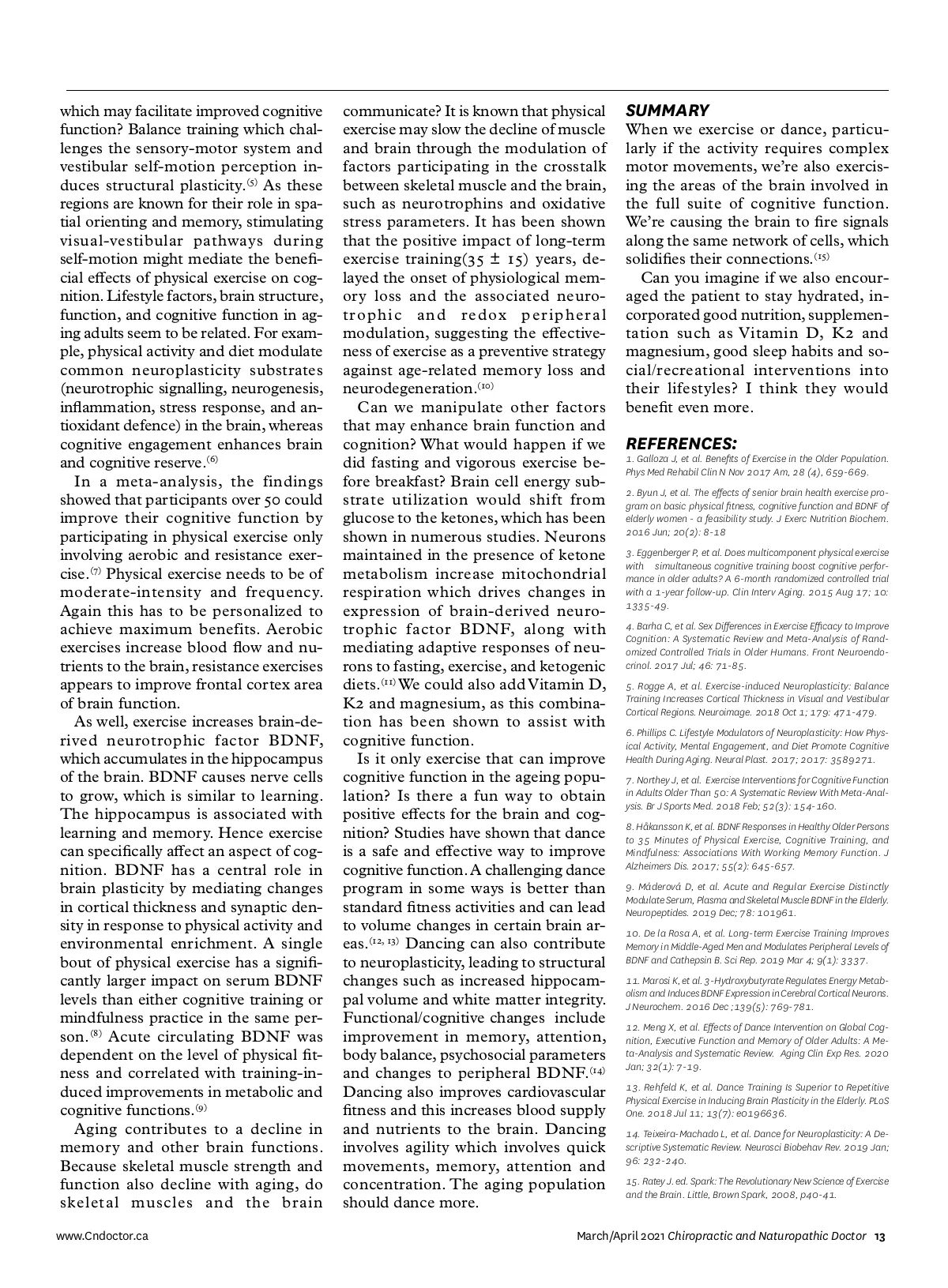
which may facilitate improved cognitive function? Balance training which chal-lenges the sensory-motor system and vestibular self-motion perception in-duces structural plasticity. (5) As these regions are known for their role in spa-tial orienting and memory, stimulating visual-vestibular pathways during self-motion might mediate the benefi-cial effects of physical exercise on cog-nition. Lifestyle factors, brain structure, function, and cognitive function in ag-ing adults seem to be related. For exam-ple, physical activity and diet modulate common neuroplasticity substrates (neurotrophic signalling, neurogenesis, inflammation, stress response, and an-tioxidant defence) in the brain, whereas cognitive engagement enhances brain and cognitive reserve. (6) In a meta-analysis, the findings showed that participants over 50 could improve their cognitive function by participating in physical exercise only involving aerobic and resistance exer-cise. (7) Physical exercise needs to be of moderate-intensity and frequency. Again this has to be personalized to achieve maximum benefits. Aerobic exercises increase blood flow and nu-trients to the brain, resistance exercises appears to improve frontal cortex area of brain function. As well, exercise increases brain-de-rived neurotrophic factor BDNF, which accumulates in the hippocampus of the brain. BDNF causes nerve cells to grow, which is similar to learning. The hippocampus is associated with learning and memory. Hence exercise can specifically affect an aspect of cog-nition. BDNF has a central role in brain plasticity by mediating changes in cortical thickness and synaptic den-sity in response to physical activity and environmental enrichment. A single bout of physical exercise has a signifi-cantly larger impact on serum BDNF levels than either cognitive training or mindfulness practice in the same per-son. (8) Acute circulating BDNF was dependent on the level of physical fit-ness and correlated with training-in-duced improvements in metabolic and cognitive functions. (9) Aging contributes to a decline in memory and other brain functions. Because skeletal muscle strength and function also decline with aging, do skeletal muscles and the brain www.Cndoctor.ca communicate? It is known that physical exercise may slow the decline of muscle and brain through the modulation of factors participating in the crosstalk between skeletal muscle and the brain, such as neurotrophins and oxidative stress parameters. It has been shown that the positive impact of long-term exercise training(35 ± 15) years, de-layed the onset of physiological mem-ory loss and the associated neuro-trophic and redox peripheral modulation, suggesting the effective-ness of exercise as a preventive strategy against age-related memory loss and neurodegeneration. (10) Can we manipulate other factors that may enhance brain function and cognition? What would happen if we did fasting and vigorous exercise be-fore breakfast? Brain cell energy sub-strate utilization would shift from glucose to the ketones, which has been shown in numerous studies. Neurons maintained in the presence of ketone metabolism increase mitochondrial respiration which drives changes in expression of brain-derived neuro-trophic factor BDNF, along with mediating adaptive responses of neu-rons to fasting, exercise, and ketogenic diets. (11) We could also add Vitamin D, K2 and magnesium, as this combina-tion has been shown to assist with cognitive function. Is it only exercise that can improve cognitive function in the ageing popu-lation? Is there a fun way to obtain positive effects for the brain and cog-nition? Studies have shown that dance is a safe and effective way to improve cognitive function. A challenging dance program in some ways is better than standard fitness activities and can lead to volume changes in certain brain ar-eas. (12, 13) Dancing can also contribute to neuroplasticity, leading to structural changes such as increased hippocam-pal volume and white matter integrity. Functional/cognitive changes include improvement in memory, attention, body balance, psychosocial parameters and changes to peripheral BDNF. (14) Dancing also improves cardiovascular fitness and this increases blood supply and nutrients to the brain. Dancing involves agility which involves quick movements, memory, attention and concentration. The aging population should dance more. SUMMARY When we exercise or dance, particu-larly if the activity requires complex motor movements, we’re also exercis-ing the areas of the brain involved in the full suite of cognitive function. We’re causing the brain to fire signals along the same network of cells, which solidifies their connections. (15) Can you imagine if we also encour-aged the patient to stay hydrated, in-corporated good nutrition, supplemen-tation such as Vitamin D, K2 and magnesium, good sleep habits and so-cial/recreational interventions into their lifestyles? I think they would benefit even more. REFERENCES: 1. Galloza J, et al. Benefits of Exercise in the Older Population. Phys Med Rehabil Clin N Nov 2017 Am, 28 (4), 659-669. 2. Byun J, et al. The effects of senior brain health exercise pro-gram on basic physical fitness, cognitive function and BDNF of elderly women -a feasibility study. J Exerc Nutrition Biochem. 2016 Jun; 20(2): 8-18 3. Eggenberger P, et al. Does multicomponent physical exercise with simultaneous cognitive training boost cognitive perfor-mance in older adults? A 6-month randomized controlled trial with a 1-year follow-up. Clin Interv Aging. 2015 Aug 17; 10: 1335-49. 4. Barha C, et al. Sex Differences in Exercise Efficacy to Improve Cognition: A Systematic Review and Meta-Analysis of Rand-omized Controlled Trials in Older Humans. Front Neuroendo-crinol. 2017 Jul; 46: 71-85. 5. Rogge A, et al. Exercise-induced Neuroplasticity: Balance Training Increases Cortical Thickness in Visual and Vestibular Cortical Regions. Neuroimage. 2018 Oct 1; 179: 471-479. 6. Phillips C. Lifestyle Modulators of Neuroplasticity: How Phys-ical Activity, Mental Engagement, and Diet Promote Cognitive Health During Aging. Neural Plast. 2017; 2017: 3589271. 7. Northey J, et al. Exercise Interventions for Cognitive Function in Adults Older Than 50: A Systematic Review With Meta-Anal-ysis. Br J Sports Med. 2018 Feb; 52(3): 154-160. 8. Håkansson K, et al. BDNF Responses in Healthy Older Persons to 35 Minutes of Physical Exercise, Cognitive Training, and Mindfulness: Associations With Working Memory Function. J Alzheimers Dis. 2017; 55(2): 645-657. 9. Máderová D, et al. Acute and Regular Exercise Distinctly Modulate Serum, Plasma and Skeletal Muscle BDNF in the Elderly. Neuropeptides. 2019 Dec; 78: 101961. 10. De la Rosa A, et al. Long-term Exercise Training Improves Memory in Middle-Aged Men and Modulates Peripheral Levels of BDNF and Cathepsin B. Sci Rep. 2019 Mar 4; 9(1): 3337. 11. Marosi K, et al. 3-Hydroxybutyrate Regulates Energy Metab-olism and Induces BDNF Expression in Cerebral Cortical Neurons. J Neurochem. 2016 Dec ;139(5): 769-781. 12. Meng X, et al. Effects of Dance Intervention on Global Cog-nition, Executive Function and Memory of Older Adults: A Me-ta-Analysis and Systematic Review. Aging Clin Exp Res. 2020 Jan; 32(1): 7-19. 13. Rehfeld K, et al. Dance Training Is Superior to Repetitive Physical Exercise in Inducing Brain Plasticity in the Elderly. PLoS One. 2018 Jul 11; 13(7): e0196636. 14. Teixeira-Machado L, et al. Dance for Neuroplasticity: A De-scriptive Systematic Review. Neurosci Biobehav Rev. 2019 Jan; 96: 232-240. 15. Ratey J. ed. Spark: The Revolutionary New Science of Exercise and the Brain. Little, Brown Spark, 2008, p40-41. March/April 2021 Chiropractic and Naturopathic Doctor 13
Chiropractic + Naturopathic Doctor March/April 2021: Page 13