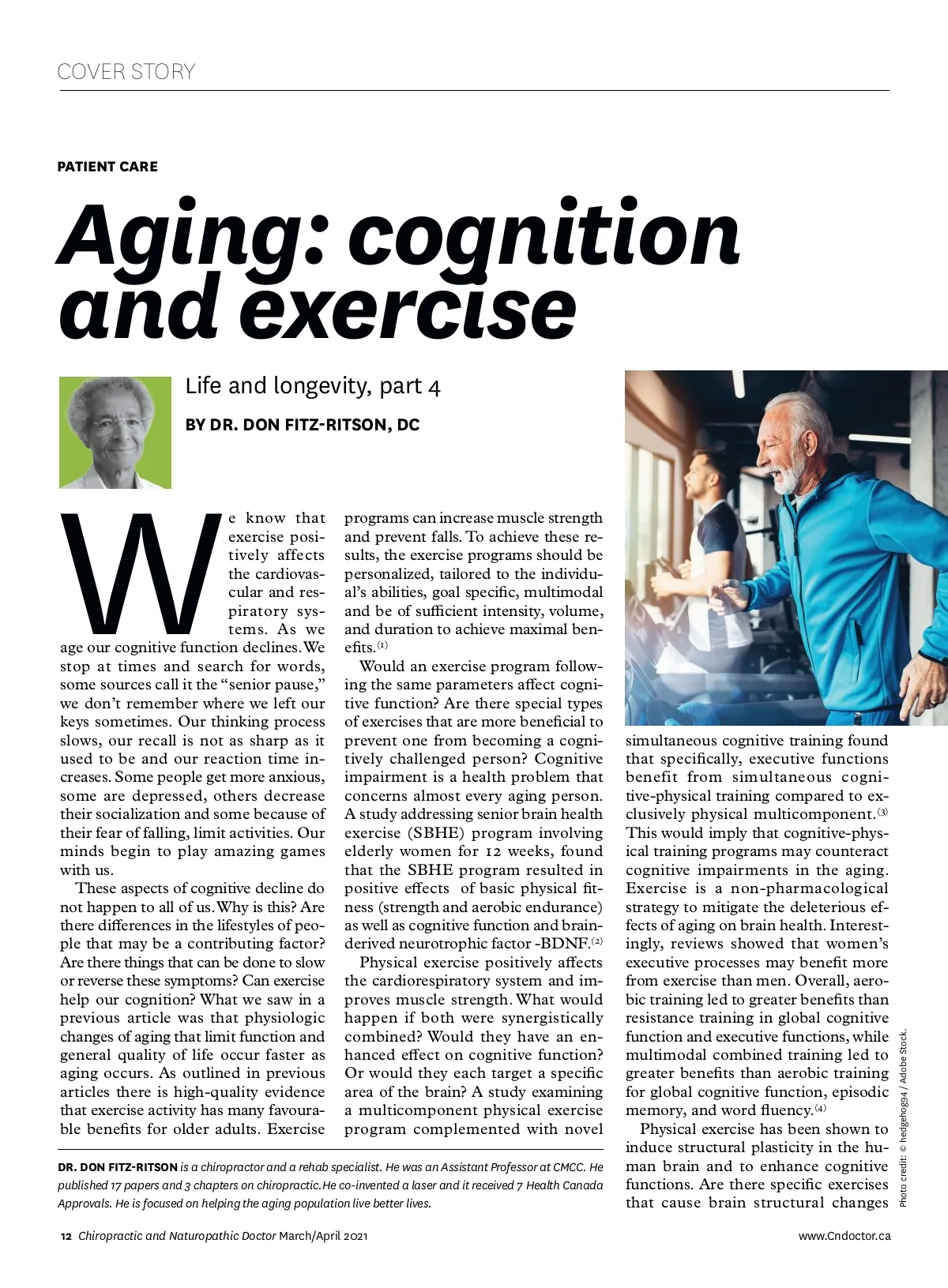
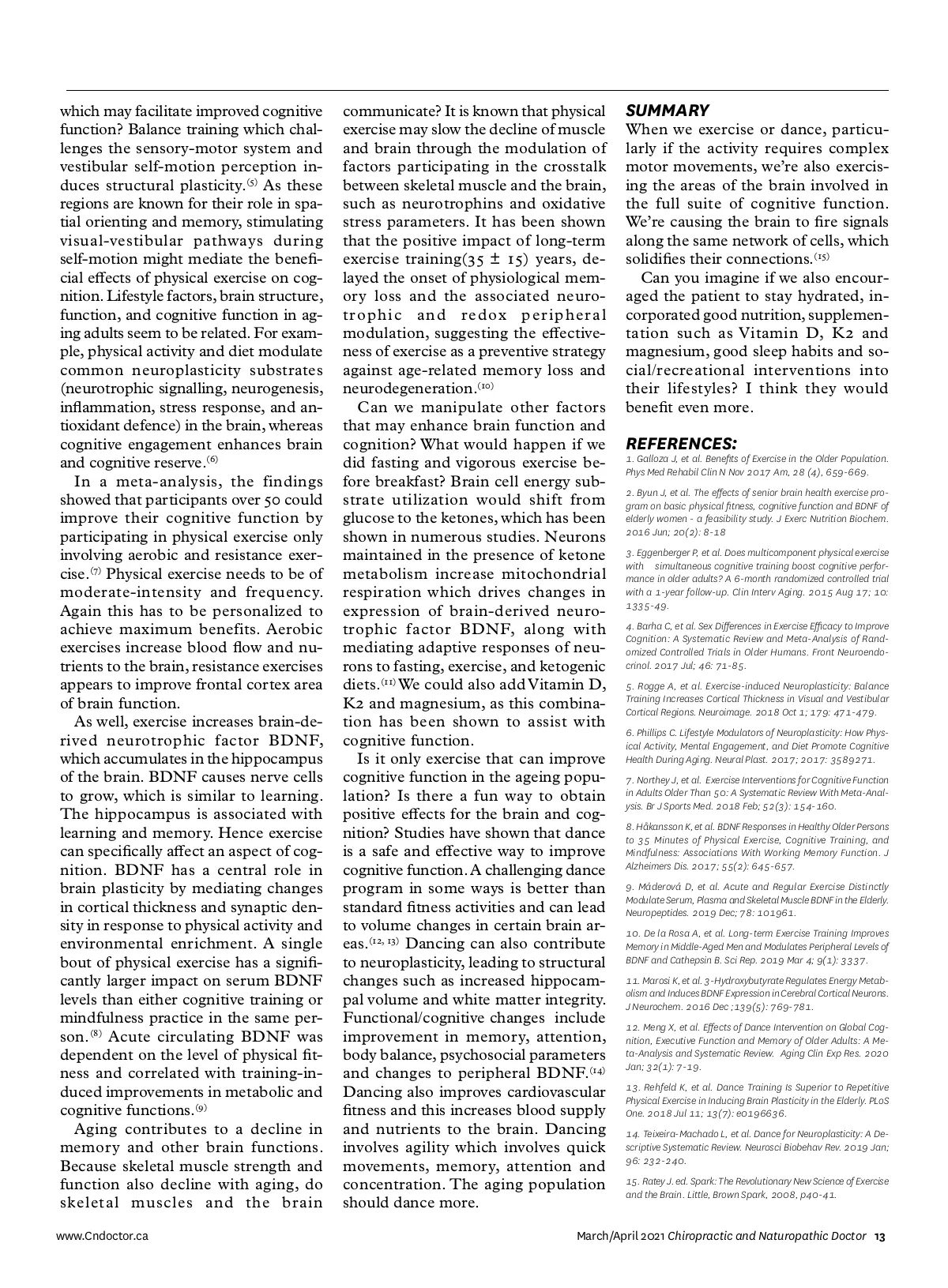
COVER STORY PATIENT CARE Aging: cognition and exercise Life and longevity, part 4 BY DR. DON FITZ-RITSON, DC W DR. DON FITZ-RITSON is a chiropractor and a rehab specialist. He was an Assistant Professor at CMCC. He published 17 papers and 3 chapters on chiropractic.He co-invented a laser and it received 7 Health Canada Approvals. He is focused on helping the aging population live better lives. 12 Chiropractic and Naturopathic Doctor March/April 2021 www.Cndoctor.ca Photo credit: © hedgehog94 / Adobe Stock. e know that exercise posi-tively affects the cardiovas-cular and res-piratory sys-tems. As we age our cognitive function declines. We stop at times and search for words, some sources call it the “senior pause,” we don’t remember where we left our keys sometimes. Our thinking process slows, our recall is not as sharp as it used to be and our reaction time in-creases. Some people get more anxious, some are depressed, others decrease their socialization and some because of their fear of falling, limit activities. Our minds begin to play amazing games with us. These aspects of cognitive decline do not happen to all of us. Why is this? Are there differences in the lifestyles of peo-ple that may be a contributing factor? Are there things that can be done to slow or reverse these symptoms? Can exercise help our cognition? What we saw in a previous article was that physiologic changes of aging that limit function and general quality of life occur faster as aging occurs. As outlined in previous articles there is high-quality evidence that exercise activity has many favoura-ble benefits for older adults. Exercise programs can increase muscle strength and prevent falls. To achieve these re-sults, the exercise programs should be personalized, tailored to the individu-al’s abilities, goal specific, multimodal and be of sufficient intensity, volume, and duration to achieve maximal ben-efits. (1) Would an exercise program follow-ing the same parameters affect cogni-tive function? Are there special types of exercises that are more beneficial to prevent one from becoming a cogni-tively challenged person? Cognitive impairment is a health problem that concerns almost every aging person. A study addressing senior brain health exercise (SBHE) program involving elderly women for 12 weeks, found that the SBHE program resulted in positive effects of basic physical fit-ness (strength and aerobic endurance) as well as cognitive function and brain-derived neurotrophic factor -BDNF. (2) Physical exercise positively affects the cardiorespiratory system and im-proves muscle strength. What would happen if both were synergistically combined? Would they have an en-hanced effect on cognitive function? Or would they each target a specific area of the brain? A study examining a multicomponent physical exercise program complemented with novel simultaneous cognitive training found that specifically, executive functions benefit from simultaneous cogni-tive-physical training compared to ex-clusively physical multicomponent. (3) This would imply that cognitive-phys-ical training programs may counteract cognitive impairments in the aging. Exercise is a non-pharmacological strategy to mitigate the deleterious ef-fects of aging on brain health. Interest-ingly, reviews showed that women’s executive processes may benefit more from exercise than men. Overall, aero-bic training led to greater benefits than resistance training in global cognitive function and executive functions, while multimodal combined training led to greater benefits than aerobic training for global cognitive function, episodic memory, and word fluency. (4) Physical exercise has been shown to induce structural plasticity in the hu-man brain and to enhance cognitive functions. Are there specific exercises that cause brain structural changes
Chiropractic + Naturopathic Doctor March/April 2021: Page 12