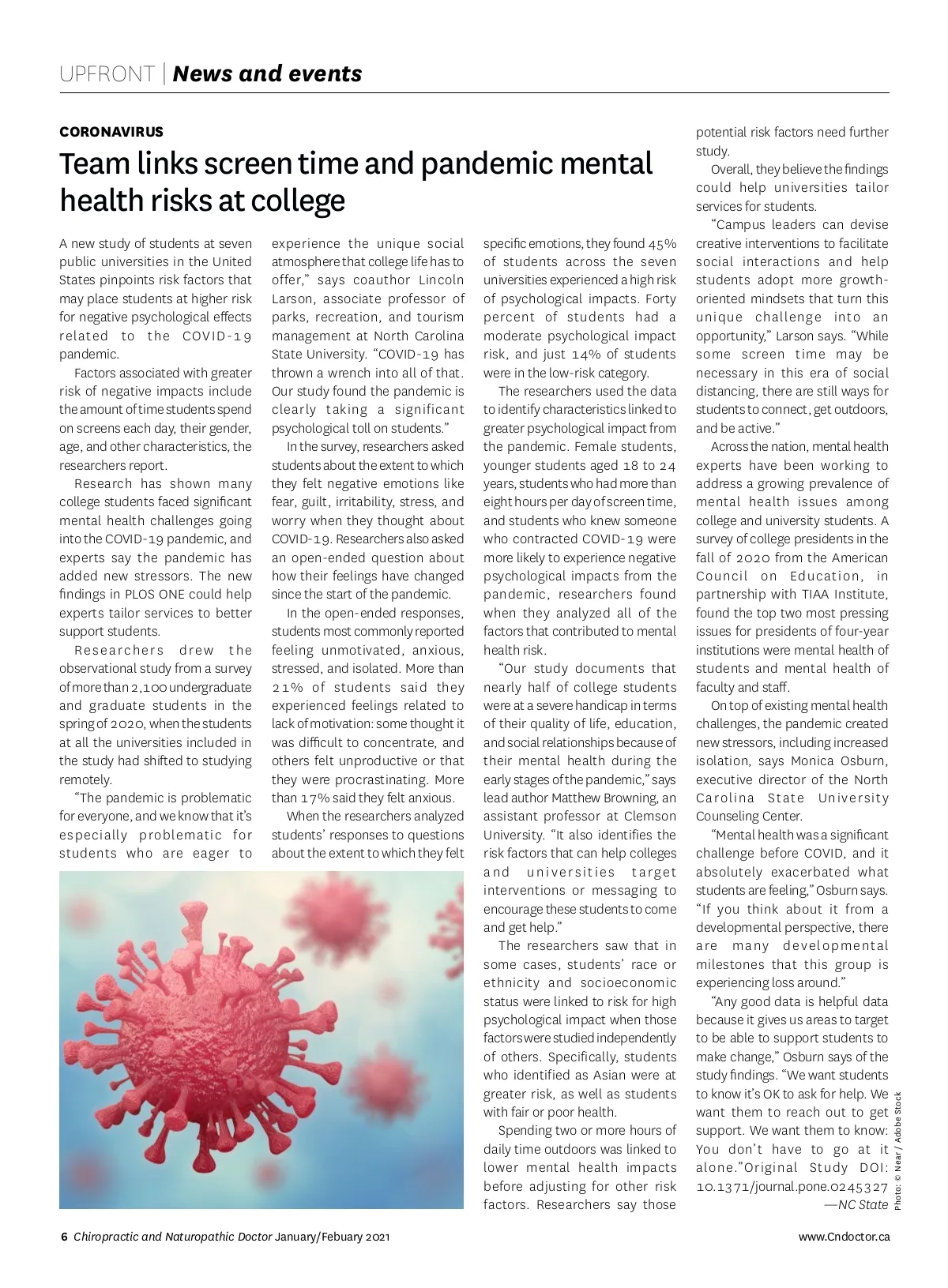
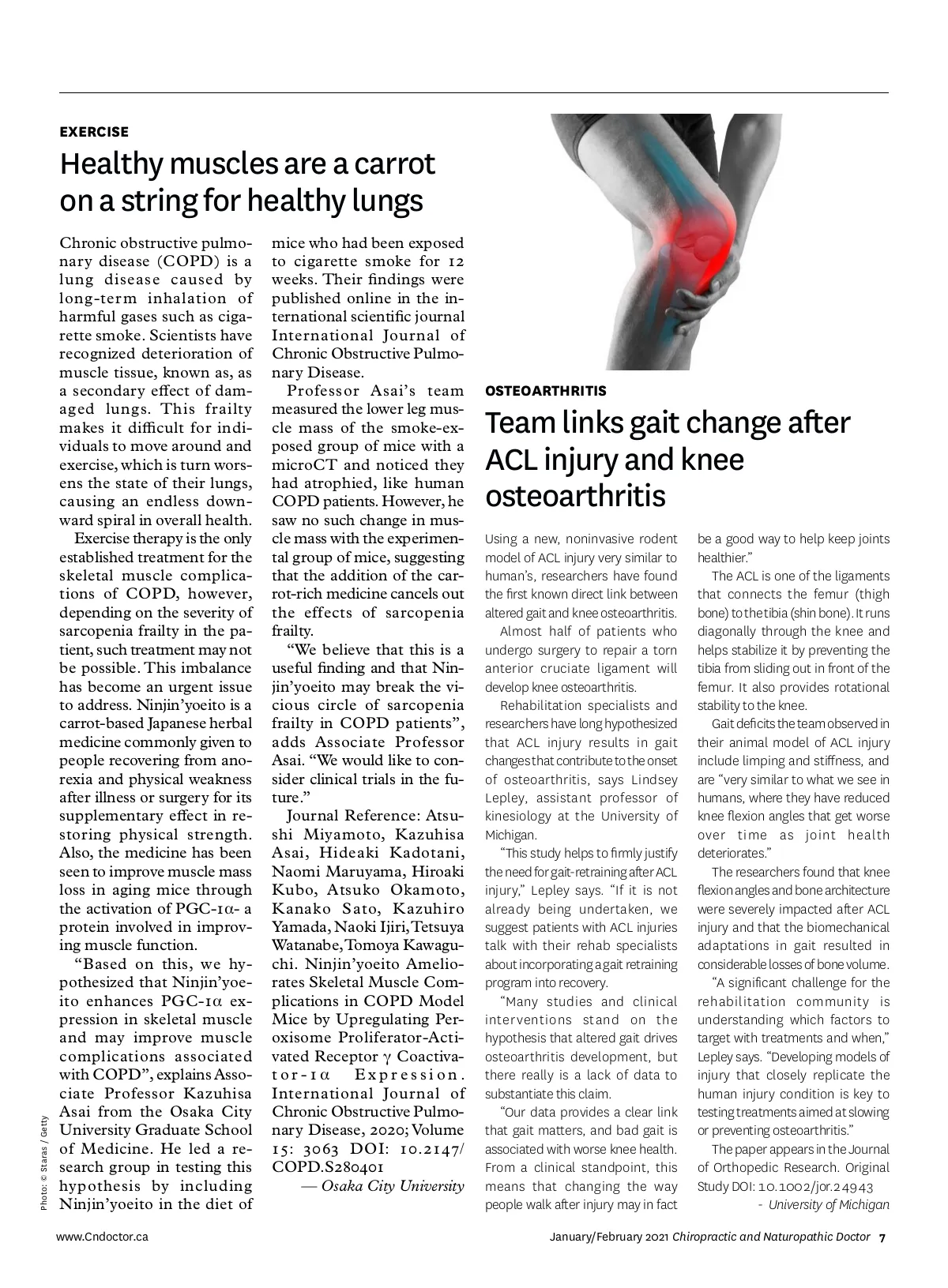
EXERCISE Healthy muscles are a carrot on a string for healthy lungs Chronic obstructive pulmo-nary disease (COPD) is a lung disease caused by long-term inhalation of harmful gases such as ciga-rette smoke. Scientists have recognized deterioration of muscle tissue, known as, as a secondary effect of dam-aged lungs. This frailty makes it difficult for indi-viduals to move around and exercise, which is turn wors-ens the state of their lungs, causing an endless down-ward spiral in overall health. Exercise therapy is the only established treatment for the skeletal muscle complica-tions of COPD, however, depending on the severity of sarcopenia frailty in the pa-tient, such treatment may not be possible. This imbalance has become an urgent issue to address. Ninjin’yoeito is a carrot-based Japanese herbal medicine commonly given to people recovering from ano-rexia and physical weakness after illness or surgery for its supplementary effect in re-storing physical strength. Also, the medicine has been seen to improve muscle mass loss in aging mice through the activation of PGC-1 α -a protein involved in improv-ing muscle function. “Based on this, we hy-pothesized that Ninjin’yoe-ito enhances PGC-1 α ex-pression in skeletal muscle and may improve muscle complications associated with COPD”, explains Asso-ciate Professor Kazuhisa Asai from the Osaka City University Graduate School of Medicine. He led a re-search group in testing this hypothesis by including Ninjin’yoeito in the diet of www.Cndoctor.ca Photo: © Staras / Getty mice who had been exposed to cigarette smoke for 12 weeks. Their findings were published online in the in-ternational scientific journal International Journal of Chronic Obstructive Pulmo-nary Disease. Professor Asai’s team measured the lower leg mus-cle mass of the smoke-ex-posed group of mice with a microCT and noticed they had atrophied, like human COPD patients. However, he saw no such change in mus-cle mass with the experimen-tal group of mice, suggesting that the addition of the car-rot-rich medicine cancels out the effects of sarcopenia frailty. “We believe that this is a useful finding and that Nin-jin’yoeito may break the vi-cious circle of sarcopenia frailty in COPD patients”, adds Associate Professor Asai. “We would like to con-sider clinical trials in the fu-ture.” Journal Reference: Atsu-shi Miyamoto, Kazuhisa Asai, Hideaki Kadotani, Naomi Maruyama, Hiroaki Kubo, Atsuko Okamoto, Kanako Sato, Kazuhiro Yamada, Naoki Ijiri, Tetsuya Watanabe, Tomoya Kawagu-chi. Ninjin’yoeito Amelio-rates Skeletal Muscle Com-plications in COPD Model Mice by Upregulating Per-oxisome Proliferator-Acti-vated Receptor γ Coactiva-tor-1 α Expression. International Journal of Chronic Obstructive Pulmo-nary Disease, 2020; Volume 15: 3063 DOI: 10.2147/ COPD.S280401 — Osaka City University OSTEOARTHRITIS Team links gait change after ACL injury and knee osteoarthritis Using a new, noninvasive rodent model of ACL injury very similar to human’s, researchers have found the first known direct link between altered gait and knee osteoarthritis. Almost half of patients who undergo surgery to repair a torn anterior cruciate ligament will develop knee osteoarthritis. Rehabilitation specialists and researchers have long hypothesized that ACL injury results in gait changes that contribute to the onset of osteoarthritis, says Lindsey Lepley, assistant professor of kinesiology at the University of Michigan. “This study helps to firmly justify the need for gait-retraining after ACL injury,” Lepley says. “If it is not already being undertaken, we suggest patients with ACL injuries talk with their rehab specialists about incorporating a gait retraining program into recovery. “Many studies and clinical interventions stand on the hypothesis that altered gait drives osteoarthritis development, but there really is a lack of data to substantiate this claim. “Our data provides a clear link that gait matters, and bad gait is associated with worse knee health. From a clinical standpoint, this means that changing the way people walk after injury may in fact be a good way to help keep joints healthier.” The ACL is one of the ligaments that connects the femur (thigh bone) to the tibia (shin bone). It runs diagonally through the knee and helps stabilize it by preventing the tibia from sliding out in front of the femur. It also provides rotational stability to the knee. Gait deficits the team observed in their animal model of ACL injury include limping and stiffness, and are “very similar to what we see in humans, where they have reduced knee flexion angles that get worse over time as joint health deteriorates.” The researchers found that knee flexion angles and bone architecture were severely impacted after ACL injury and that the biomechanical adaptations in gait resulted in considerable losses of bone volume. “A significant challenge for the rehabilitation community is understanding which factors to target with treatments and when,” Lepley says. “Developing models of injury that closely replicate the human injury condition is key to testing treatments aimed at slowing or preventing osteoarthritis.” The paper appears in the Journal of Orthopedic Research. Original Study DOI: 10.1002/jor.24943 -University of Michigan January/February 2021 Chiropractic and Naturopathic Doctor 7
Chiropractic + Naturopathic Doctor January-February 2021: Page 7