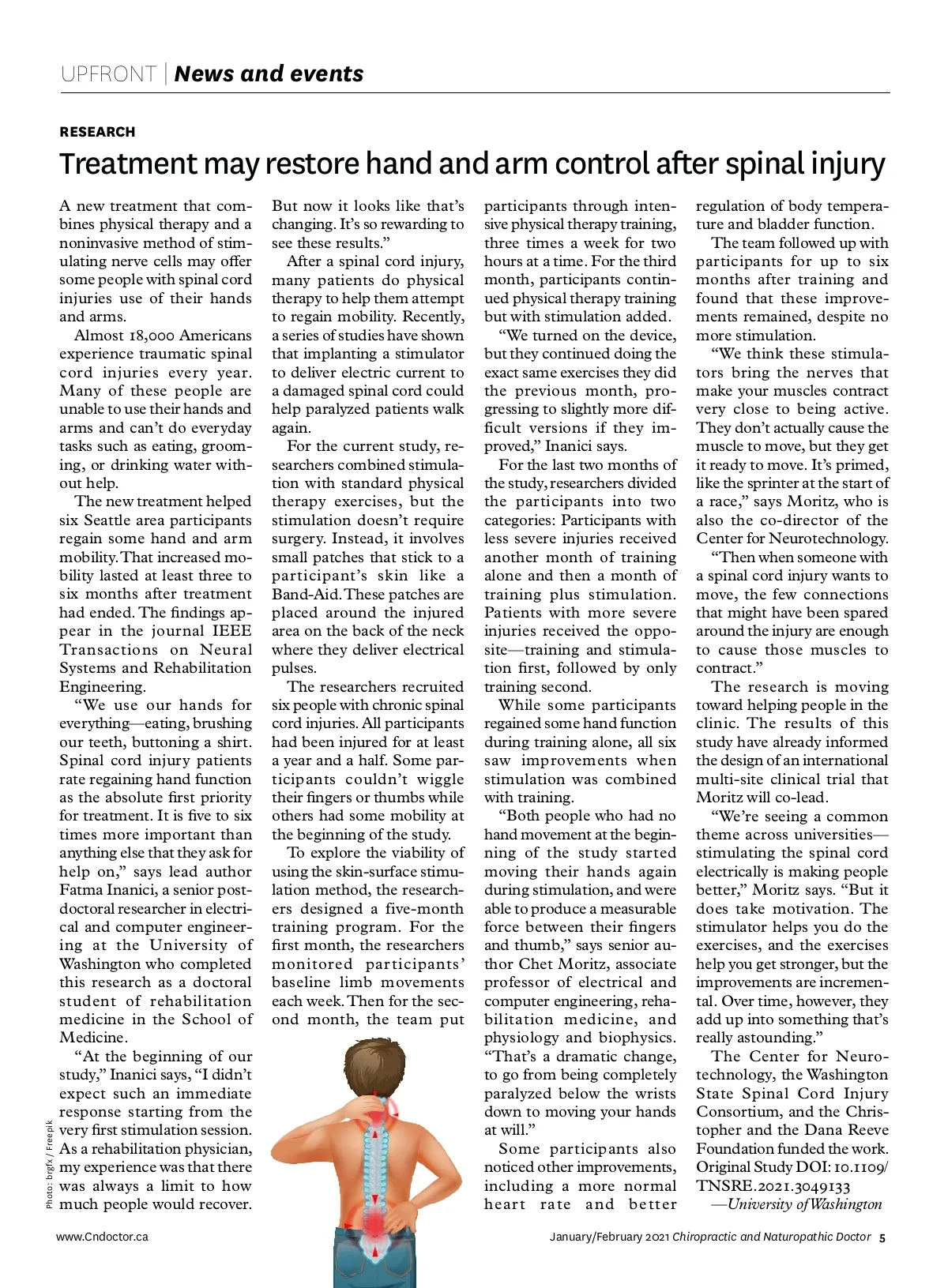
UPFRONT | News and events RESEARCH Treatment may restore hand and arm control after spinal injury A new treatment that com-bines physical therapy and a noninvasive method of stim-ulating nerve cells may offer some people with spinal cord injuries use of their hands and arms. Almost 18,000 Americans experience traumatic spinal cord injuries every year. Many of these people are unable to use their hands and arms and can’t do everyday tasks such as eating, groom-ing, or drinking water with-out help. The new treatment helped six Seattle area participants regain some hand and arm mobility. That increased mo-bility lasted at least three to six months after treatment had ended. The findings ap-pear in the journal IEEE Transactions on Neural Systems and Rehabilitation Engineering. “We use our hands for everything—eating, brushing our teeth, buttoning a shirt. Spinal cord injury patients rate regaining hand function as the absolute first priority for treatment. It is five to six times more important than anything else that they ask for help on,” says lead author Fatma Inanici, a senior post-doctoral researcher in electri-cal and computer engineer-ing at the University of Washington who completed this research as a doctoral student of rehabilitation medicine in the School of Medicine. “At the beginning of our study,” Inanici says, “I didn’t expect such an immediate response starting from the very first stimulation session. As a rehabilitation physician, my experience was that there was always a limit to how much people would recover. www.Cndoctor.ca But now it looks like that’s changing. It’s so rewarding to see these results.” After a spinal cord injury, many patients do physical therapy to help them attempt to regain mobility. Recently, a series of studies have shown that implanting a stimulator to deliver electric current to a damaged spinal cord could help paralyzed patients walk again. For the current study, re-searchers combined stimula-tion with standard physical therapy exercises, but the stimulation doesn’t require surgery. Instead, it involves small patches that stick to a participant’s skin like a Band-Aid. These patches are placed around the injured area on the back of the neck where they deliver electrical pulses. The researchers recruited six people with chronic spinal cord injuries. All participants had been injured for at least a year and a half. Some par-ticipants couldn’t wiggle their fingers or thumbs while others had some mobility at the beginning of the study. To explore the viability of using the skin-surface stimu-lation method, the research-ers designed a five-month training program. For the first month, the researchers monitored participants’ baseline limb movements each week. Then for the sec-ond month, the team put participants through inten-sive physical therapy training, three times a week for two hours at a time. For the third month, participants contin-ued physical therapy training but with stimulation added. “We turned on the device, but they continued doing the exact same exercises they did the previous month, pro-gressing to slightly more dif-ficult versions if they im-proved,” Inanici says. For the last two months of the study, researchers divided the participants into two categories: Participants with less severe injuries received another month of training alone and then a month of training plus stimulation. Patients with more severe injuries received the oppo-site—training and stimula-tion first, followed by only training second. While some participants regained some hand function during training alone, all six saw improvements when stimulation was combined with training. “Both people who had no hand movement at the begin-ning of the study started moving their hands again during stimulation, and were able to produce a measurable force between their fingers and thumb,” says senior au-thor Chet Moritz, associate professor of electrical and computer engineering, reha-bilitation medicine, and physiology and biophysics. “That’s a dramatic change, to go from being completely paralyzed below the wrists down to moving your hands at will.” Some participants also noticed other improvements, including a more normal heart rate and better regulation of body tempera-ture and bladder function. The team followed up with participants for up to six months after training and found that these improve-ments remained, despite no more stimulation. “We think these stimula-tors bring the nerves that make your muscles contract very close to being active. They don’t actually cause the muscle to move, but they get it ready to move. It’s primed, like the sprinter at the start of a race,” says Moritz, who is also the co-director of the Center for Neurotechnology. “Then when someone with a spinal cord injury wants to move, the few connections that might have been spared around the injury are enough to cause those muscles to contract.” The research is moving toward helping people in the clinic. The results of this study have already informed the design of an international multi-site clinical trial that Moritz will co-lead. “We’re seeing a common theme across universities— stimulating the spinal cord electrically is making people better,” Moritz says. “But it does take motivation. The stimulator helps you do the exercises, and the exercises help you get stronger, but the improvements are incremen-tal. Over time, however, they add up into something that’s really astounding.” The Center for Neuro-technology, the Washington State Spinal Cord Injury Consortium, and the Chris-topher and the Dana Reeve Foundation funded the work. Original Study DOI: 10.1109/ TNSRE.2021.3049133 —University of Washington Photo: brgfx / Freepik January/February 2021 Chiropractic and Naturopathic Doctor 5
Chiropractic + Naturopathic Doctor January-February 2021: Page 5