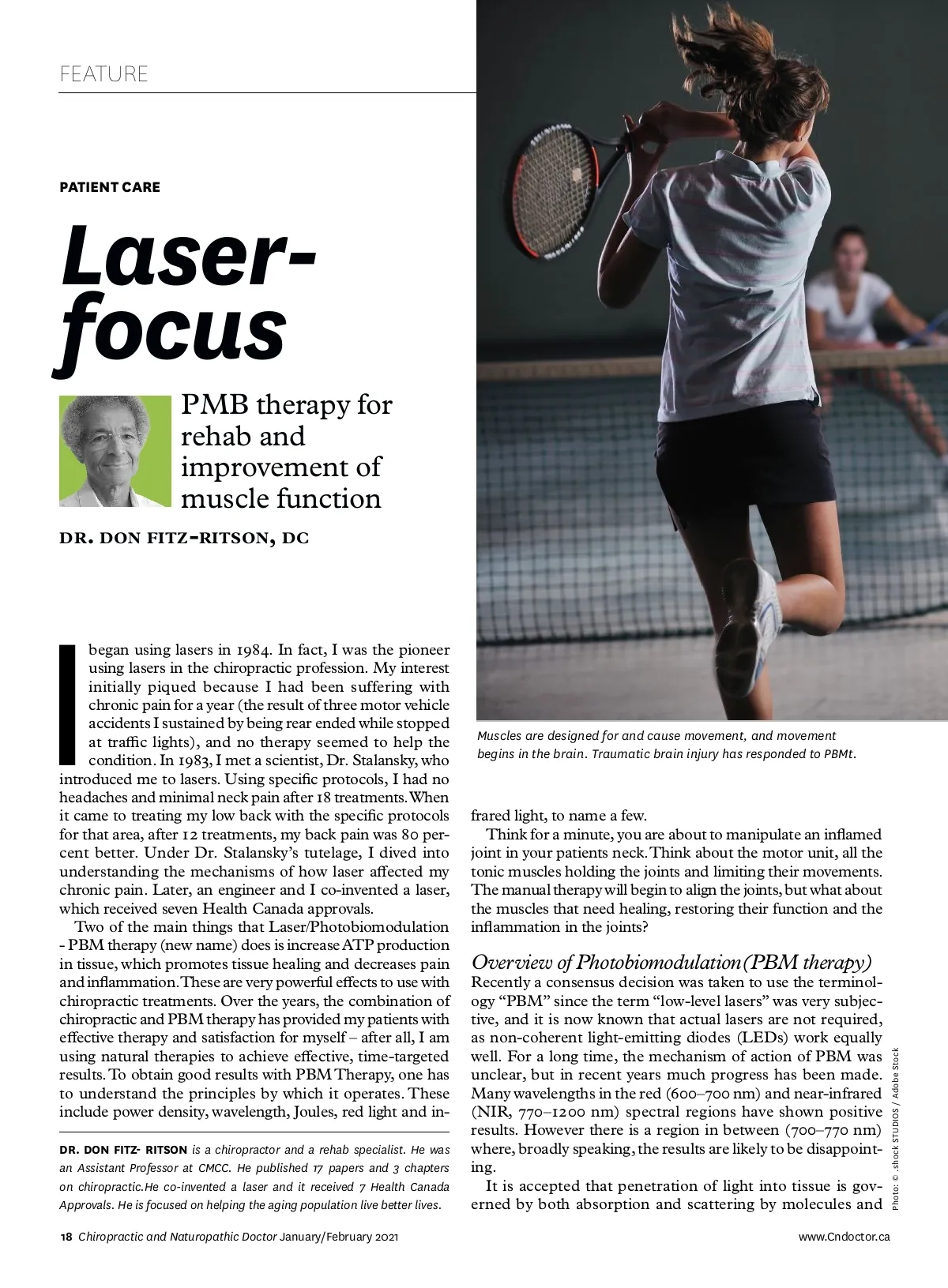
synthesis and angiogenesis.(2) The above insights will inform one on how to use PBM ther-apy (PBMt) for pain relief and to reduce inflammation, enhance healing of tissue repair and improve function. The application of these properties has been employed and observed in the treatment of various diseases and conditions, such as diabetes, brain injury, spinal cord damage, dermatological conditions, oral irritation, and in different areas of dentistry.(3) For example, for neuropathic pain, a combination of initial high irradiance/ fluence rates for fast pain relief, followed by a series of low irra-diance/fluence rates for prolonged pain relief, will alter the chronic inflammation residues.(4) Target areas for muscle performance structures present in the tissue. Both absorption and scat-tering become significantly less as the wavelength gets longer, so the penetration depth of NIR is maximal at about 810 nm, and at longer wavelengths water becomes an im-portant absorber and penetration depth gets shorter again. The “biphasic dose response” describes a situation in which there is an optimum value of the “dose” of PBM most often defined by the energy density (J/cm2). It has been consistently found that when the dose of PBM therapy is increased, a maximum response is reached at some value, and if the dose is increased beyond that maximal value, the response dimin-ishes, disappears and it is even possible that negative or inhib-itory effects are produced at very high fluences. Also one has to be aware of the physiology of the tissue been treated. Cells/ tissues with high numbers of mitochondria tended to respond to lower doses of light compared to cells/tissues with lower number of mitochondria.(1) The effect on the cell’s mitochondria is striking. The pri-mary chromophores have been identified as cytochrome c oxidase in mitochondria, and calcium ion channels (possibly mediated by light absorption by opsins). Secondary effects of photon absorption include increases in ATP, a brief burst of reactive oxygen species, an increase in nitric oxide, and mod-ulation of calcium levels. Tertiary effects include activation of a wide range of transcription factors leading to improved cell survival, increased proliferation, migration and new protein www.Cndoctor.ca Outlined are areas where one can apply PBM therapy and im-prove muscle performance. Muscles are designed for and cause movement and movement begins in the brain. Traumatic brain injury has been shown to respond to PBM therapy. PBMt helps the brain repair itself by stimulating neurogenesis, upregulating BDNF synthesis, and encouraging synaptogenesis. PBMt in-creases regional cerebral blood flow, tissue oxygenation, and improves memory, mood, and cognitive function. There is also improvement with executive function, working memory, and sleep.(5) If one were to use PBMt on the brain area for say the quads, would this initiate the process of improving the quads function? A recent study showed that by stimulating the hand area of the motor cortex with PBMt, finger taps increased in both hands as an indicator of motor performance improvement. (6) This may work for the quads too. Spinal cord and peripheral nerves respond effectively to PBMt. PBMt decreases inflammation in spinal cord injury.(7) As well, PBMt accelerates the axonal cell growth by increasing their function via biochemical activity and improves morpho-logical recovery in atrophied muscle.(8) Combining PBMt and Chiropractic therapy, we now have ways to improve spinal cord, peripheral nerves and muscle atrophy. Many patients with rhomboid and gastrocnemius atrophy have responded effec-tively with this combination in my practice. The intervertebral disc (IVD) is constantly under wear and tear, and low grade inflammation may develop. This low grade inflammation can exert pressure on the spinal cord and nerves, affecting innervation patterns and nutrient flow to muscles. The annulus fibrosus (AF) cells, are the first line of defense in preventing inflammation in the IVD. PBMt, using different wavelengths and doses, selectively inhibites the production of inflammatory mediators, catabolic enzymes, and neurotrophins by human AF cells in a dose-and wave-length-dependent manner. This study results suggest that PBMt could be a superior and advanced treatment strategy for IVD degeneration.(9) The nucleus pulposus (NP) cells of the IVD, also responds to different doses and wavelengths of PBMt regarding inflammation. However, there is a specific wavelength which also modulated the protein and gene ex-pression of IL-8, which is responsible for the anabolic re-sponse in human NP cells. The findings suggeste that PBMt, at an optimal dose and wavelength, is a useful therapeutic tool to treat IVD degeneration.(10) Understanding the above and appreciating that PBMt modulates prostaglandin E2 lev-els, indicates that these may be the mechanisms involved in the analgesic effects of PBMt in patients with LBP.(11) January/February 2021 Chiropractic and Naturopathic Doctor 19
Chiropractic + Naturopathic Doctor January-February 2021: Page 19