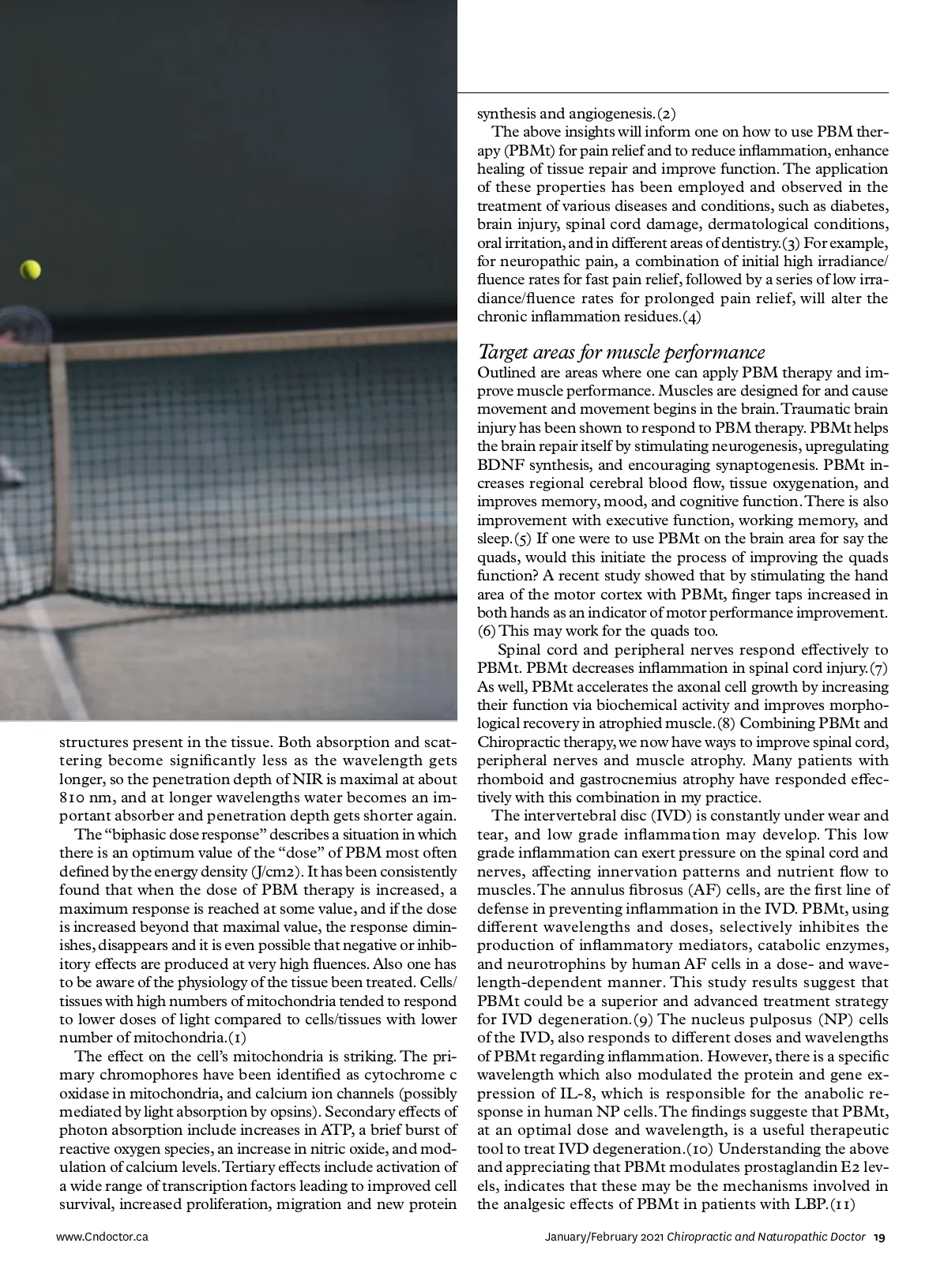
FEATURE PATIENT CARE Laser-focus PMB therapy for rehab and improvement of muscle function dr . don fitz -ritson , dc I DR. DON FITZ-RITSON is a chiropractor and a rehab specialist. He was an Assistant Professor at CMCC. He published 17 papers and 3 chapters on chiropractic.He co-invented a laser and it received 7 Health Canada Approvals. He is focused on helping the aging population live better lives. 18 Chiropractic and Naturopathic Doctor January/February 2021 www.Cndoctor.ca Photo: © .shock STUDIOS / Adobe Stock began using lasers in 1984. In fact, I was the pioneer using lasers in the chiropractic profession. My interest initially piqued because I had been suffering with chronic pain for a year (the result of three motor vehicle accidents I sustained by being rear ended while stopped at traffic lights), and no therapy seemed to help the condition. In 1983, I met a scientist, Dr. Stalansky, who introduced me to lasers. Using specific protocols, I had no headaches and minimal neck pain after 18 treatments. When it came to treating my low back with the specific protocols for that area, after 12 treatments, my back pain was 80 per-cent better. Under Dr. Stalansky’s tutelage, I dived into understanding the mechanisms of how laser affected my chronic pain. Later, an engineer and I co-invented a laser, which received seven Health Canada approvals. Two of the main things that Laser/Photobiomodulation -PBM therapy (new name) does is increase ATP production in tissue, which promotes tissue healing and decreases pain and inflammation. These are very powerful effects to use with chiropractic treatments. Over the years, the combination of chiropractic and PBM therapy has provided my patients with effective therapy and satisfaction for myself – after all, I am using natural therapies to achieve effective, time-targeted results. To obtain good results with PBM Therapy, one has to understand the principles by which it operates. These include power density, wavelength, Joules, red light and in-Muscles are designed for and cause movement, and movement begins in the brain. Traumatic brain injury has responded to PBMt. frared light, to name a few. Think for a minute, you are about to manipulate an inflamed joint in your patients neck. Think about the motor unit, all the tonic muscles holding the joints and limiting their movements. The manual therapy will begin to align the joints, but what about the muscles that need healing, restoring their function and the inflammation in the joints? Overview of Photobiomodulation(PBM therapy) Recently a consensus decision was taken to use the terminol-ogy “PBM” since the term “low-level lasers” was very subjec-tive, and it is now known that actual lasers are not required, as non-coherent light-emitting diodes (LEDs) work equally well. For a long time, the mechanism of action of PBM was unclear, but in recent years much progress has been made. Many wavelengths in the red (600–700 nm) and near-infrared (NIR, 770–1200 nm) spectral regions have shown positive results. However there is a region in between (700–770 nm) where, broadly speaking, the results are likely to be disappoint-ing. It is accepted that penetration of light into tissue is gov-erned by both absorption and scattering by molecules and
Chiropractic + Naturopathic Doctor January-February 2021: Page 18