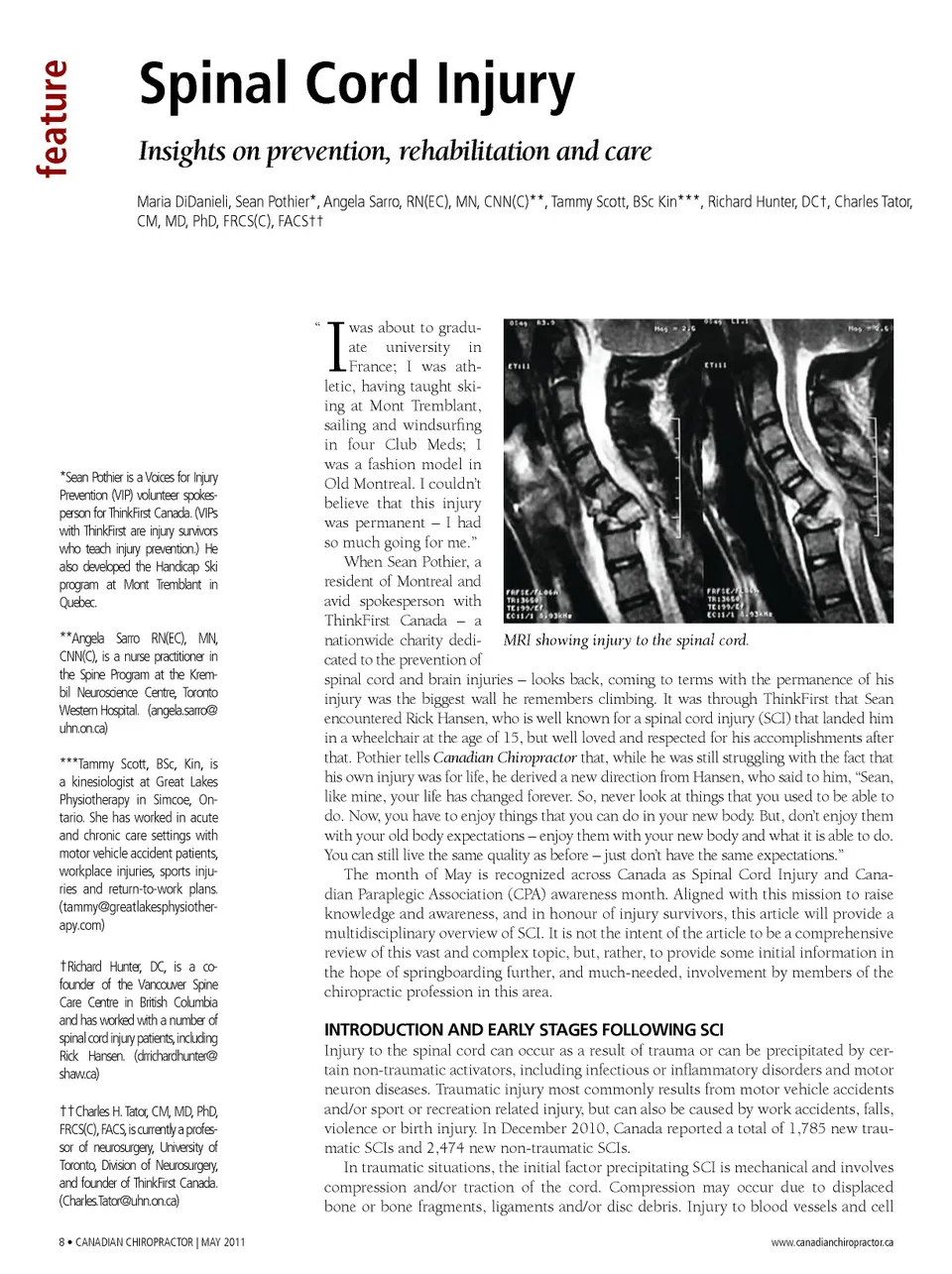
feature Spinal Cord Injury Insights on prevention, rehabilitation and care Maria didanieli, Sean pothier*, Angela Sarro, RN(EC), MN, CNN(C)**, Tammy Scott, BSc Kin***, Richard Hunter, dC†, Charles Tator, CM, Md, phd, FRCS(C), FACS†† “ I *Sean pothier is a Voices for injury prevention (Vip) volunteer spokes -person for ThinkFirst Canada. (Vips with ThinkFirst are injury survivors who teach injury prevention.) He also developed the Handicap Ski program at Mont Tremblant in Quebec. **Angela Sarro RN(EC), MN, CNN(C), is a nurse practitioner in the Spine Program at the Krem-bil Neuroscience Centre, Toronto Western Hospital. (angela.sarro@ uhn.on.ca) ***Tammy Scott, BSc, Kin, is a kinesiologist at Great Lakes Physiotherapy in Simcoe, On-tario. She has worked in acute and chronic care settings with motor vehicle accident patients, workplace injuries, sports inju-ries and return-to-work plans. ([email protected]) † Richard Hunter, DC, is a co-founder of the Vancouver Spine Care Centre in British Columbia and has worked with a number of spinal cord injury patients, including Rick Hansen. (drrichardhunter@ shaw.ca) was about to gradu-ate university in France; I was ath-letic, having taught ski-ing at Mont Tremblant, sailing and windsurfing in four Club Meds; I was a fashion model in Old Montreal. I couldn’t believe that this injury was permanent – I had so much going for me.” When Sean Pothier, a resident of Montreal and avid spokesperson with ThinkFirst Canada – a nationwide charity dedi-MRI showing injury to the spinal cord. cated to the prevention of spinal cord and brain injuries – looks back, coming to terms with the permanence of his injury was the biggest wall he remembers climbing. It was through ThinkFirst that Sean encountered Rick Hansen, who is well known for a spinal cord injury (SCI) that landed him in a wheelchair at the age of 15, but well loved and respected for his accomplishments after that. Pothier tells Canadian Chiropractor that, while he was still struggling with the fact that his own injury was for life, he derived a new direction from Hansen, who said to him, “Sean, like mine, your life has changed forever. So, never look at things that you used to be able to do. Now, you have to enjoy things that you can do in your new body. But, don’t enjoy them with your old body expectations – enjoy them with your new body and what it is able to do. You can still live the same quality as before – just don’t have the same expectations.” The month of May is recognized across Canada as Spinal Cord Injury and Cana-dian Paraplegic Association (CPA) awareness month. Aligned with this mission to raise knowledge and awareness, and in honour of injury survivors, this article will provide a multidisciplinary overview of SCI. It is not the intent of the article to be a comprehensive review of this vast and complex topic, but, rather, to provide some initial information in the hope of springboarding further, and much-needed, involvement by members of the chiropractic profession in this area. †† Charles H. Tator, CM, MD, PhD, FRCS(C), FACS, is currently a profes -sor of neurosurgery, University of Toronto, division of Neurosurgery, and founder of ThinkFirst Canada. ([email protected]) 8 • CANAdiAN CHiROpRACTOR | MAY 2011 INTRODUCTION AND EARLY STAGES FOLLOWING SCI Injury to the spinal cord can occur as a result of trauma or can be precipitated by cer-tain non-traumatic activators, including infectious or inflammatory disorders and motor neuron diseases. Traumatic injury most commonly results from motor vehicle accidents and/or sport or recreation related injury, but can also be caused by work accidents, falls, violence or birth injury. In December 2010, Canada reported a total of 1,785 new trau -matic SCIs and 2,474 new non-traumatic SCIs. In traumatic situations, the initial factor precipitating SCI is mechanical and involves compression and/or traction of the cord. Compression may occur due to displaced bone or bone fragments, ligaments and/or disc debris. Injury to blood vessels and cell www.canadianchiropractor.ca
Chiropractic + Naturopathic Doctor May 2011: Page 8