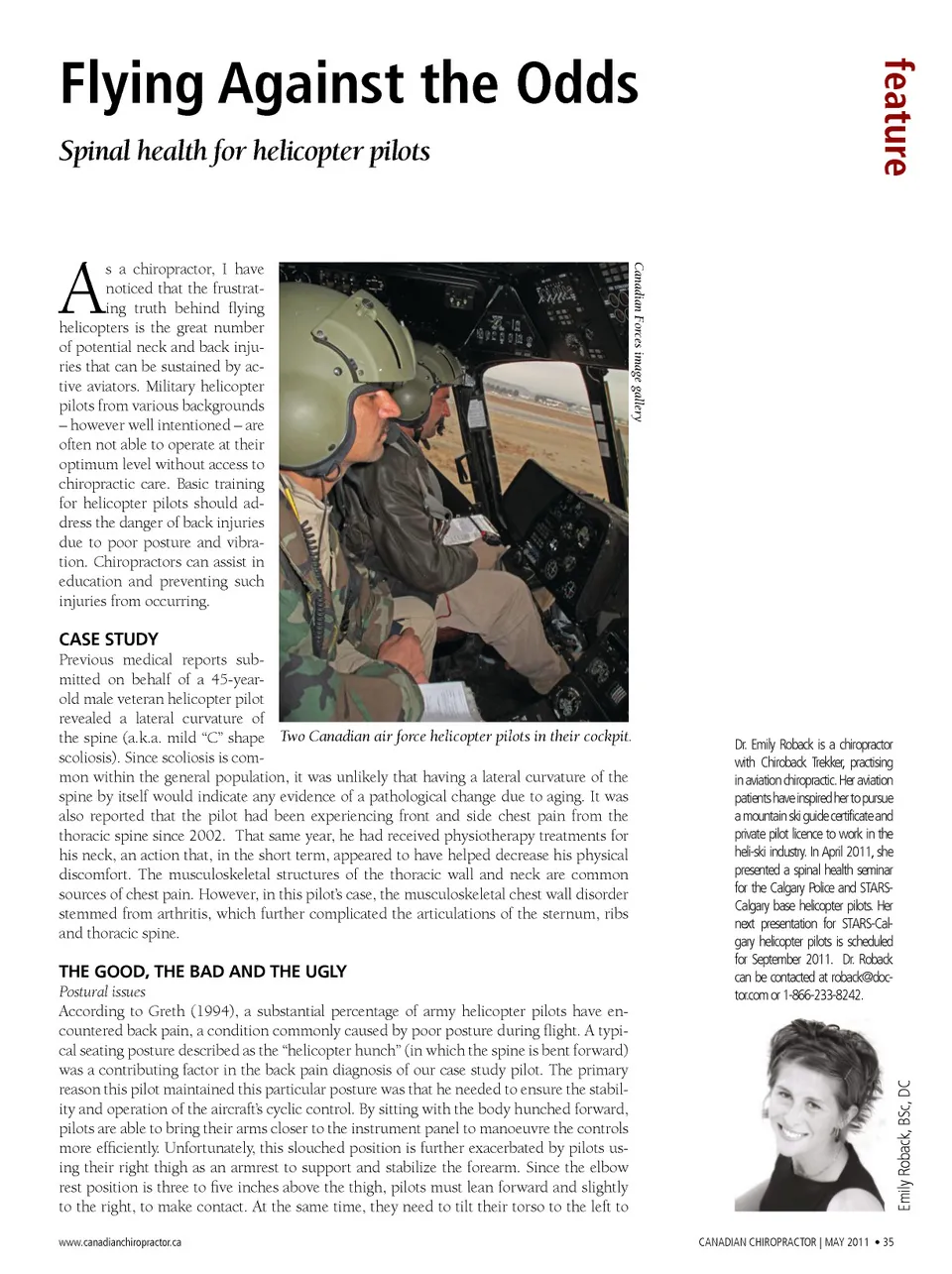
Flying Against the Odds Spinal health for helicopter pilots feature A s a chiropractor, I have noticed that the frustrat-ing truth behind flying helicopters is the great number of potential neck and back inju-ries that can be sustained by ac-tive aviators. Military helicopter pilots from various backgrounds – however well intentioned – are often not able to operate at their optimum level without access to chiropractic care. Basic training for helicopter pilots should ad-dress the danger of back injuries due to poor posture and vibra-tion. Chiropractors can assist in education and preventing such injuries from occurring. CASE STUDY Previous medical reports sub-mitted on behalf of a 45-year-old male veteran helicopter pilot revealed a lateral curvature of the spine (a.k.a. mild “C” shape Two Canadian air force helicopter pilots in their cockpit. scoliosis). Since scoliosis is com-mon within the general population, it was unlikely that having a lateral curvature of the spine by itself would indicate any evidence of a pathological change due to aging. It was also reported that the pilot had been experiencing front and side chest pain from the thoracic spine since 2002. That same year, he had received physiotherapy treatments for his neck, an action that, in the short term, appeared to have helped decrease his physical discomfort. The musculoskeletal structures of the thoracic wall and neck are common sources of chest pain. However, in this pilot’s case, the musculoskeletal chest wall disorder stemmed from arthritis, which further complicated the articulations of the sternum, ribs and thoracic spine. THE GOOD, THE BAD AND THE UGLY Postural issues According to Greth (1994), a substantial percentage of army helicopter pilots have en-countered back pain, a condition commonly caused by poor posture during flight. A typi-cal seating posture described as the “helicopter hunch” (in which the spine is bent forward) was a contributing factor in the back pain diagnosis of our case study pilot. The primary reason this pilot maintained this particular posture was that he needed to ensure the stabil-ity and operation of the aircraft’s cyclic control. By sitting with the body hunched forward, pilots are able to bring their arms closer to the instrument panel to manoeuvre the controls more efficiently. Unfortunately, this slouched position is further exacerbated by pilots us-ing their right thigh as an armrest to support and stabilize the forearm. Since the elbow rest position is three to five inches above the thigh, pilots must lean forward and slightly to the right, to make contact. At the same time, they need to tilt their torso to the left to www.canadianchiropractor.ca CANAdiAN CHiROpRACTOR | MAY 2011 • 35 Emily Roback, BSc, DC Canadian Forces image gallery Dr. Emily Roback is a chiropractor with Chiroback Trekker, practising in aviation chiropractic. Her aviation patients have inspired her to pursue a mountain ski guide certificate and private pilot licence to work in the heli-ski industry. In April 2011, she presented a spinal health seminar for the Calgary Police and STARS-Calgary base helicopter pilots. Her next presentation for STARS-Cal-gary helicopter pilots is scheduled for September 2011. Dr. Roback can be contacted at [email protected] or 1-866-233-8242.
Chiropractic + Naturopathic Doctor May 2011: Page 35