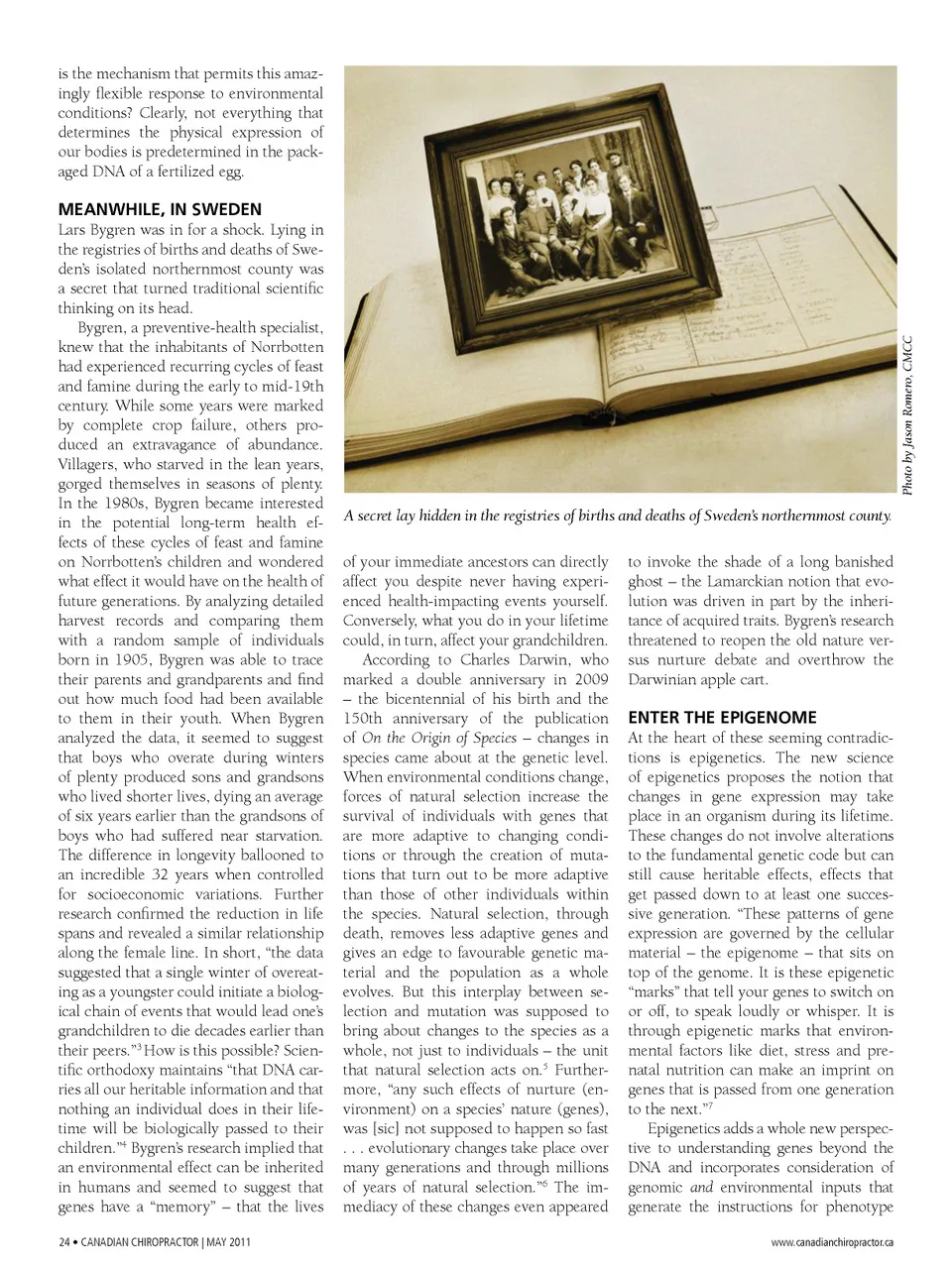
is the mechanism that permits this amaz-ingly flexible response to environmental conditions? Clearly, not everything that determines the physical expression of our bodies is predetermined in the pack-aged DNA of a fertilized egg. MEANWHILE, IN SWEDEN Lars Bygren was in for a shock. Lying in the registries of births and deaths of Swe-den’s isolated northernmost county was a secret that turned traditional scientific thinking on its head. Bygren, a preventive-health specialist, knew that the inhabitants of Norrbotten had experienced recurring cycles of feast and famine during the early to mid-19th century. While some years were marked by complete crop failure, others pro-duced an extravagance of abundance. Villagers, who starved in the lean years, gorged themselves in seasons of plenty. In the 1980s, Bygren became interested in the potential long-term health ef-fects of these cycles of feast and famine on Norrbotten’s children and wondered what effect it would have on the health of future generations. By analyzing detailed harvest records and comparing them with a random sample of individuals born in 1905, Bygren was able to trace their parents and grandparents and find out how much food had been available to them in their youth. When Bygren analyzed the data, it seemed to suggest that boys who overate during winters of plenty produced sons and grandsons who lived shorter lives, dying an average of six years earlier than the grandsons of boys who had suffered near starvation. The difference in longevity ballooned to an incredible 32 years when controlled for socioeconomic variations. Further research confirmed the reduction in life spans and revealed a similar relationship along the female line. In short, “the data suggested that a single winter of overeat-ing as a youngster could initiate a biolog-ical chain of events that would lead one’s grandchildren to die decades earlier than their peers.” 3 How is this possible? Scien-tific orthodoxy maintains “that DNA car-ries all our heritable information and that nothing an individual does in their life-time will be biologically passed to their children.” 4 Bygren’s research implied that an environmental effect can be inherited in humans and seemed to suggest that genes have a “memory” – that the lives 24 • CANAdiAN CHiROpRACTOR | MAY 2011 A secret lay hidden in the registries of births and deaths of Sweden’s northernmost county. of your immediate ancestors can directly affect you despite never having experi-enced health-impacting events yourself. Conversely, what you do in your lifetime could, in turn, affect your grandchildren. According to Charles Darwin, who marked a double anniversary in 2009 – the bicentennial of his birth and the 150th anniversary of the publication of On the Origin of Species – changes in species came about at the genetic level. When environmental conditions change, forces of natural selection increase the survival of individuals with genes that are more adaptive to changing condi-tions or through the creation of muta-tions that turn out to be more adaptive than those of other individuals within the species. Natural selection, through death, removes less adaptive genes and gives an edge to favourable genetic ma-terial and the population as a whole evolves. But this interplay between se-lection and mutation was supposed to bring about changes to the species as a whole, not just to individuals – the unit that natural selection acts on. 5 Further-more, “any such effects of nurture (en-vironment) on a species’ nature (genes), was [sic] not supposed to happen so fast . . . evolutionary changes take place over many generations and through millions of years of natural selection.” 6 The im-mediacy of these changes even appeared to invoke the shade of a long banished ghost – the Lamarckian notion that evo-lution was driven in part by the inheri-tance of acquired traits. Bygren’s research threatened to reopen the old nature ver-sus nurture debate and overthrow the Darwinian apple cart. ENTER THE EPIGENOME At the heart of these seeming contradic-tions is epigenetics. The new science of epigenetics proposes the notion that changes in gene expression may take place in an organism during its lifetime. These changes do not involve alterations to the fundamental genetic code but can still cause heritable effects, effects that get passed down to at least one succes-sive generation. “These patterns of gene expression are governed by the cellular material – the epigenome – that sits on top of the genome. It is these epigenetic “marks” that tell your genes to switch on or off, to speak loudly or whisper. It is through epigenetic marks that environ-mental factors like diet, stress and pre-natal nutrition can make an imprint on genes that is passed from one generation to the next.” 7 Epigenetics adds a whole new perspec-tive to understanding genes beyond the DNA and incorporates consideration of genomic and environmental inputs that generate the instructions for phenotype www.canadianchiropractor.ca Photo by Jason Romero, CMCC
Chiropractic + Naturopathic Doctor May 2011: Page 24