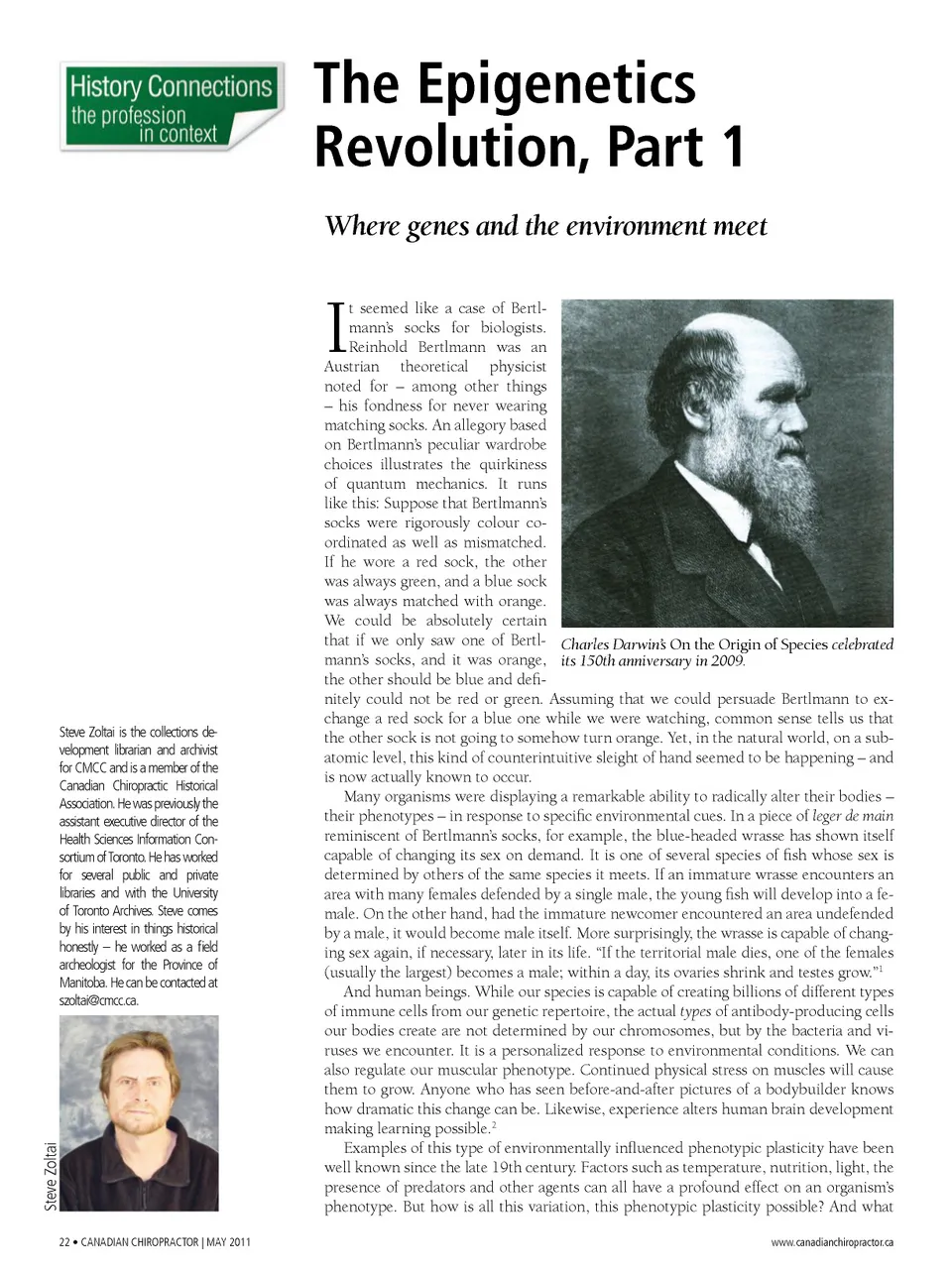
The Epigenetics Revolution, Part 1 Where genes and the environment meet I Steve Zoltai is the collections de-velopment librarian and archivist for CMCC and is a member of the Canadian Chiropractic Historical Association. He was previously the assistant executive director of the Health Sciences Information Con-sortium of Toronto. He has worked for several public and private libraries and with the University of Toronto Archives. Steve comes by his interest in things historical honestly – he worked as a field archeologist for the Province of Manitoba. He can be contacted at [email protected]. t seemed like a case of Bertl-mann’s socks for biologists. Reinhold Bertlmann was an Austrian theoretical physicist noted for – among other things – his fondness for never wearing matching socks. An allegory based on Bertlmann’s peculiar wardrobe choices illustrates the quirkiness of quantum mechanics. It runs like this: Suppose that Bertlmann’s socks were rigorously colour co-ordinated as well as mismatched. If he wore a red sock, the other was always green, and a blue sock was always matched with orange. We could be absolutely certain that if we only saw one of Bertl-Charles Darwin’s On the Origin of Species celebrated mann’s socks, and it was orange, its 150th anniversary in 2009. the other should be blue and defi-nitely could not be red or green. Assuming that we could persuade Bertlmann to ex-change a red sock for a blue one while we were watching, common sense tells us that the other sock is not going to somehow turn orange. Yet, in the natural world, on a sub -atomic level, this kind of counterintuitive sleight of hand seemed to be happening – and is now actually known to occur. Many organisms were displaying a remarkable ability to radically alter their bodies – their phenotypes – in response to specific environmental cues. In a piece of leger de main reminiscent of Bertlmann’s socks, for example, the blue-headed wrasse has shown itself capable of changing its sex on demand. It is one of several species of fish whose sex is determined by others of the same species it meets. If an immature wrasse encounters an area with many females defended by a single male, the young fish will develop into a fe-male. On the other hand, had the immature newcomer encountered an area undefended by a male, it would become male itself. More surprisingly, the wrasse is capable of chang-ing sex again, if necessary, later in its life. “If the territorial male dies, one of the females (usually the largest) becomes a male; within a day, its ovaries shrink and testes grow.” 1 And human beings. While our species is capable of creating billions of different types of immune cells from our genetic repertoire, the actual types of antibody-producing cells our bodies create are not determined by our chromosomes, but by the bacteria and vi-ruses we encounter. It is a personalized response to environmental conditions. We can also regulate our muscular phenotype. Continued physical stress on muscles will cause them to grow. Anyone who has seen before-and-after pictures of a bodybuilder knows how dramatic this change can be. Likewise, experience alters human brain development making learning possible. 2 Examples of this type of environmentally influenced phenotypic plasticity have been well known since the late 19th century. Factors such as temperature, nutrition, light, the presence of predators and other agents can all have a profound effect on an organism’s phenotype. But how is all this variation, this phenotypic plasticity possible? And what www.canadianchiropractor.ca Steve Zoltai 22 • CANAdiAN CHiROpRACTOR | MAY 2011
Chiropractic + Naturopathic Doctor May 2011: Page 22