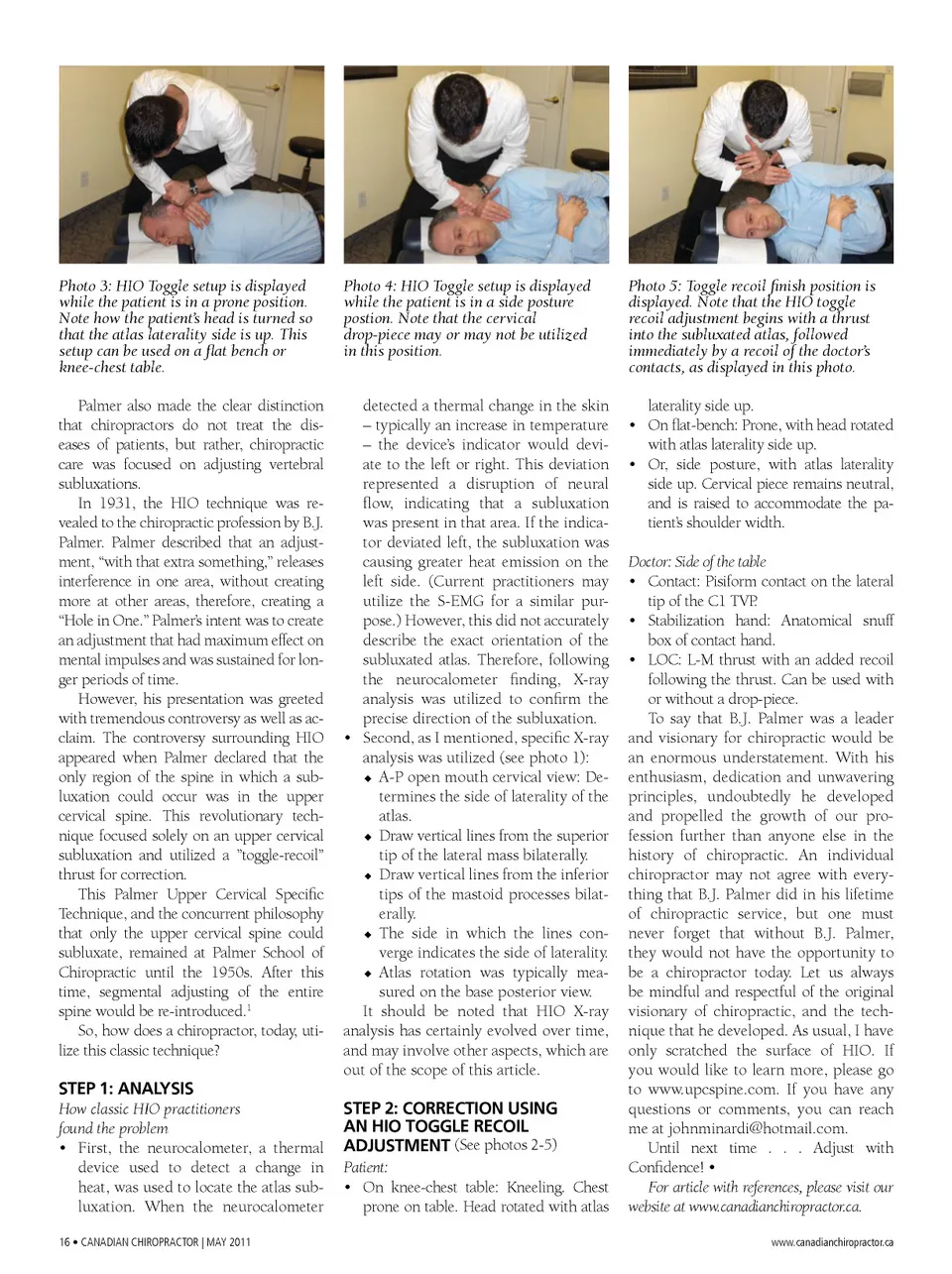
Photo 3: HIO Toggle setup is displayed while the patient is in a prone position. Note how the patient’s head is turned so that the atlas laterality side is up. This setup can be used on a flat bench or knee-chest table. Palmer also made the clear distinction that chiropractors do not treat the dis-eases of patients, but rather, chiropractic care was focused on adjusting vertebral subluxations. In 1931, the HIO technique was re -vealed to the chiropractic profession by B.J. Palmer. Palmer described that an adjust-ment, “with that extra something,” releases interference in one area, without creating more at other areas, therefore, creating a “Hole in One.” Palmer’s intent was to create an adjustment that had maximum effect on mental impulses and was sustained for lon-ger periods of time. However, his presentation was greeted with tremendous controversy as well as ac-claim. The controversy surrounding HIO appeared when Palmer declared that the only region of the spine in which a sub-luxation could occur was in the upper cervical spine. This revolutionary tech-nique focused solely on an upper cervical subluxation and utilized a ”toggle-recoil” thrust for correction. This Palmer Upper Cervical Specific Technique, and the concurrent philosophy that only the upper cervical spine could subluxate, remained at Palmer School of Chiropractic until the 1950s. After this time, segmental adjusting of the entire spine would be re-introduced. 1 So, how does a chiropractor, today, uti-lize this classic technique? Photo 4: HIO Toggle setup is displayed while the patient is in a side posture postion. Note that the cervical drop-piece may or may not be utilized in this position. detected a thermal change in the skin – typically an increase in temperature – the device’s indicator would devi-ate to the left or right. This deviation represented a disruption of neural flow, indicating that a subluxation was present in that area. If the indica-tor deviated left, the subluxation was causing greater heat emission on the left side. (Current practitioners may utilize the S-EMG for a similar pur-pose.) However, this did not accurately describe the exact orientation of the subluxated atlas. Therefore, following the neurocalometer finding, X-ray analysis was utilized to confirm the precise direction of the subluxation. • Second, as I mentioned, specific X-ray analysis was utilized (see photo 1): A-P open mouth cervical view: De-termines the side of laterality of the atlas. Draw vertical lines from the superior tip of the lateral mass bilaterally. Draw vertical lines from the inferior tips of the mastoid processes bilat-erally. The side in which the lines con-verge indicates the side of laterality. Atlas rotation was typically mea-sured on the base posterior view. It should be noted that HIO X-ray analysis has certainly evolved over time, and may involve other aspects, which are out of the scope of this article. Photo 5: Toggle recoil finish position is displayed. Note that the HIO toggle recoil adjustment begins with a thrust into the subluxated atlas, followed immediately by a recoil of the doctor’s contacts, as displayed in this photo. laterality side up. • On flat-bench: Prone, with head rotated with atlas laterality side up. • Or, side posture, with atlas laterality side up. Cervical piece remains neutral, and is raised to accommodate the pa-tient’s shoulder width. Doctor: Side of the table • Contact: Pisiform contact on the lateral tip of the C1 TVP . • Stabilization hand: Anatomical snuff box of contact hand. • LOC: L-M thrust with an added recoil following the thrust. Can be used with or without a drop-piece. To say that B.J. Palmer was a leader and visionary for chiropractic would be an enormous understatement. With his enthusiasm, dedication and unwavering principles, undoubtedly he developed and propelled the growth of our pro-fession further than anyone else in the history of chiropractic. An individual chiropractor may not agree with every-thing that B.J. Palmer did in his lifetime of chiropractic service, but one must never forget that without B.J. Palmer, they would not have the opportunity to be a chiropractor today. Let us always be mindful and respectful of the original visionary of chiropractic, and the tech-nique that he developed. As usual, I have only scratched the surface of HIO. If you would like to learn more, please go to www.upcspine.com. If you have any questions or comments, you can reach me at [email protected]. Until next time . . . Adjust with Confidence! • For article with references, please visit our website at www.canadianchiropractor.ca. www.canadianchiropractor.ca STEP 1: ANALYSIS How classic HIO practitioners found the problem • First, the neurocalometer, a thermal device used to detect a change in heat, was used to locate the atlas sub-luxation. When the neurocalometer 16 • CANAdiAN CHiROpRACTOR | MAY 2011 STEP 2: CORRECTION USING AN HIO TOGGLE RECOIL ADJUSTMENT (See photos 2-5) Patient: • On knee-chest table: Kneeling. Chest prone on table. Head rotated with atlas
Chiropractic + Naturopathic Doctor May 2011: Page 16