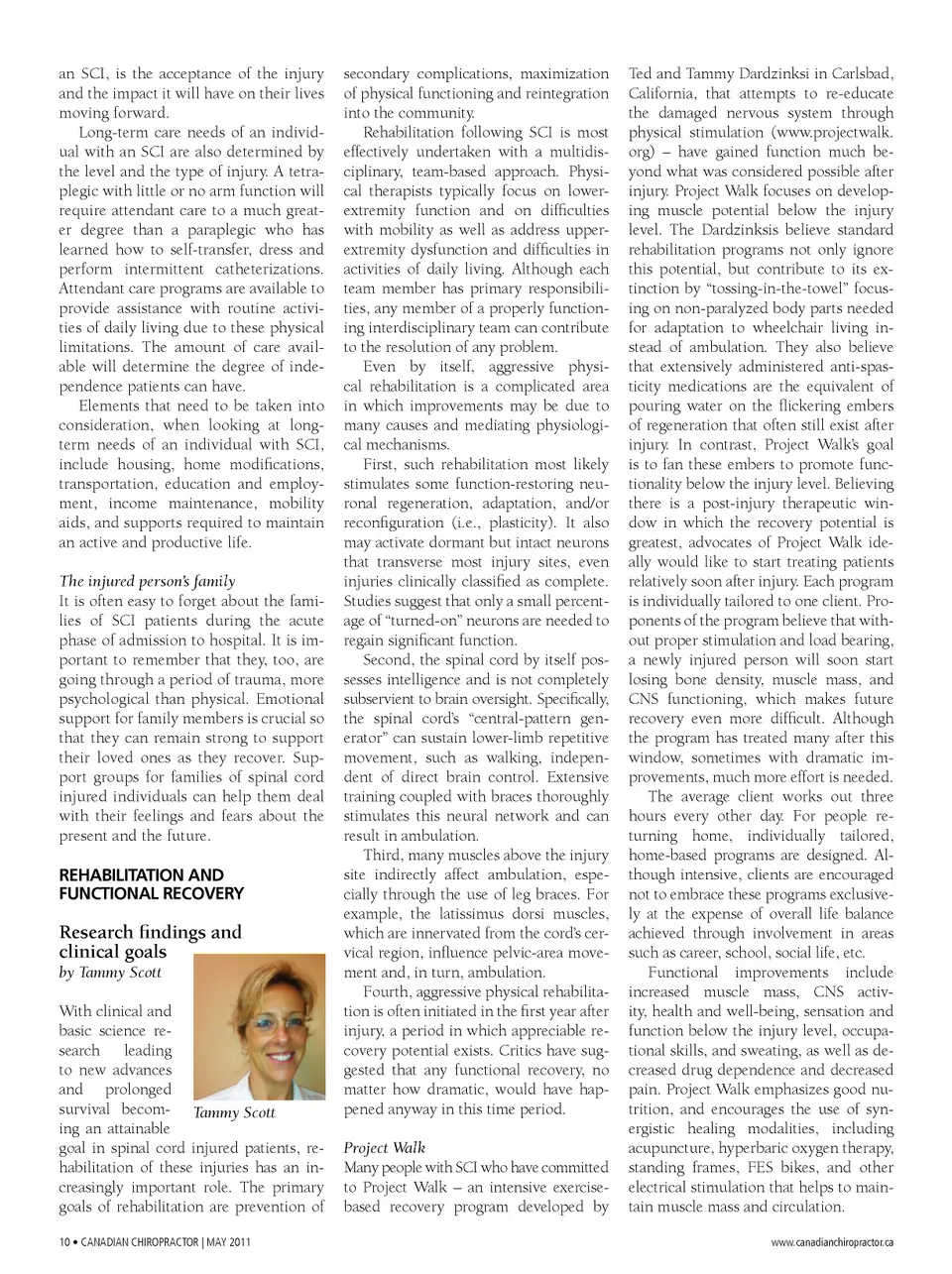
an SCI, is the acceptance of the injury and the impact it will have on their lives moving forward. Long-term care needs of an individ-ual with an SCI are also determined by the level and the type of injury. A tetra-plegic with little or no arm function will require attendant care to a much great-er degree than a paraplegic who has learned how to self-transfer, dress and perform intermittent catheterizations. Attendant care programs are available to provide assistance with routine activi-ties of daily living due to these physical limitations. The amount of care avail-able will determine the degree of inde-pendence patients can have. Elements that need to be taken into consideration, when looking at long-term needs of an individual with SCI, include housing, home modifications, transportation, education and employ-ment, income maintenance, mobility aids, and supports required to maintain an active and productive life. The injured person’s family It is often easy to forget about the fami-lies of SCI patients during the acute phase of admission to hospital. It is im-portant to remember that they, too, are going through a period of trauma, more psychological than physical. Emotional support for family members is crucial so that they can remain strong to support their loved ones as they recover. Sup-port groups for families of spinal cord injured individuals can help them deal with their feelings and fears about the present and the future. REHABILITATION AND FUNCTIONAL RECOVERY Research findings and clinical goals by Tammy Scott With clinical and basic science re-search leading to new advances and prolonged survival becom-Tammy Scott ing an attainable goal in spinal cord injured patients, re-habilitation of these injuries has an in-creasingly important role. The primary goals of rehabilitation are prevention of 10 • CANAdiAN CHiROpRACTOR | MAY 2011 secondary complications, maximization of physical functioning and reintegration into the community. Rehabilitation following SCI is most effectively undertaken with a multidis-ciplinary, team-based approach. Physi-cal therapists typically focus on lower-extremity function and on difficulties with mobility as well as address upper-extremity dysfunction and difficulties in activities of daily living. Although each team member has primary responsibili-ties, any member of a properly function-ing interdisciplinary team can contribute to the resolution of any problem. Even by itself, aggressive physi-cal rehabilitation is a complicated area in which improvements may be due to many causes and mediating physiologi-cal mechanisms. First, such rehabilitation most likely stimulates some function-restoring neu-ronal regeneration, adaptation, and/or reconfiguration (i.e., plasticity). It also may activate dormant but intact neurons that transverse most injury sites, even injuries clinically classified as complete. Studies suggest that only a small percent-age of “turned-on” neurons are needed to regain significant function. Second, the spinal cord by itself pos-sesses intelligence and is not completely subservient to brain oversight. Specifically, the spinal cord’s “central-pattern gen-erator” can sustain lower-limb repetitive movement, such as walking, indepen-dent of direct brain control. Extensive training coupled with braces thoroughly stimulates this neural network and can result in ambulation. Third, many muscles above the injury site indirectly affect ambulation, espe-cially through the use of leg braces. For example, the latissimus dorsi muscles, which are innervated from the cord’s cer-vical region, influence pelvic-area move-ment and, in turn, ambulation. Fourth, aggressive physical rehabilita-tion is often initiated in the first year after injury, a period in which appreciable re-covery potential exists. Critics have sug-gested that any functional recovery, no matter how dramatic, would have hap-pened anyway in this time period. Project Walk Many people with SCI who have committed to Project Walk – an intensive exercise-based recovery program developed by Ted and Tammy Dardzinksi in Carlsbad, California, that attempts to re-educate the damaged nervous system through physical stimulation (www.projectwalk. org) – have gained function much be-yond what was considered possible after injury. Project Walk focuses on develop-ing muscle potential below the injury level. The Dardzinksis believe standard rehabilitation programs not only ignore this potential, but contribute to its ex-tinction by “tossing-in-the-towel” focus-ing on non-paralyzed body parts needed for adaptation to wheelchair living in-stead of ambulation. They also believe that extensively administered anti-spas-ticity medications are the equivalent of pouring water on the flickering embers of regeneration that often still exist after injury. In contrast, Project Walk’s goal is to fan these embers to promote func-tionality below the injury level. Believing there is a post-injury therapeutic win-dow in which the recovery potential is greatest, advocates of Project Walk ide-ally would like to start treating patients relatively soon after injury. Each program is individually tailored to one client. Pro-ponents of the program believe that with-out proper stimulation and load bearing, a newly injured person will soon start losing bone density, muscle mass, and CNS functioning, which makes future recovery even more difficult. Although the program has treated many after this window, sometimes with dramatic im-provements, much more effort is needed. The average client works out three hours every other day. For people re-turning home, individually tailored, home-based programs are designed. Al-though intensive, clients are encouraged not to embrace these programs exclusive-ly at the expense of overall life balance achieved through involvement in areas such as career, school, social life, etc. Functional improvements include increased muscle mass, CNS activ-ity, health and well-being, sensation and function below the injury level, occupa-tional skills, and sweating, as well as de-creased drug dependence and decreased pain. Project Walk emphasizes good nu-trition, and encourages the use of syn-ergistic healing modalities, including acupuncture, hyperbaric oxygen therapy, standing frames, FES bikes, and other electrical stimulation that helps to main-tain muscle mass and circulation. www.canadianchiropractor.ca
Chiropractic + Naturopathic Doctor May 2011: Page 10