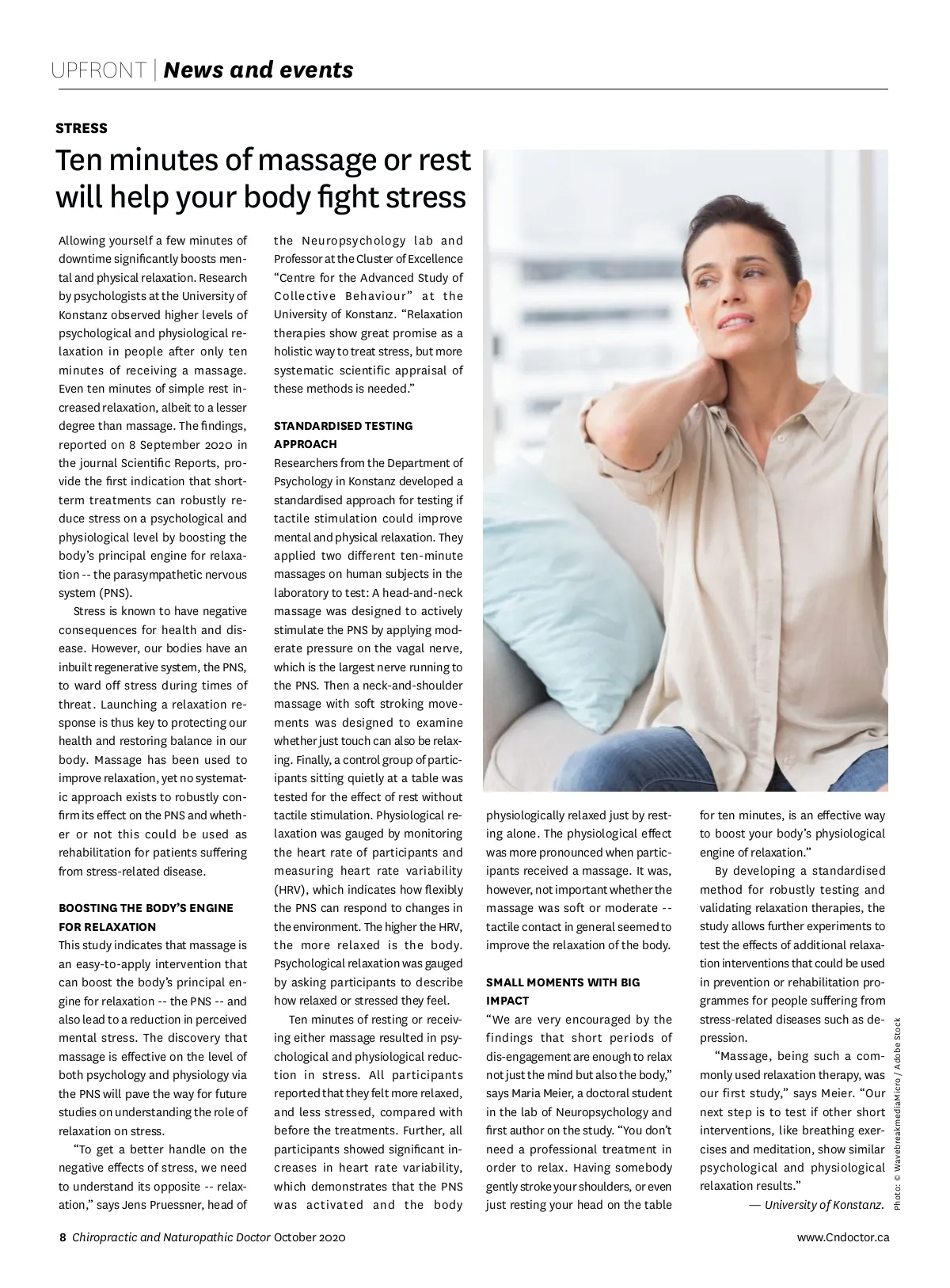
UPFRONT | News and events STRESS Ten minutes of massage or rest will help your body fight stress Allowing yourself a few minutes of downtime significantly boosts men-tal and physical relaxation. Research by psychologists at the University of Konstanz observed higher levels of psychological and physiological re-laxation in people after only ten minutes of receiving a massage. Even ten minutes of simple rest in-creased relaxation, albeit to a lesser degree than massage. The findings, reported on 8 September 2020 in the journal Scientific Reports, pro-vide the first indication that short-term treatments can robustly re-duce stress on a psychological and physiological level by boosting the body’s principal engine for relaxa-tion --the parasympathetic nervous system (PNS). Stress is known to have negative consequences for health and dis-ease. However, our bodies have an inbuilt regenerative system, the PNS, to ward off stress during times of threat. Launching a relaxation re-sponse is thus key to protecting our health and restoring balance in our body. Massage has been used to improve relaxation, yet no systemat-ic approach exists to robustly con-firm its effect on the PNS and wheth-er or not this could be used as rehabilitation for patients suffering from stress-related disease. BOOSTING THE BODY’S ENGINE FOR RELAXATION This study indicates that massage is an easy-to-apply intervention that can boost the body’s principal en-gine for relaxation --the PNS --and also lead to a reduction in perceived mental stress. The discovery that massage is effective on the level of both psychology and physiology via the PNS will pave the way for future studies on understanding the role of relaxation on stress. “To get a better handle on the negative effects of stress, we need to understand its opposite --relax-ation,” says Jens Pruessner, head of the Neuropsychology lab and Professor at the Cluster of Excellence “Centre for the Advanced Study of Collective Behaviour” at the University of Konstanz. “Relaxation therapies show great promise as a holistic way to treat stress, but more systematic scientific appraisal of these methods is needed.” STANDARDISED TESTING APPROACH Researchers from the Department of Psychology in Konstanz developed a standardised approach for testing if tactile stimulation could improve mental and physical relaxation. They applied two different ten-minute massages on human subjects in the laboratory to test: A head-and-neck massage was designed to actively stimulate the PNS by applying mod-erate pressure on the vagal nerve, which is the largest nerve running to the PNS. Then a neck-and-shoulder massage with soft stroking move-ments was designed to examine whether just touch can also be relax-ing. Finally, a control group of partic-ipants sitting quietly at a table was tested for the effect of rest without tactile stimulation. Physiological re-laxation was gauged by monitoring the heart rate of participants and measuring heart rate variability (HRV), which indicates how flexibly the PNS can respond to changes in the environment. The higher the HRV, the more relaxed is the body. Psychological relaxation was gauged by asking participants to describe how relaxed or stressed they feel. Ten minutes of resting or receiv-ing either massage resulted in psy-chological and physiological reduc-tion in stress. All participants reported that they felt more relaxed, and less stressed, compared with before the treatments. Further, all participants showed significant in-creases in heart rate variability, which demonstrates that the PNS was activated and the body physiologically relaxed just by rest-ing alone. The physiological effect was more pronounced when partic-ipants received a massage. It was, however, not important whether the massage was soft or moderate --tactile contact in general seemed to improve the relaxation of the body. SMALL MOMENTS WITH BIG IMPACT “We are very encouraged by the findings that short periods of dis-engagement are enough to relax not just the mind but also the body,” says Maria Meier, a doctoral student in the lab of Neuropsychology and first author on the study. “You don’t need a professional treatment in order to relax. Having somebody gently stroke your shoulders, or even just resting your head on the table for ten minutes, is an effective way to boost your body’s physiological engine of relaxation.” By developing a standardised method for robustly testing and validating relaxation therapies, the study allows further experiments to test the effects of additional relaxa-tion interventions that could be used in prevention or rehabilitation pro-grammes for people suffering from stress-related diseases such as de-pression. “Massage, being such a com-monly used relaxation therapy, was our first study,” says Meier. “Our next step is to test if other short interventions, like breathing exer-cises and meditation, show similar psychological and physiological relaxation results.” — University of Konstanz. www.Cndoctor.ca 8 Chiropractic and Naturopathic Doctor October 2020 Photo: © WavebreakmediaMicro / Adobe Stock
Chiropractic + Naturopathic Doctor October 2020: Page 8