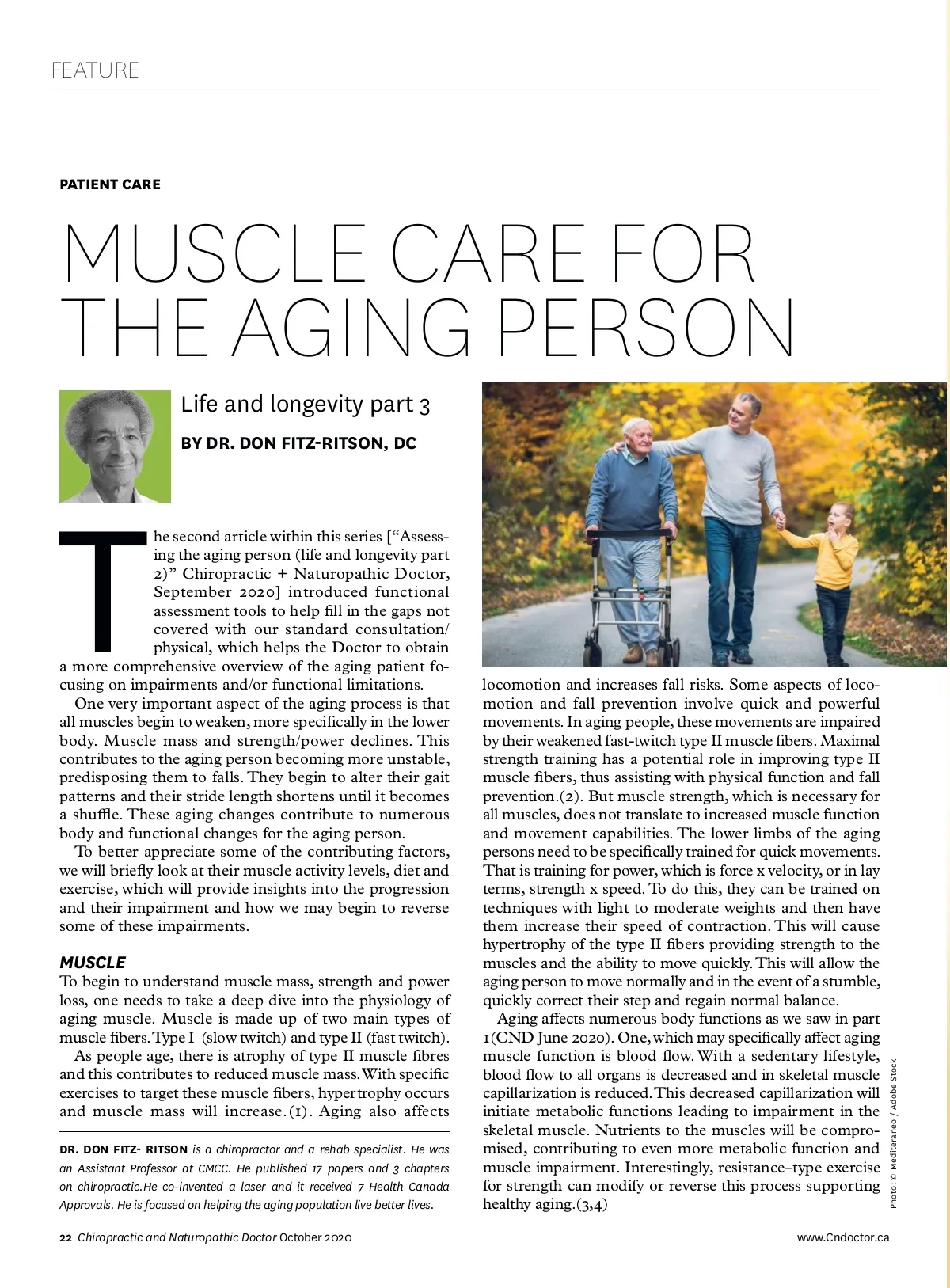
FEATURE PATIENT CARE MUSCLE CARE FOR THE AGING PERSON Life and longevity part 3 BY DR. DON FITZ-RITSON, DC T MUSCLE he second article within this series [“Assess-ing the aging person (life and longevity part 2)” Chiropractic + Naturopathic Doctor, September 2020] introduced functional assessment tools to help fill in the gaps not covered with our standard consultation/ physical, which helps the Doctor to obtain a more comprehensive overview of the aging patient fo-cusing on impairments and/or functional limitations. One very important aspect of the aging process is that all muscles begin to weaken, more specifically in the lower body. Muscle mass and strength/power declines. This contributes to the aging person becoming more unstable, predisposing them to falls. They begin to alter their gait patterns and their stride length shortens until it becomes a shuffle. These aging changes contribute to numerous body and functional changes for the aging person. To better appreciate some of the contributing factors, we will briefly look at their muscle activity levels, diet and exercise, which will provide insights into the progression and their impairment and how we may begin to reverse some of these impairments. To begin to understand muscle mass, strength and power loss, one needs to take a deep dive into the physiology of aging muscle. Muscle is made up of two main types of muscle fibers. Type I (slow twitch) and type II (fast twitch). As people age, there is atrophy of type II muscle fibres and this contributes to reduced muscle mass. With specific exercises to target these muscle fibers, hypertrophy occurs and muscle mass will increase.(1). Aging also affects DR. DON FITZ-RITSON is a chiropractor and a rehab specialist. He was an Assistant Professor at CMCC. He published 17 papers and 3 chapters on chiropractic.He co-invented a laser and it received 7 Health Canada Approvals. He is focused on helping the aging population live better lives. 22 Chiropractic and Naturopathic Doctor October 2020 locomotion and increases fall risks. Some aspects of loco-motion and fall prevention involve quick and powerful movements. In aging people, these movements are impaired by their weakened fast-twitch type II muscle fibers. Maximal strength training has a potential role in improving type II muscle fibers, thus assisting with physical function and fall prevention.(2). But muscle strength, which is necessary for all muscles, does not translate to increased muscle function and movement capabilities. The lower limbs of the aging persons need to be specifically trained for quick movements. That is training for power, which is force x velocity, or in lay terms, strength x speed. To do this, they can be trained on techniques with light to moderate weights and then have them increase their speed of contraction. This will cause hypertrophy of the type II fibers providing strength to the muscles and the ability to move quickly. This will allow the aging person to move normally and in the event of a stumble, quickly correct their step and regain normal balance. Aging affects numerous body functions as we saw in part 1(CND June 2020). One, which may specifically affect aging muscle function is blood flow. With a sedentary lifestyle, blood flow to all organs is decreased and in skeletal muscle capillarization is reduced. This decreased capillarization will initiate metabolic functions leading to impairment in the skeletal muscle. Nutrients to the muscles will be compro-mised, contributing to even more metabolic function and muscle impairment. Interestingly, resistance–type exercise for strength can modify or reverse this process supporting healthy aging.(3,4) www.Cndoctor.ca Photo: © Mediteraneo / Adobe Stock
Chiropractic + Naturopathic Doctor October 2020: Page 22