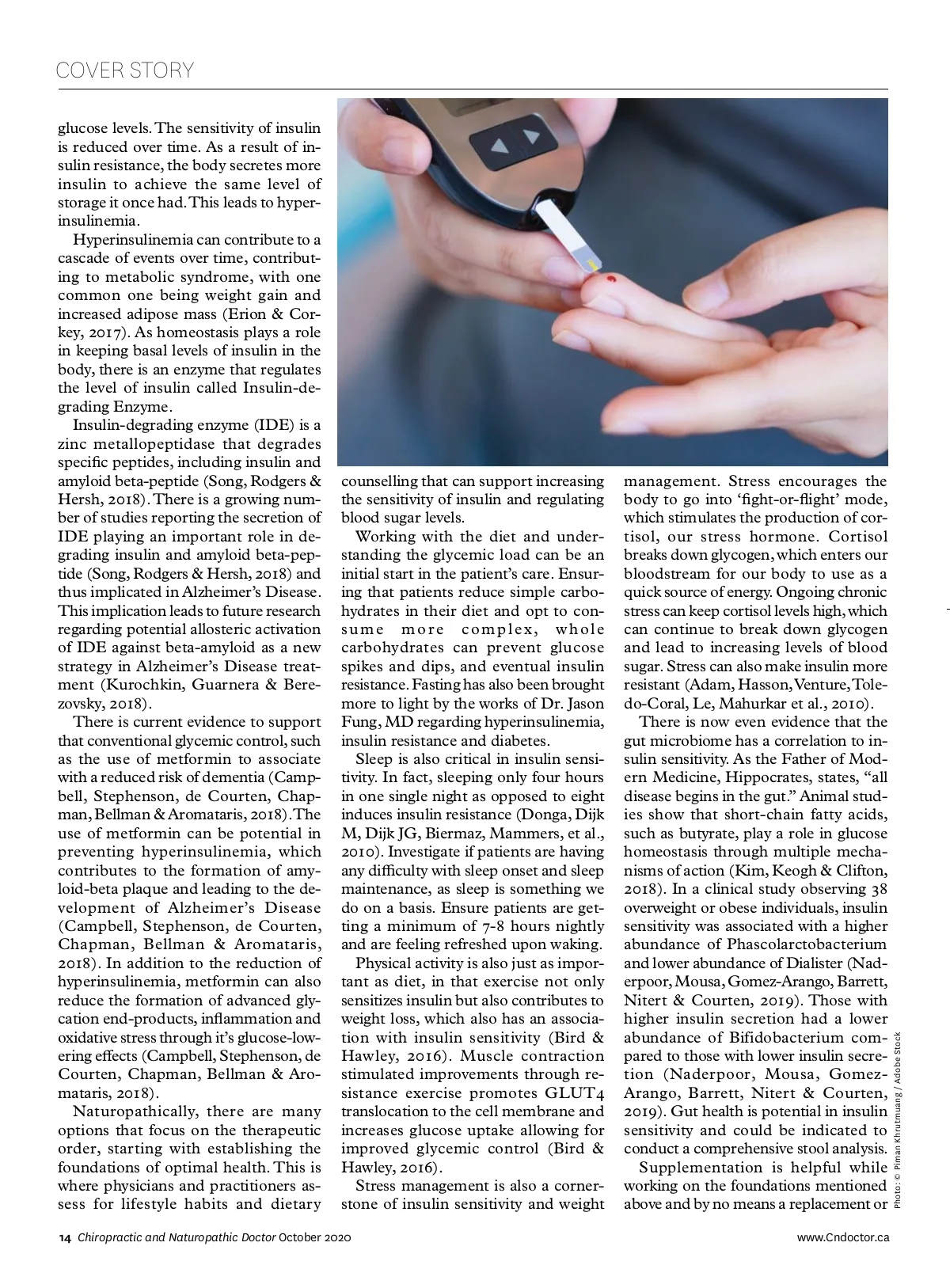
COVER STORY glucose levels. The sensitivity of insulin is reduced over time. As a result of in-sulin resistance, the body secretes more insulin to achieve the same level of storage it once had. This leads to hyper-insulinemia. Hyperinsulinemia can contribute to a cascade of events over time, contribut-ing to metabolic syndrome, with one common one being weight gain and increased adipose mass (Erion & Cor-key, 2017). As homeostasis plays a role in keeping basal levels of insulin in the body, there is an enzyme that regulates the level of insulin called Insulin-de-grading Enzyme. Insulin-degrading enzyme (IDE) is a zinc metallopeptidase that degrades specific peptides, including insulin and amyloid beta-peptide (Song, Rodgers & Hersh, 2018). There is a growing num-ber of studies reporting the secretion of IDE playing an important role in de-grading insulin and amyloid beta-pep-tide (Song, Rodgers & Hersh, 2018) and thus implicated in Alzheimer’s Disease. This implication leads to future research regarding potential allosteric activation of IDE against beta-amyloid as a new strategy in Alzheimer’s Disease treat-ment (Kurochkin, Guarnera & Bere-zovsky, 2018). There is current evidence to support that conventional glycemic control, such as the use of metformin to associate with a reduced risk of dementia (Camp-bell, Stephenson, de Courten, Chap-man, Bellman & Aromataris, 2018). The use of metformin can be potential in preventing hyperinsulinemia, which contributes to the formation of amy-loid-beta plaque and leading to the de-velopment of Alzheimer’s Disease (Campbell, Stephenson, de Courten, Chapman, Bellman & Aromataris, 2018). In addition to the reduction of hyperinsulinemia, metformin can also reduce the formation of advanced gly-cation end-products, inflammation and oxidative stress through it’s glucose-low-ering effects (Campbell, Stephenson, de Courten, Chapman, Bellman & Aro-mataris, 2018). Naturopathically, there are many options that focus on the therapeutic order, starting with establishing the foundations of optimal health. This is where physicians and practitioners as-sess for lifestyle habits and dietary counselling that can support increasing the sensitivity of insulin and regulating blood sugar levels. Working with the diet and under-standing the glycemic load can be an initial start in the patient’s care. Ensur-ing that patients reduce simple carbo-hydrates in their diet and opt to con-sume more complex, whole carbohydrates can prevent glucose spikes and dips, and eventual insulin resistance. Fasting has also been brought more to light by the works of Dr. Jason Fung, MD regarding hyperinsulinemia, insulin resistance and diabetes. Sleep is also critical in insulin sensi-tivity. In fact, sleeping only four hours in one single night as opposed to eight induces insulin resistance (Donga, Dijk M, Dijk JG, Biermaz, Mammers, et al., 2010). Investigate if patients are having any difficulty with sleep onset and sleep maintenance, as sleep is something we do on a basis. Ensure patients are get-ting a minimum of 7-8 hours nightly and are feeling refreshed upon waking. Physical activity is also just as impor-tant as diet, in that exercise not only sensitizes insulin but also contributes to weight loss, which also has an associa-tion with insulin sensitivity (Bird & Hawley, 2016). Muscle contraction stimulated improvements through re-sistance exercise promotes GLUT4 translocation to the cell membrane and increases glucose uptake allowing for improved glycemic control (Bird & Hawley, 2016). Stress management is also a corner-stone of insulin sensitivity and weight management. Stress encourages the body to go into ‘fight-or-flight’ mode, which stimulates the production of cor-tisol, our stress hormone. Cortisol breaks down glycogen, which enters our bloodstream for our body to use as a quick source of energy. Ongoing chronic stress can keep cortisol levels high, which can continue to break down glycogen and lead to increasing levels of blood sugar. Stress can also make insulin more resistant (Adam, Hasson, Venture, Tole-do-Coral, Le, Mahurkar et al., 2010). There is now even evidence that the gut microbiome has a correlation to in-sulin sensitivity. As the Father of Mod-ern Medicine, Hippocrates, states, “all disease begins in the gut.” Animal stud-ies show that short-chain fatty acids, such as butyrate, play a role in glucose homeostasis through multiple mecha-nisms of action (Kim, Keogh & Clifton, 2018). In a clinical study observing 38 overweight or obese individuals, insulin sensitivity was associated with a higher abundance of Phascolarctobacterium and lower abundance of Dialister (Nad-erpoor, Mousa, Gomez-Arango, Barrett, Nitert & Courten, 2019). Those with higher insulin secretion had a lower abundance of Bifidobacterium com-pared to those with lower insulin secre-tion (Naderpoor, Mousa, Gomez-Arango, Barrett, Nitert & Courten, 2019). Gut health is potential in insulin sensitivity and could be indicated to conduct a comprehensive stool analysis. Supplementation is helpful while working on the foundations mentioned above and by no means a replacement or www.Cndoctor.ca 14 Chiropractic and Naturopathic Doctor October 2020 Photo: © Piman Khrutmuang / Adobe Stock
Chiropractic + Naturopathic Doctor October 2020: Page 14