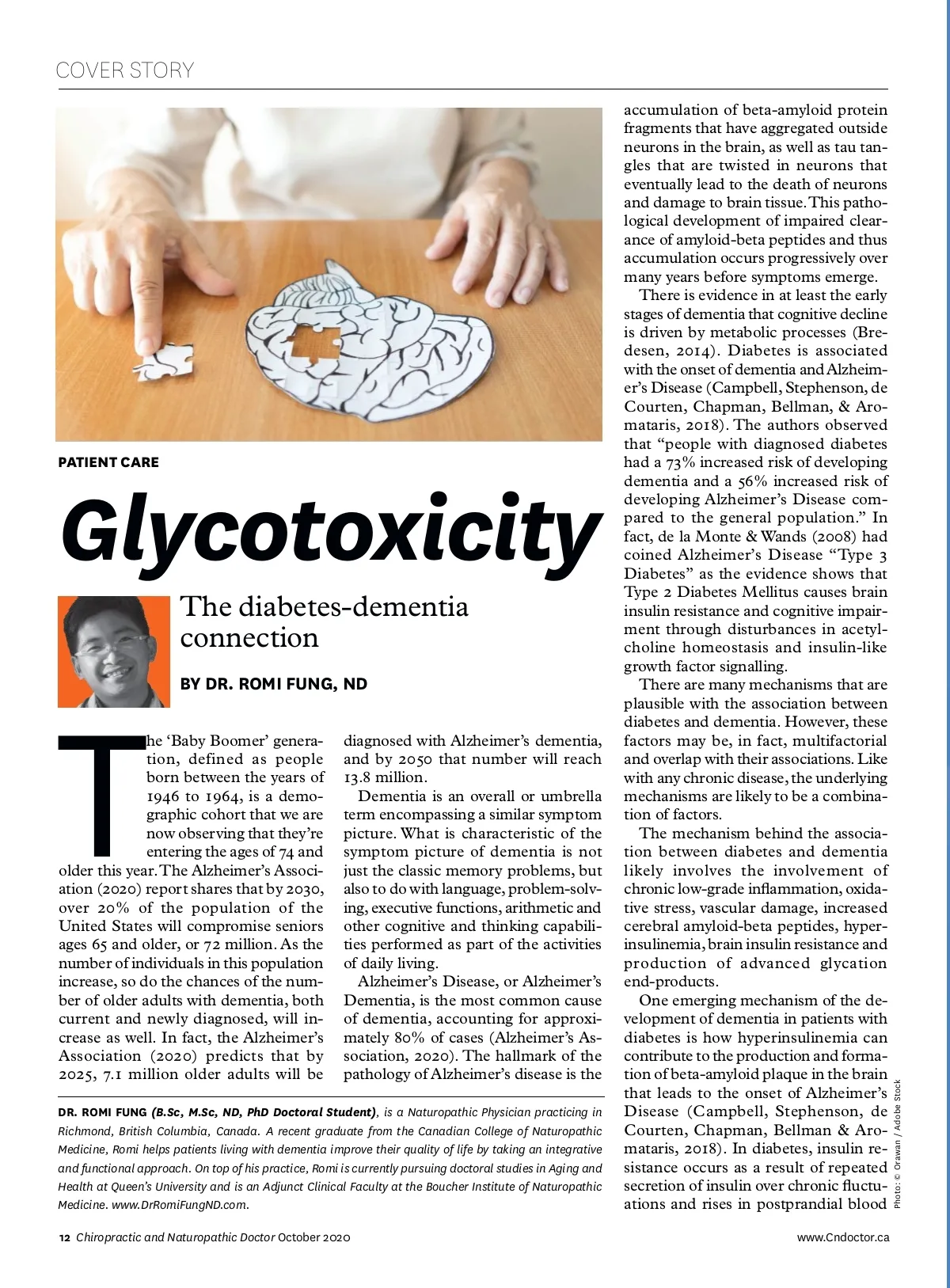
COVER STORY accumulation of beta-amyloid protein fragments that have aggregated outside neurons in the brain, as well as tau tan-gles that are twisted in neurons that eventually lead to the death of neurons and damage to brain tissue. This patho-logical development of impaired clear-ance of amyloid-beta peptides and thus accumulation occurs progressively over many years before symptoms emerge. There is evidence in at least the early stages of dementia that cognitive decline is driven by metabolic processes (Bre-desen, 2014). Diabetes is associated with the onset of dementia and Alzheim-er’s Disease (Campbell, Stephenson, de Courten, Chapman, Bellman, & Aro-mataris, 2018). The authors observed that “people with diagnosed diabetes had a 73% increased risk of developing dementia and a 56% increased risk of developing Alzheimer’s Disease com-pared to the general population.” In fact, de la Monte & Wands (2008) had coined Alzheimer’s Disease “Type 3 Diabetes” as the evidence shows that Type 2 Diabetes Mellitus causes brain insulin resistance and cognitive impair-ment through disturbances in acetyl-choline homeostasis and insulin-like growth factor signalling. There are many mechanisms that are plausible with the association between diabetes and dementia. However, these factors may be, in fact, multifactorial and overlap with their associations. Like with any chronic disease, the underlying mechanisms are likely to be a combina-tion of factors. The mechanism behind the associa-tion between diabetes and dementia likely involves the involvement of chronic low-grade inflammation, oxida-tive stress, vascular damage, increased cerebral amyloid-beta peptides, hyper-insulinemia, brain insulin resistance and production of advanced glycation end-products. One emerging mechanism of the de-velopment of dementia in patients with diabetes is how hyperinsulinemia can contribute to the production and forma-tion of beta-amyloid plaque in the brain that leads to the onset of Alzheimer’s Disease (Campbell, Stephenson, de Courten, Chapman, Bellman & Aro-mataris, 2018). In diabetes, insulin re-sistance occurs as a result of repeated secretion of insulin over chronic fluctu-ations and rises in postprandial blood www.Cndoctor.ca PATIENT CARE Glycotoxicity The diabetes-dementia connection T BY DR. ROMI FUNG, ND diagnosed with Alzheimer’s dementia, and by 2050 that number will reach 13.8 million. Dementia is an overall or umbrella term encompassing a similar symptom picture. What is characteristic of the symptom picture of dementia is not just the classic memory problems, but also to do with language, problem-solv-ing, executive functions, arithmetic and other cognitive and thinking capabili-ties performed as part of the activities of daily living. Alzheimer’s Disease, or Alzheimer’s Dementia, is the most common cause of dementia, accounting for approxi-mately 80% of cases (Alzheimer’s As-sociation, 2020). The hallmark of the pathology of Alzheimer’s disease is the DR. ROMI FUNG (B.Sc, M.Sc, ND, PhD Doctoral Student) , is a Naturopathic Physician practicing in Richmond, British Columbia, Canada. A recent graduate from the Canadian College of Naturopathic Medicine, Romi helps patients living with dementia improve their quality of life by taking an integrative and functional approach. On top of his practice, Romi is currently pursuing doctoral studies in Aging and Health at Queen’s University and is an Adjunct Clinical Faculty at the Boucher Institute of Naturopathic Medicine. www.DrRomiFungND.com. 12 Chiropractic and Naturopathic Doctor October 2020 Photo: © Orawan / Adobe Stock he ‘Baby Boomer’ genera-tion, defined as people born between the years of 1946 to 1964, is a demo-graphic cohort that we are now observing that they’re entering the ages of 74 and older this year. The Alzheimer’s Associ-ation (2020) report shares that by 2030, over 20% of the population of the United States will compromise seniors ages 65 and older, or 72 million. As the number of individuals in this population increase, so do the chances of the num-ber of older adults with dementia, both current and newly diagnosed, will in-crease as well. In fact, the Alzheimer’s Association (2020) predicts that by 2025, 7.1 million older adults will be
Chiropractic + Naturopathic Doctor October 2020: Page 12