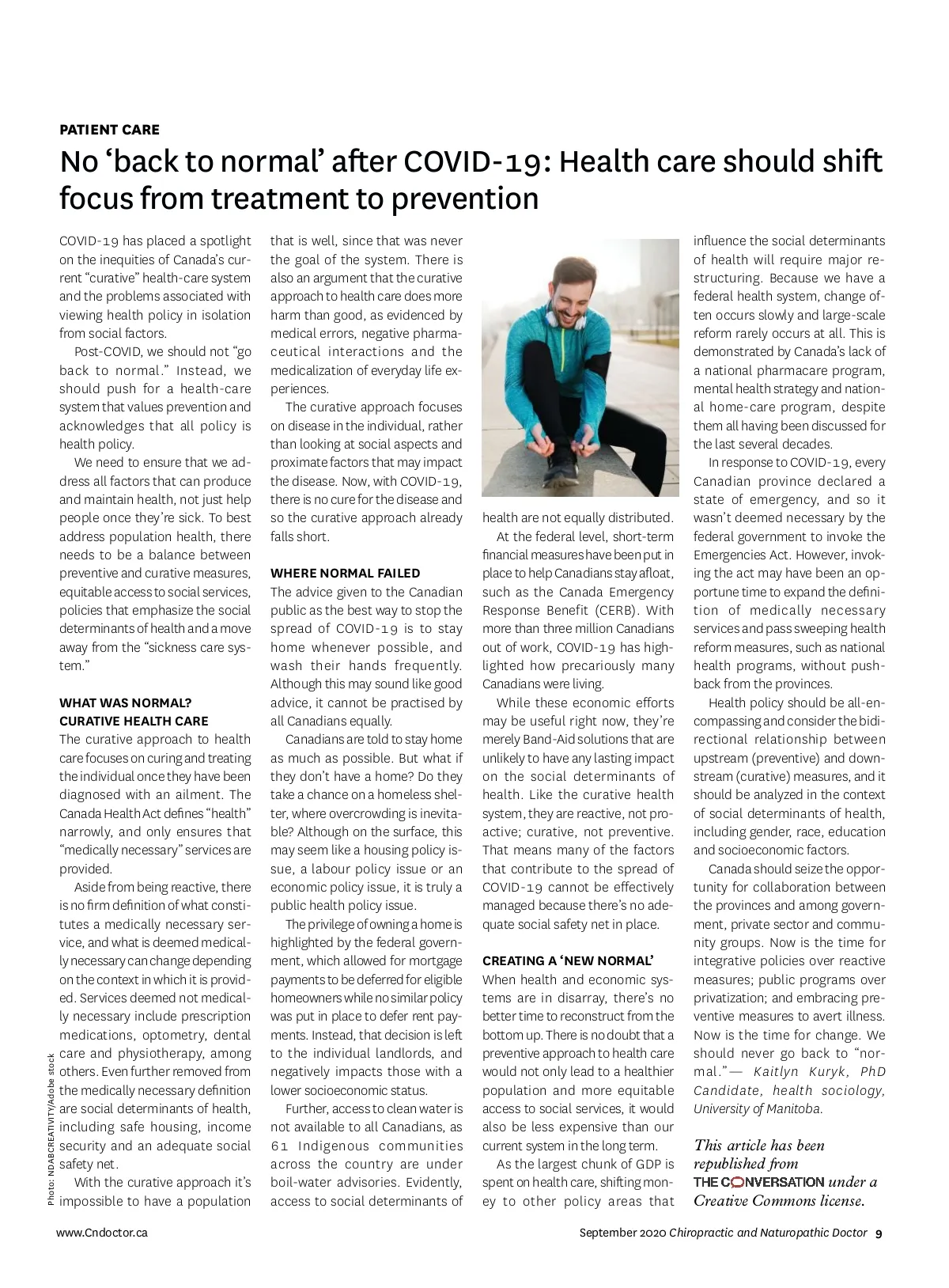
PATIENT CARE No ‘back to normal’ after COVID-19: Health care should shift focus from treatment to prevention COVID-19 has placed a spotlight on the inequities of Canada’s cur-rent “curative” health-care system and the problems associated with viewing health policy in isolation from social factors. Post-COVID, we should not “go back to normal.” Instead, we should push for a health-care system that values prevention and acknowledges that all policy is health policy. We need to ensure that we ad-dress all factors that can produce and maintain health, not just help people once they’re sick. To best address population health, there needs to be a balance between preventive and curative measures, equitable access to social services, policies that emphasize the social determinants of health and a move away from the “sickness care sys-tem.” WHAT WAS NORMAL? CURATIVE HEALTH CARE The curative approach to health care focuses on curing and treating the individual once they have been diagnosed with an ailment. The Canada Health Act defines “health” narrowly, and only ensures that “medically necessary” services are provided. Aside from being reactive, there is no firm definition of what consti-tutes a medically necessary ser-vice, and what is deemed medical-ly necessary can change depending on the context in which it is provid-ed. Services deemed not medical-ly necessary include prescription medications, optometry, dental care and physiotherapy, among others. Even further removed from the medically necessary definition are social determinants of health, including safe housing, income security and an adequate social safety net. With the curative approach it’s impossible to have a population www.Cndoctor.ca that is well, since that was never the goal of the system. There is also an argument that the curative approach to health care does more harm than good, as evidenced by medical errors, negative pharma-ceutical interactions and the medicalization of everyday life ex-periences. The curative approach focuses on disease in the individual, rather than looking at social aspects and proximate factors that may impact the disease. Now, with COVID-19, there is no cure for the disease and so the curative approach already falls short. WHERE NORMAL FAILED The advice given to the Canadian public as the best way to stop the spread of COVID-19 is to stay home whenever possible, and wash their hands frequently. Although this may sound like good advice, it cannot be practised by all Canadians equally. Canadians are told to stay home as much as possible. But what if they don’t have a home? Do they take a chance on a homeless shel-ter, where overcrowding is inevita-ble? Although on the surface, this may seem like a housing policy is-sue, a labour policy issue or an economic policy issue, it is truly a public health policy issue. The privilege of owning a home is highlighted by the federal govern-ment, which allowed for mortgage payments to be deferred for eligible homeowners while no similar policy was put in place to defer rent pay-ments. Instead, that decision is left to the individual landlords, and negatively impacts those with a lower socioeconomic status. Further, access to clean water is not available to all Canadians, as 61 Indigenous communities across the country are under boil-water advisories. Evidently, access to social determinants of health are not equally distributed. At the federal level, short-term financial measures have been put in place to help Canadians stay afloat, such as the Canada Emergency Response Benefit (CERB). With more than three million Canadians out of work, COVID-19 has high-lighted how precariously many Canadians were living. While these economic efforts may be useful right now, they’re merely Band-Aid solutions that are unlikely to have any lasting impact on the social determinants of health. Like the curative health system, they are reactive, not pro-active; curative, not preventive. That means many of the factors that contribute to the spread of COVID-19 cannot be effectively managed because there’s no ade-quate social safety net in place. CREATING A ‘NEW NORMAL’ When health and economic sys-tems are in disarray, there’s no better time to reconstruct from the bottom up. There is no doubt that a preventive approach to health care would not only lead to a healthier population and more equitable access to social services, it would also be less expensive than our current system in the long term. As the largest chunk of GDP is spent on health care, shifting mon-ey to other policy areas that Photo: NDABCREATIVITY/Adobe stock influence the social determinants of health will require major re-structuring. Because we have a federal health system, change of-ten occurs slowly and large-scale reform rarely occurs at all. This is demonstrated by Canada’s lack of a national pharmacare program, mental health strategy and nation-al home-care program, despite them all having been discussed for the last several decades. In response to COVID-19, every Canadian province declared a state of emergency, and so it wasn’t deemed necessary by the federal government to invoke the Emergencies Act. However, invok-ing the act may have been an op-portune time to expand the defini-tion of medically necessary services and pass sweeping health reform measures, such as national health programs, without push-back from the provinces. Health policy should be all-en-compassing and consider the bidi-rectional relationship between upstream (preventive) and down-stream (curative) measures, and it should be analyzed in the context of social determinants of health, including gender, race, education and socioeconomic factors. Canada should seize the oppor-tunity for collaboration between the provinces and among govern-ment, private sector and commu-nity groups. Now is the time for integrative policies over reactive measures; public programs over privatization; and embracing pre-ventive measures to avert illness. Now is the time for change. We should never go back to “nor-mal.”— Kaitlyn Kuryk, PhD Candidate, health sociology, University of Manitoba. This article has been republished from under a Creative Commons license. September 2020 Chiropractic and Naturopathic Doctor 9
Chiropractic + Naturopathic Doctor September 2020: Page 9