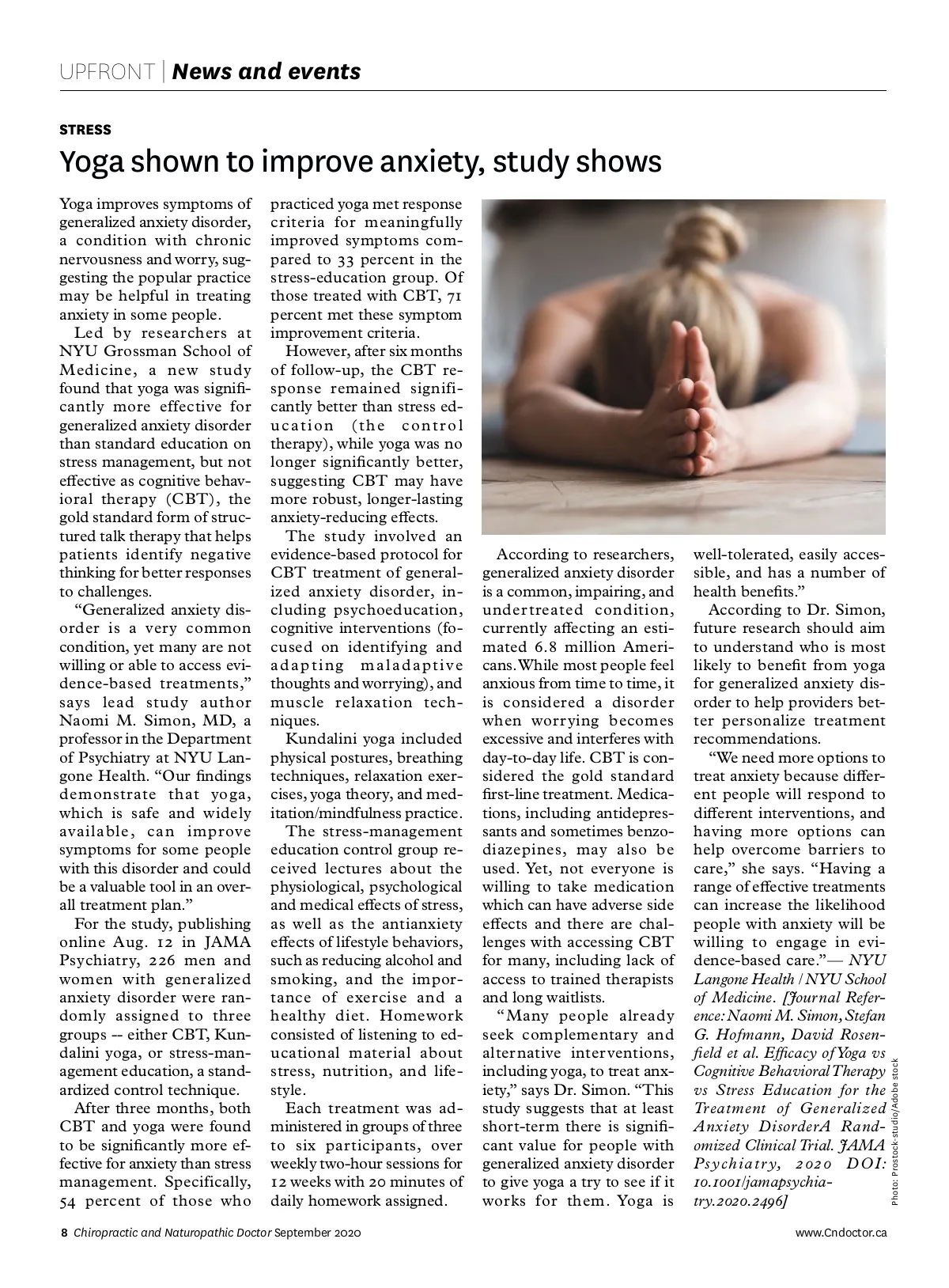
UPFRONT | News and events STRESS Yoga shown to improve anxiety, study shows Yoga improves symptoms of generalized anxiety disorder, a condition with chronic nervousness and worry, sug-gesting the popular practice may be helpful in treating anxiety in some people. Led by researchers at NYU Grossman School of Medicine, a new study found that yoga was signifi-cantly more effective for generalized anxiety disorder than standard education on stress management, but not effective as cognitive behav-ioral therapy (CBT), the gold standard form of struc-tured talk therapy that helps patients identify negative thinking for better responses to challenges. “Generalized anxiety dis-order is a very common condition, yet many are not willing or able to access evi-dence-based treatments,” says lead study author Naomi M. Simon, MD, a professor in the Department of Psychiatry at NYU Lan-gone Health. “Our findings demonstrate that yoga, which is safe and widely available, can improve symptoms for some people with this disorder and could be a valuable tool in an over-all treatment plan.” For the study, publishing online Aug. 12 in JAMA Psychiatry, 226 men and women with generalized anxiety disorder were ran-domly assigned to three groups --either CBT, Kun-dalini yoga, or stress-man-agement education, a stand-ardized control technique. After three months, both CBT and yoga were found to be significantly more ef-fective for anxiety than stress management. Specifically, 54 percent of those who practiced yoga met response criteria for meaningfully improved symptoms com-pared to 33 percent in the stress-education group. Of those treated with CBT, 71 percent met these symptom improvement criteria. However, after six months of follow-up, the CBT re-sponse remained signifi-cantly better than stress ed-ucation (the control therapy), while yoga was no longer significantly better, suggesting CBT may have more robust, longer-lasting anxiety-reducing effects. The study involved an evidence-based protocol for CBT treatment of general-ized anxiety disorder, in-cluding psychoeducation, cognitive interventions (fo-cused on identifying and adapting maladaptive thoughts and worrying), and muscle relaxation tech-niques. Kundalini yoga included physical postures, breathing techniques, relaxation exer-cises, yoga theory, and med-itation/mindfulness practice. The stress-management education control group re-ceived lectures about the physiological, psychological and medical effects of stress, as well as the antianxiety effects of lifestyle behaviors, such as reducing alcohol and smoking, and the impor-tance of exercise and a healthy diet. Homework consisted of listening to ed-ucational material about stress, nutrition, and life-style. Each treatment was ad-ministered in groups of three to six participants, over weekly two-hour sessions for 12 weeks with 20 minutes of daily homework assigned. According to researchers, generalized anxiety disorder is a common, impairing, and undertreated condition, currently affecting an esti-mated 6.8 million Ameri-cans. While most people feel anxious from time to time, it is considered a disorder when worrying becomes excessive and interferes with day-to-day life. CBT is con-sidered the gold standard first-line treatment. Medica-tions, including antidepres-sants and sometimes benzo-diazepines, may also be used. Yet, not everyone is willing to take medication which can have adverse side effects and there are chal-lenges with accessing CBT for many, including lack of access to trained therapists and long waitlists. “Many people already seek complementary and alternative interventions, including yoga, to treat anx-iety,” says Dr. Simon. “This study suggests that at least short-term there is signifi-cant value for people with generalized anxiety disorder to give yoga a try to see if it works for them. Yoga is well-tolerated, easily acces-sible, and has a number of health benefits.” According to Dr. Simon, future research should aim to understand who is most likely to benefit from yoga for generalized anxiety dis-order to help providers bet-ter personalize treatment recommendations. “We need more options to treat anxiety because differ-ent people will respond to different interventions, and having more options can help overcome barriers to care,” she says. “Having a range of effective treatments can increase the likelihood people with anxiety will be willing to engage in evi-dence-based care.”— NYU Langone Health / NYU School of Medicine. [Journal Refer-ence: Naomi M. Simon, Stefan G. Hofmann, David Rosen-field et al. Efficacy of Yoga vs Cognitive Behavioral Therapy vs Stress Education for the Treatment of Generalized Anxiety DisorderA Rand-omized Clinical Trial. JAMA Psychiatry, 2020 DOI: 10.1001/jamapsychia-try.2020.2496] www.Cndoctor.ca 8 Chiropractic and Naturopathic Doctor September 2020 Photo: Prostock-studio/Adobe stock
Chiropractic + Naturopathic Doctor September 2020: Page 8