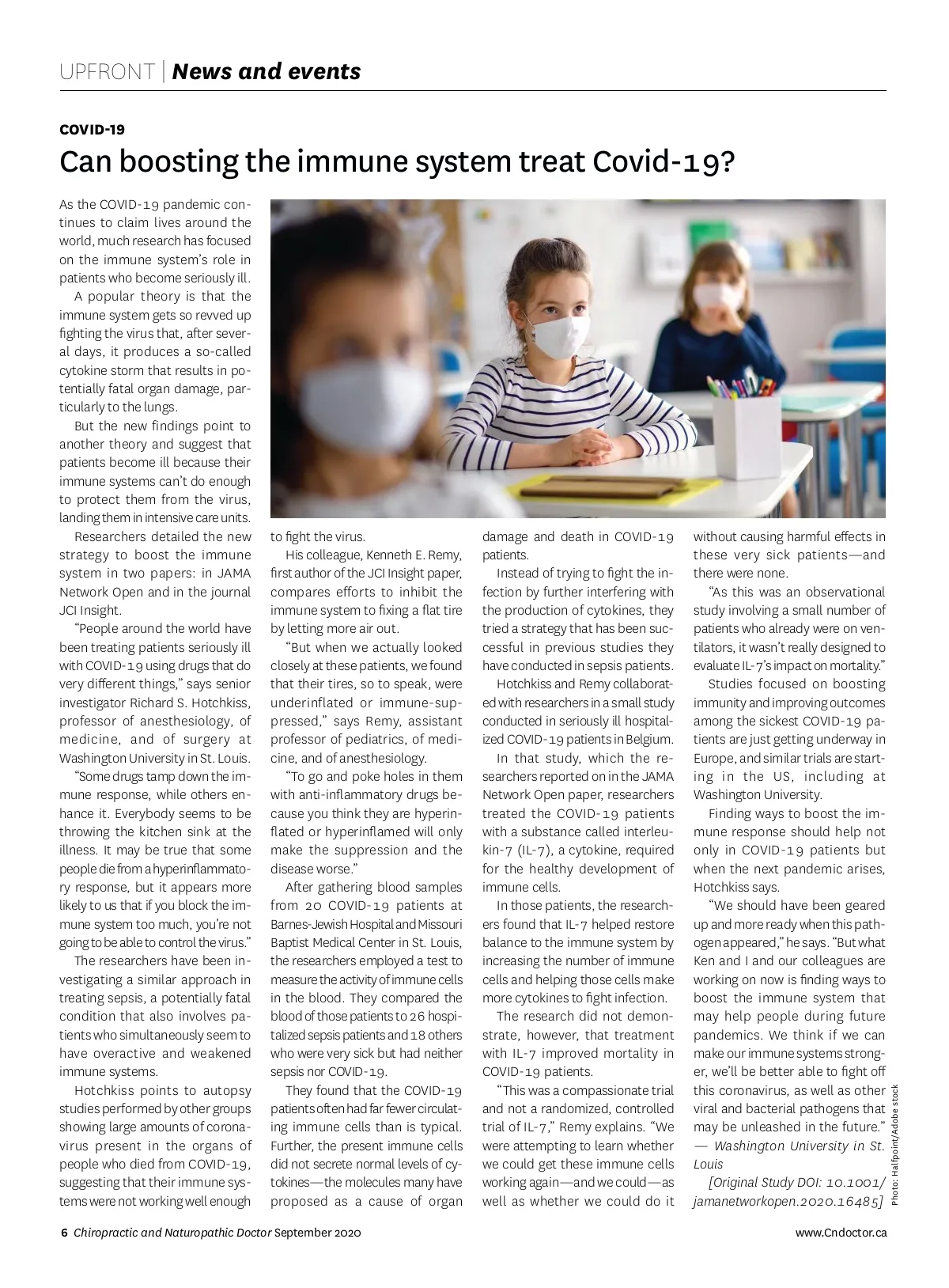
UPFRONT | News and events COVID-19 Can boosting the immune system treat Covid-19? As the COVID-19 pandemic con-tinues to claim lives around the world, much research has focused on the immune system’s role in patients who become seriously ill. A popular theory is that the immune system gets so revved up fighting the virus that, after sever-al days, it produces a so-called cytokine storm that results in po-tentially fatal organ damage, par-ticularly to the lungs. But the new findings point to another theory and suggest that patients become ill because their immune systems can’t do enough to protect them from the virus, landing them in intensive care units. Researchers detailed the new strategy to boost the immune system in two papers: in JAMA Network Open and in the journal JCI Insight. “People around the world have been treating patients seriously ill with COVID-19 using drugs that do very different things,” says senior investigator Richard S. Hotchkiss, professor of anesthesiology, of medicine, and of surgery at Washington University in St. Louis. “Some drugs tamp down the im-mune response, while others en-hance it. Everybody seems to be throwing the kitchen sink at the illness. It may be true that some people die from a hyperinflammato-ry response, but it appears more likely to us that if you block the im-mune system too much, you’re not going to be able to control the virus.” The researchers have been in-vestigating a similar approach in treating sepsis, a potentially fatal condition that also involves pa-tients who simultaneously seem to have overactive and weakened immune systems. Hotchkiss points to autopsy studies performed by other groups showing large amounts of corona-virus present in the organs of people who died from COVID-19, suggesting that their immune sys-tems were not working well enough to fight the virus. His colleague, Kenneth E. Remy, first author of the JCI Insight paper, compares efforts to inhibit the immune system to fixing a flat tire by letting more air out. “But when we actually looked closely at these patients, we found that their tires, so to speak, were underinflated or immune-sup-pressed,” says Remy, assistant professor of pediatrics, of medi-cine, and of anesthesiology. “To go and poke holes in them with anti-inflammatory drugs be-cause you think they are hyperin-flated or hyperinflamed will only make the suppression and the disease worse.” After gathering blood samples from 20 COVID-19 patients at Barnes-Jewish Hospital and Missouri Baptist Medical Center in St. Louis, the researchers employed a test to measure the activity of immune cells in the blood. They compared the blood of those patients to 26 hospi-talized sepsis patients and 18 others who were very sick but had neither sepsis nor COVID-19. They found that the COVID-19 patients often had far fewer circulat-ing immune cells than is typical. Further, the present immune cells did not secrete normal levels of cy-tokines—the molecules many have proposed as a cause of organ damage and death in COVID-19 patients. Instead of trying to fight the in-fection by further interfering with the production of cytokines, they tried a strategy that has been suc-cessful in previous studies they have conducted in sepsis patients. Hotchkiss and Remy collaborat-ed with researchers in a small study conducted in seriously ill hospital-ized COVID-19 patients in Belgium. In that study, which the re-searchers reported on in the JAMA Network Open paper, researchers treated the COVID-19 patients with a substance called interleu-kin-7 (IL-7), a cytokine, required for the healthy development of immune cells. In those patients, the research-ers found that IL-7 helped restore balance to the immune system by increasing the number of immune cells and helping those cells make more cytokines to fight infection. The research did not demon-strate, however, that treatment with IL-7 improved mortality in COVID-19 patients. “This was a compassionate trial and not a randomized, controlled trial of IL-7,” Remy explains. “We were attempting to learn whether we could get these immune cells working again—and we could—as well as whether we could do it without causing harmful effects in these very sick patients—and there were none. “As this was an observational study involving a small number of patients who already were on ven-tilators, it wasn’t really designed to evaluate IL-7’s impact on mortality.” Studies focused on boosting immunity and improving outcomes among the sickest COVID-19 pa-tients are just getting underway in Europe, and similar trials are start-ing in the US, including at Washington University. Finding ways to boost the im-mune response should help not only in COVID-19 patients but when the next pandemic arises, Hotchkiss says. “We should have been geared up and more ready when this path-ogen appeared,” he says. “But what Ken and I and our colleagues are working on now is finding ways to boost the immune system that may help people during future pandemics. We think if we can make our immune systems strong-er, we’ll be better able to fight off this coronavirus, as well as other viral and bacterial pathogens that may be unleashed in the future.” — Washington University in St. Louis [Original Study DOI: 10.1001/ jamanetworkopen.2020.16485] www.Cndoctor.ca 6 Chiropractic and Naturopathic Doctor September 2020 Photo: Halfpoint/Adobe stock
Chiropractic + Naturopathic Doctor September 2020: Page 6