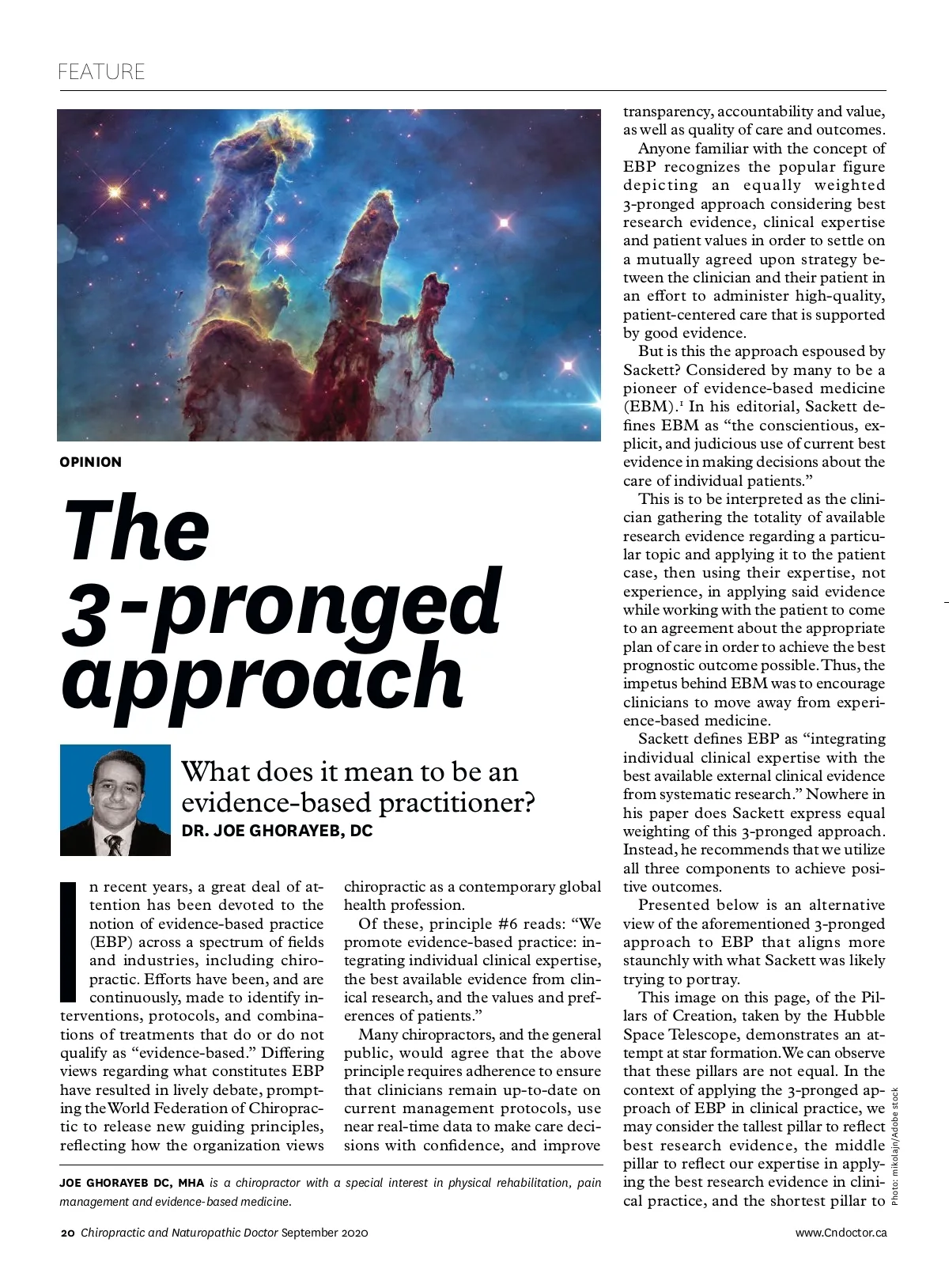
FEATURE transparency, accountability and value, as well as quality of care and outcomes. Anyone familiar with the concept of EBP recognizes the popular figure depicting an equally weighted 3-pronged approach considering best research evidence, clinical expertise and patient values in order to settle on a mutually agreed upon strategy be-tween the clinician and their patient in an effort to administer high-quality, patient-centered care that is supported by good evidence. But is this the approach espoused by Sackett? Considered by many to be a pioneer of evidence-based medicine (EBM). 1 In his editorial, Sackett de-fines EBM as “the conscientious, ex-plicit, and judicious use of current best evidence in making decisions about the care of individual patients.” This is to be interpreted as the clini-cian gathering the totality of available research evidence regarding a particu-lar topic and applying it to the patient case, then using their expertise, not experience, in applying said evidence while working with the patient to come to an agreement about the appropriate plan of care in order to achieve the best prognostic outcome possible. Thus, the impetus behind EBM was to encourage clinicians to move away from experi-ence-based medicine. Sackett defines EBP as “integrating individual clinical expertise with the best available external clinical evidence from systematic research.” Nowhere in his paper does Sackett express equal weighting of this 3-pronged approach. Instead, he recommends that we utilize all three components to achieve posi-tive outcomes. Presented below is an alternative view of the aforementioned 3-pronged approach to EBP that aligns more staunchly with what Sackett was likely trying to portray. This image on this page, of the Pil-lars of Creation, taken by the Hubble Space Telescope, demonstrates an at-tempt at star formation. We can observe that these pillars are not equal. In the context of applying the 3-pronged ap-proach of EBP in clinical practice, we may consider the tallest pillar to reflect best research evidence, the middle pillar to reflect our expertise in apply-ing the best research evidence in clini-cal practice, and the shortest pillar to www.Cndoctor.ca OPINION The 3-pronged approach I What does it mean to be an evidence-based practitioner? DR. JOE GHORAYEB, DC chiropractic as a contemporary global health profession. Of these, principle #6 reads: “We promote evidence-based practice: in-tegrating individual clinical expertise, the best available evidence from clin-ical research, and the values and pref-erences of patients.” Many chiropractors, and the general public, would agree that the above principle requires adherence to ensure that clinicians remain up-to-date on current management protocols, use near real-time data to make care deci-sions with confidence, and improve JOE GHORAYEB DC, MHA is a chiropractor with a special interest in physical rehabilitation, pain management and evidence-based medicine. 20 Chiropractic and Naturopathic Doctor September 2020 Photo: mikolajn/Adobe stock n recent years, a great deal of at-tention has been devoted to the notion of evidence-based practice (EBP) across a spectrum of fields and industries, including chiro-practic. Efforts have been, and are continuously, made to identify in-terventions, protocols, and combina-tions of treatments that do or do not qualify as “evidence-based.” Differing views regarding what constitutes EBP have resulted in lively debate, prompt-ing the World Federation of Chiroprac-tic to release new guiding principles, reflecting how the organization views
Chiropractic + Naturopathic Doctor September 2020: Page 20