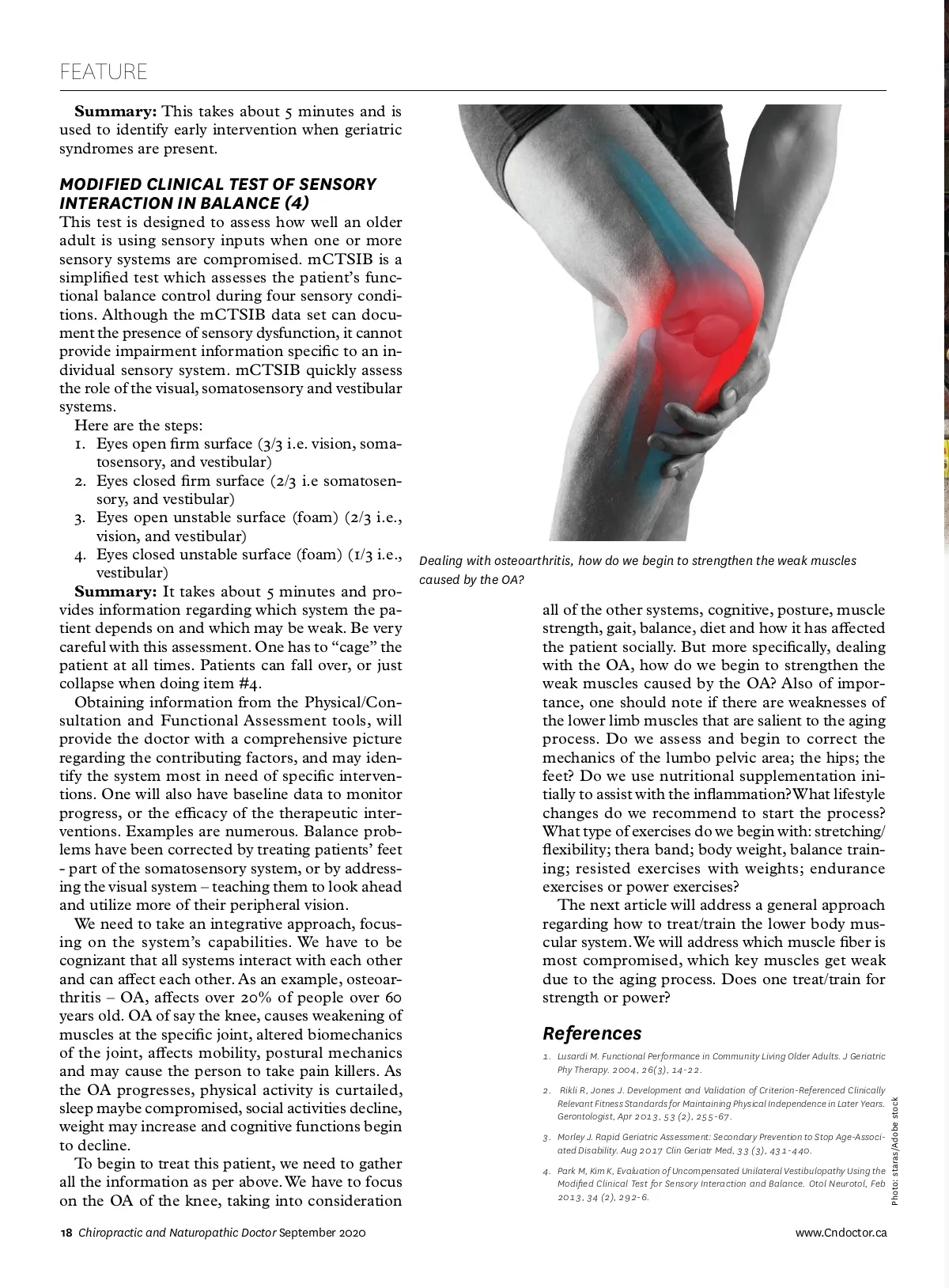
FEATURE Summary: This takes about 5 minutes and is used to identify early intervention when geriatric syndromes are present. This test is designed to assess how well an older adult is using sensory inputs when one or more sensory systems are compromised. mCTSIB is a simplified test which assesses the patient’s func-tional balance control during four sensory condi-tions. Although the mCTSIB data set can docu-ment the presence of sensory dysfunction, it cannot provide impairment information specific to an in-dividual sensory system. mCTSIB quickly assess the role of the visual, somatosensory and vestibular systems. Here are the steps: 1. Eyes open firm surface (3/3 i.e. vision, soma-tosensory, and vestibular) 2. Eyes closed firm surface (2/3 i.e somatosen-sory, and vestibular) 3. Eyes open unstable surface (foam) (2/3 i.e., vision, and vestibular) 4. Eyes closed unstable surface (foam) (1/3 i.e., vestibular) Summary: It takes about 5 minutes and pro-vides information regarding which system the pa-tient depends on and which may be weak. Be very careful with this assessment. One has to “cage” the patient at all times. Patients can fall over, or just collapse when doing item #4. Obtaining information from the Physical/Con-sultation and Functional Assessment tools, will provide the doctor with a comprehensive picture regarding the contributing factors, and may iden-tify the system most in need of specific interven-tions. One will also have baseline data to monitor progress, or the efficacy of the therapeutic inter-ventions. Examples are numerous. Balance prob-lems have been corrected by treating patients’ feet -part of the somatosensory system, or by address-ing the visual system – teaching them to look ahead and utilize more of their peripheral vision. We need to take an integrative approach, focus-ing on the system’s capabilities. We have to be cognizant that all systems interact with each other and can affect each other. As an example, osteoar-thritis – OA, affects over 20% of people over 60 years old. OA of say the knee, causes weakening of muscles at the specific joint, altered biomechanics of the joint, affects mobility, postural mechanics and may cause the person to take pain killers. As the OA progresses, physical activity is curtailed, sleep maybe compromised, social activities decline, weight may increase and cognitive functions begin to decline. To begin to treat this patient, we need to gather all the information as per above. We have to focus on the OA of the knee, taking into consideration 18 Chiropractic and Naturopathic Doctor September 2020 MODIFIED CLINICAL TEST OF SENSORY INTERACTION IN BALANCE (4) Dealing with osteoarthritis, how do we begin to strengthen the weak muscles caused by the OA? all of the other systems, cognitive, posture, muscle strength, gait, balance, diet and how it has affected the patient socially. But more specifically, dealing with the OA, how do we begin to strengthen the weak muscles caused by the OA? Also of impor-tance, one should note if there are weaknesses of the lower limb muscles that are salient to the aging process. Do we assess and begin to correct the mechanics of the lumbo pelvic area; the hips; the feet? Do we use nutritional supplementation ini-tially to assist with the inflammation? What lifestyle changes do we recommend to start the process? What type of exercises do we begin with: stretching/ flexibility; thera band; body weight, balance train-ing; resisted exercises with weights; endurance exercises or power exercises? The next article will address a general approach regarding how to treat/train the lower body mus-cular system. We will address which muscle fiber is most compromised, which key muscles get weak due to the aging process. Does one treat/train for strength or power? References 1. Lusardi M. Functional Performance in Community Living Older Adults. J Geriatric Phy Therapy. 2004, 26(3), 14-22. Photo: staras/Adobe stock 2. Rikli R, Jones J. Development and Validation of Criterion-Referenced Clinically Relevant Fitness Standards for Maintaining Physical Independence in Later Years. Gerontologist, Apr 2013, 53 (2), 255-67. 3. Morley J. Rapid Geriatric Assessment: Secondary Prevention to Stop Age-Associ-ated Disability. Aug 2017 Clin Geriatr Med, 33 (3), 431-440. 4. Park M, Kim K, Evaluation of Uncompensated Unilateral Vestibulopathy Using the Modified Clinical Test for Sensory Interaction and Balance. Otol Neurotol, Feb 2013, 34 (2), 292-6. www.Cndoctor.ca
Chiropractic + Naturopathic Doctor September 2020: Page 18