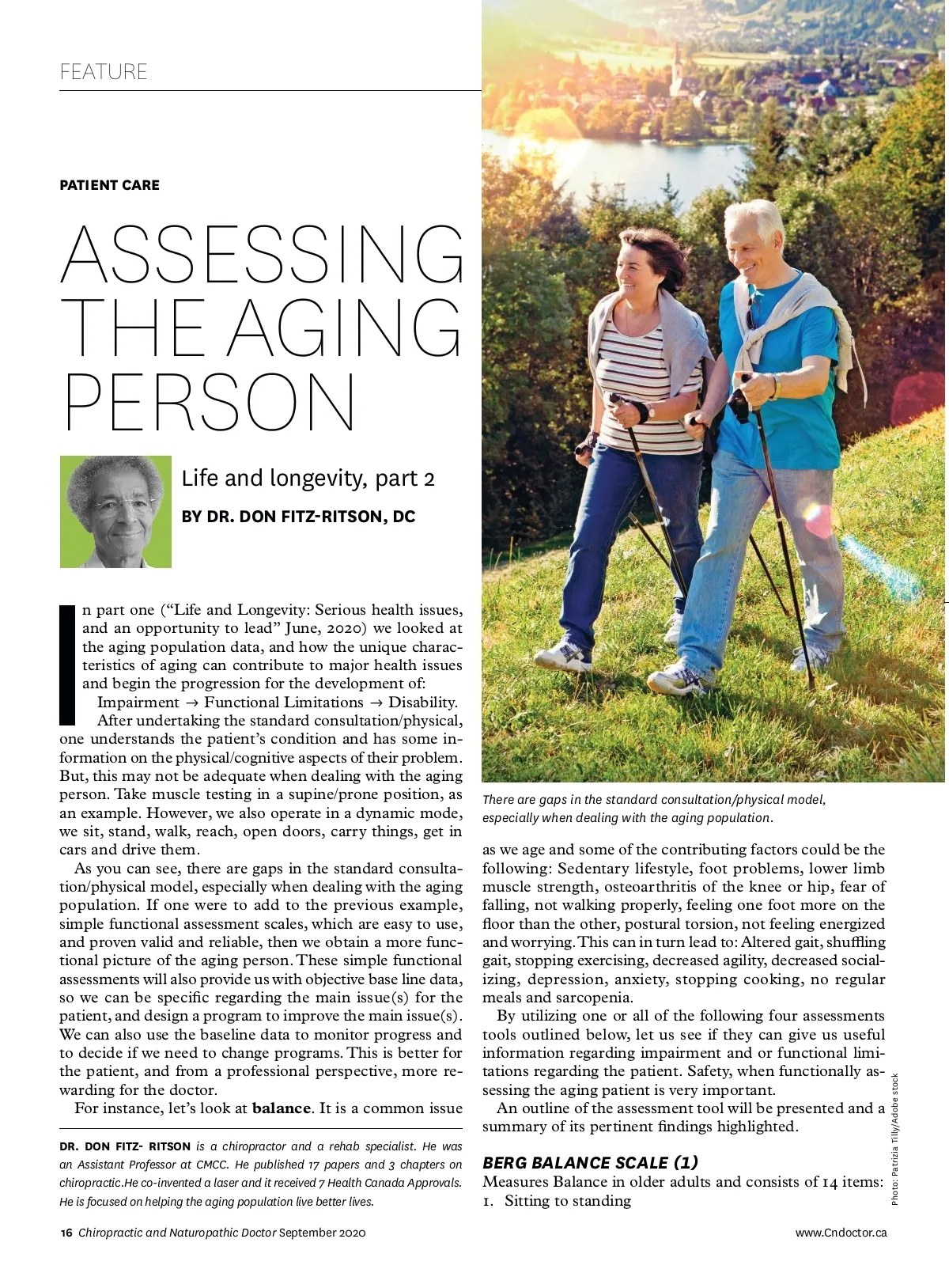
FEATURE PATIENT CARE ASSESSING THE AGING PERSON Life and longevity, part 2 BY DR. DON FITZ-RITSON, DC I DR. DON FITZ-RITSON is a chiropractor and a rehab specialist. He was an Assistant Professor at CMCC. He published 17 papers and 3 chapters on chiropractic.He co-invented a laser and it received 7 Health Canada Approvals. He is focused on helping the aging population live better lives. 16 Chiropractic and Naturopathic Doctor September 2020 BERG BALANCE SCALE (1) Measures Balance in older adults and consists of 14 items: 1. Sitting to standing www.Cndoctor.ca Photo: Patrizia Tilly/Adobe stock n part one (“Life and Longevity: Serious health issues, and an opportunity to lead” June, 2020) we looked at the aging population data, and how the unique charac-teristics of aging can contribute to major health issues and begin the progression for the development of: Impairment $ Functional Limitations $ Disability. After undertaking the standard consultation/physical, one understands the patient’s condition and has some in-formation on the physical/cognitive aspects of their problem. But, this may not be adequate when dealing with the aging person. Take muscle testing in a supine/prone position, as an example. However, we also operate in a dynamic mode, we sit, stand, walk, reach, open doors, carry things, get in cars and drive them. As you can see, there are gaps in the standard consulta-tion/physical model, especially when dealing with the aging population. If one were to add to the previous example, simple functional assessment scales, which are easy to use, and proven valid and reliable, then we obtain a more func-tional picture of the aging person. These simple functional assessments will also provide us with objective base line data, so we can be specific regarding the main issue(s) for the patient, and design a program to improve the main issue(s). We can also use the baseline data to monitor progress and to decide if we need to change programs. This is better for the patient, and from a professional perspective, more re-warding for the doctor. For instance, let’s look at balance . It is a common issue There are gaps in the standard consultation/physical model, especially when dealing with the aging population. as we age and some of the contributing factors could be the following: Sedentary lifestyle, foot problems, lower limb muscle strength, osteoarthritis of the knee or hip, fear of falling, not walking properly, feeling one foot more on the floor than the other, postural torsion, not feeling energized and worrying. This can in turn lead to: Altered gait, shuffling gait, stopping exercising, decreased agility, decreased social-izing, depression, anxiety, stopping cooking, no regular meals and sarcopenia. By utilizing one or all of the following four assessments tools outlined below, let us see if they can give us useful information regarding impairment and or functional limi-tations regarding the patient. Safety, when functionally as-sessing the aging patient is very important. An outline of the assessment tool will be presented and a summary of its pertinent findings highlighted.
Chiropractic + Naturopathic Doctor September 2020: Page 16