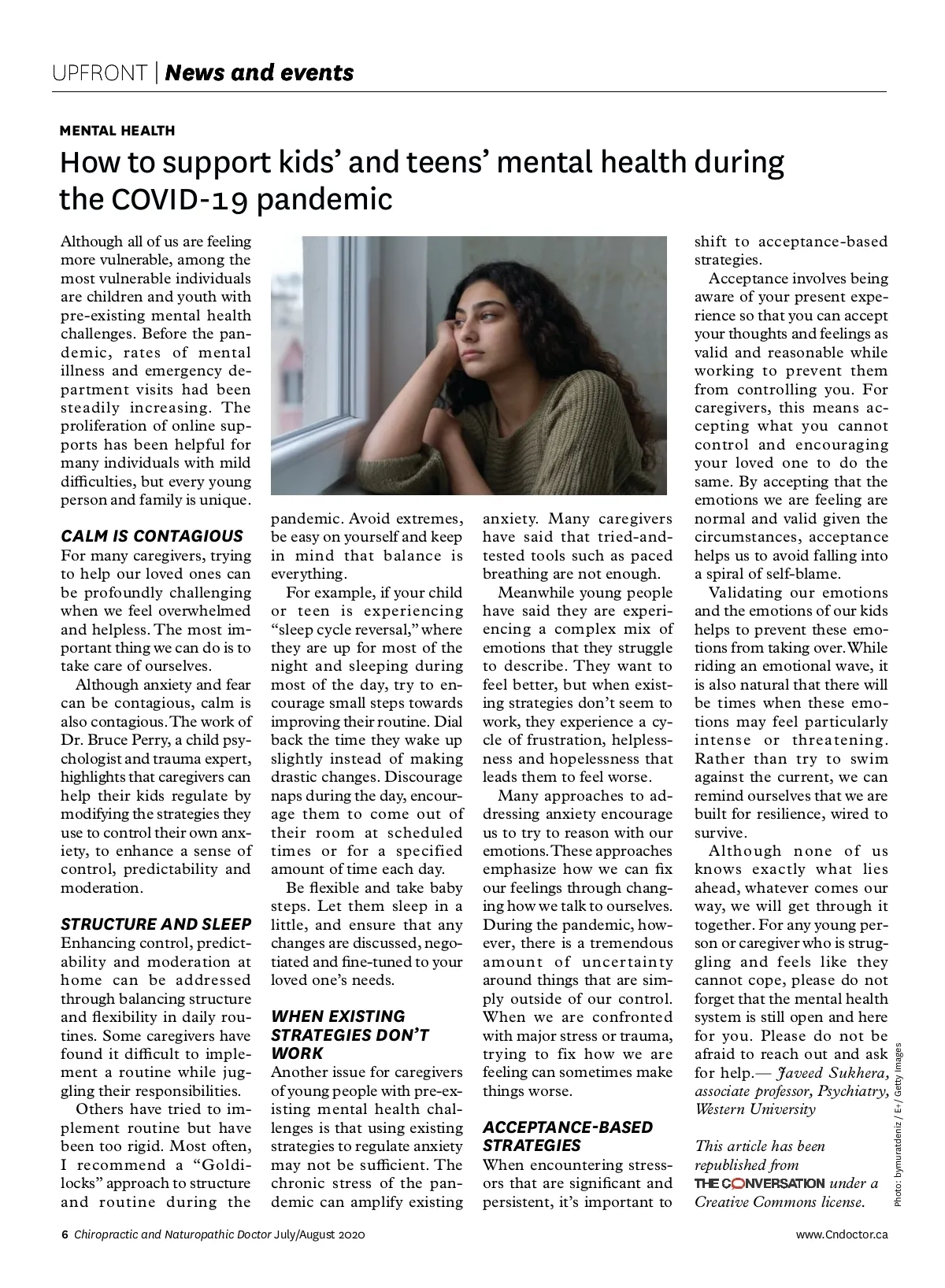
UPFRONT | News and events MENTAL HEALTH How to support kids’ and teens’ mental health during the COVID-19 pandemic Although all of us are feeling more vulnerable, among the most vulnerable individuals are children and youth with pre-existing mental health challenges. Before the pan-demic, rates of mental illness and emergency de-partment visits had been steadily increasing. The proliferation of online sup-ports has been helpful for many individuals with mild difficulties, but every young person and family is unique. shift to acceptance-based strategies. Acceptance involves being aware of your present expe-rience so that you can accept your thoughts and feelings as valid and reasonable while working to prevent them from controlling you. For caregivers, this means ac-cepting what you cannot control and encouraging your loved one to do the same. By accepting that the emotions we are feeling are normal and valid given the circumstances, acceptance helps us to avoid falling into a spiral of self-blame. Validating our emotions and the emotions of our kids helps to prevent these emo-tions from taking over. While riding an emotional wave, it is also natural that there will be times when these emo-tions may feel particularly intense or threatening. Rather than try to swim against the current, we can remind ourselves that we are built for resilience, wired to survive. Although none of us knows exactly what lies ahead, whatever comes our way, we will get through it together. For any young per-son or caregiver who is strug-gling and feels like they cannot cope, please do not forget that the mental health system is still open and here for you. Please do not be afraid to reach out and ask for help. — Javeed Sukhera, associate professor, Psychiatry, Western University This article has been republished from CALM IS CONTAGIOUS For many caregivers, trying to help our loved ones can be profoundly challenging when we feel overwhelmed and helpless. The most im-portant thing we can do is to take care of ourselves. Although anxiety and fear can be contagious, calm is also contagious. The work of Dr. Bruce Perry, a child psy-chologist and trauma expert, highlights that caregivers can help their kids regulate by modifying the strategies they use to control their own anx-iety, to enhance a sense of control, predictability and moderation. STRUCTURE AND SLEEP Enhancing control, predict-ability and moderation at home can be addressed through balancing structure and flexibility in daily rou-tines. Some caregivers have found it difficult to imple-ment a routine while jug-gling their responsibilities. Others have tried to im-plement routine but have been too rigid. Most often, I recommend a “Goldi-locks” approach to structure and routine during the pandemic. Avoid extremes, be easy on yourself and keep in mind that balance is everything. For example, if your child or teen is experiencing “sleep cycle reversal,” where they are up for most of the night and sleeping during most of the day, try to en-courage small steps towards improving their routine. Dial back the time they wake up slightly instead of making drastic changes. Discourage naps during the day, encour-age them to come out of their room at scheduled times or for a specified amount of time each day. Be flexible and take baby steps. Let them sleep in a little, and ensure that any changes are discussed, nego-tiated and fine-tuned to your loved one’s needs. Another issue for caregivers of young people with pre-ex-isting mental health chal-lenges is that using existing strategies to regulate anxiety may not be sufficient. The chronic stress of the pan-demic can amplify existing ACCEPTANCE-BASED STRATEGIES When encountering stress-ors that are significant and persistent, it’s important to under a Creative Commons license. www.Cndoctor.ca 6 Chiropractic and Naturopathic Doctor July/August 2020 Photo: bymuratdeniz / E+/ Getty Images WHEN EXISTING STRATEGIES DON’T WORK anxiety. Many caregivers have said that tried-and-tested tools such as paced breathing are not enough. Meanwhile young people have said they are experi-encing a complex mix of emotions that they struggle to describe. They want to feel better, but when exist-ing strategies don’t seem to work, they experience a cy-cle of frustration, helpless-ness and hopelessness that leads them to feel worse. Many approaches to ad-dressing anxiety encourage us to try to reason with our emotions. These approaches emphasize how we can fix our feelings through chang-ing how we talk to ourselves. During the pandemic, how-ever, there is a tremendous amount of uncertainty around things that are sim-ply outside of our control. When we are confronted with major stress or trauma, trying to fix how we are feeling can sometimes make things worse.
Chiropractic + Naturopathic Doctor July/August 2020: Page 6