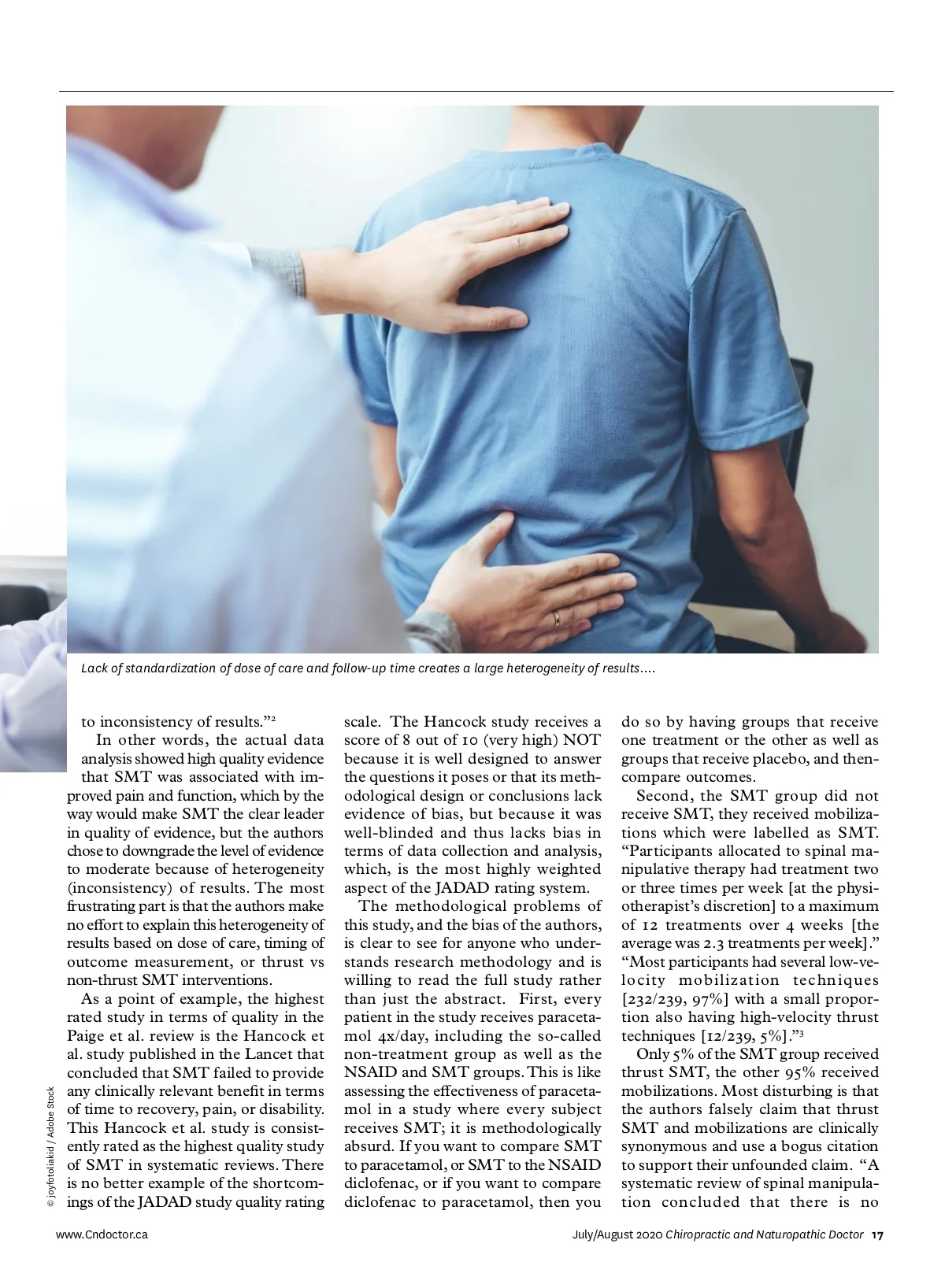
Lack of standardization of dose of care and follow-up time creates a large heterogeneity of results.... to inconsistency of results.” 2 In other words, the actual data analysis showed high quality evidence that SMT was associated with im-proved pain and function, which by the way would make SMT the clear leader in quality of evidence, but the authors chose to downgrade the level of evidence to moderate because of heterogeneity (inconsistency) of results. The most frustrating part is that the authors make no effort to explain this heterogeneity of results based on dose of care, timing of outcome measurement, or thrust vs non-thrust SMT interventions. As a point of example, the highest rated study in terms of quality in the Paige et al. review is the Hancock et al. study published in the Lancet that concluded that SMT failed to provide any clinically relevant benefit in terms of time to recovery, pain, or disability. This Hancock et al. study is consist-ently rated as the highest quality study of SMT in systematic reviews. There is no better example of the shortcom-ings of the JADAD study quality rating www.Cndoctor.ca scale. The Hancock study receives a score of 8 out of 10 (very high) NOT because it is well designed to answer the questions it poses or that its meth-odological design or conclusions lack evidence of bias, but because it was well-blinded and thus lacks bias in terms of data collection and analysis, which, is the most highly weighted aspect of the JADAD rating system. The methodological problems of this study, and the bias of the authors, is clear to see for anyone who under-stands research methodology and is willing to read the full study rather than just the abstract. First, every patient in the study receives paraceta-mol 4x/day, including the so-called non-treatment group as well as the NSAID and SMT groups. This is like assessing the effectiveness of paraceta-mol in a study where every subject receives SMT; it is methodologically absurd. If you want to compare SMT to paracetamol, or SMT to the NSAID diclofenac, or if you want to compare diclofenac to paracetamol, then you do so by having groups that receive one treatment or the other as well as groups that receive placebo, and then-compare outcomes. Second, the SMT group did not receive SMT, they received mobiliza-tions which were labelled as SMT. “Participants allocated to spinal ma-nipulative therapy had treatment two or three times per week [at the physi-otherapist’s discretion] to a maximum of 12 treatments over 4 weeks [the average was 2.3 treatments per week].” “Most participants had several low-ve-locity mobilization techniques [232/239, 97%] with a small propor-tion also having high-velocity thrust techniques [12/239, 5%].” 3 Only 5% of the SMT group received thrust SMT, the other 95% received mobilizations. Most disturbing is that the authors falsely claim that thrust SMT and mobilizations are clinically synonymous and use a bogus citation to support their unfounded claim. “A systematic review of spinal manipula-tion concluded that there is no © joyfotoliakid / Adobe Stock July/August 2020 Chiropractic and Naturopathic Doctor 17
Chiropractic + Naturopathic Doctor July/August 2020: Page 17