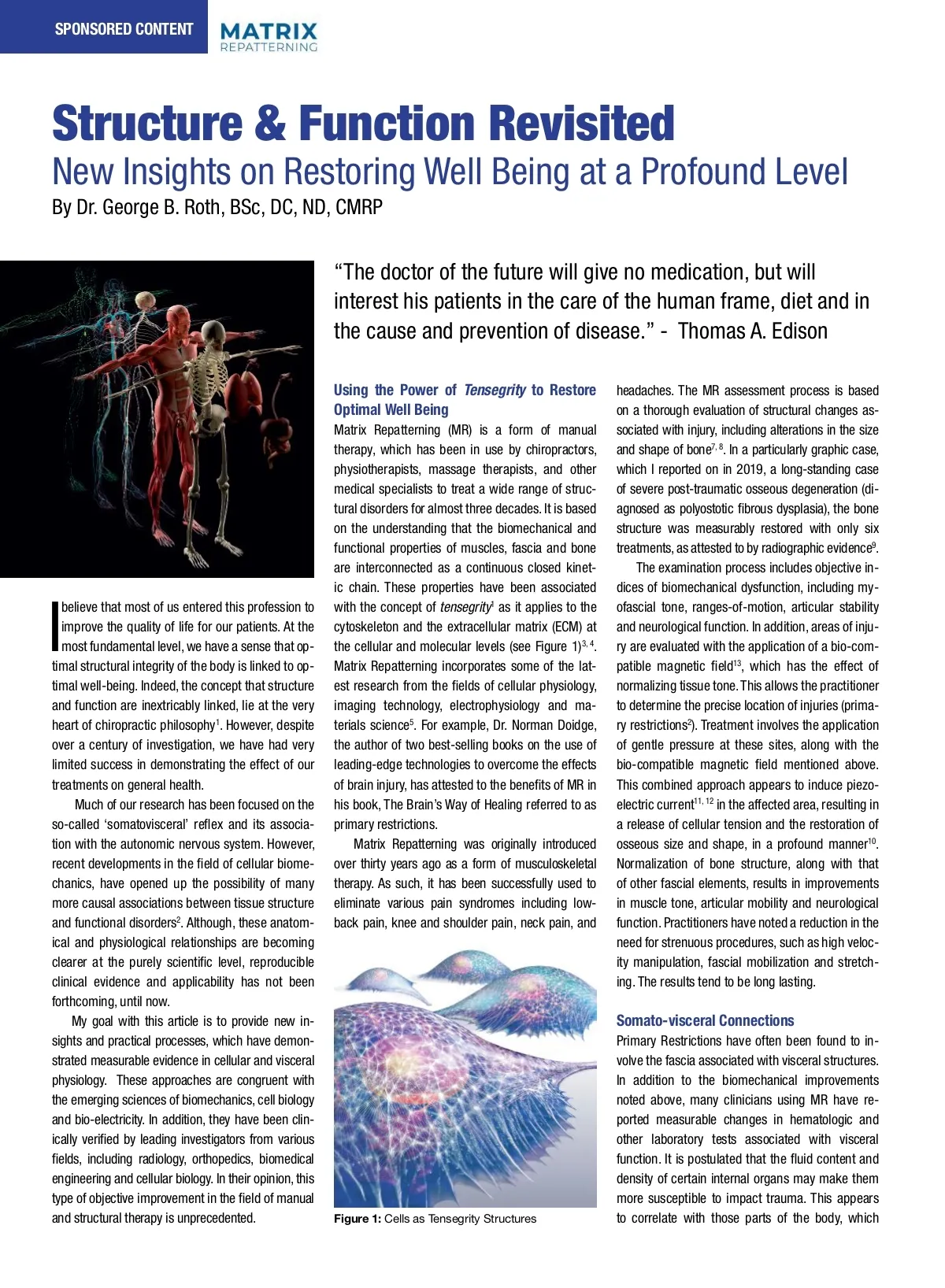
SPONSORED CONTENT R o are vulnerable to ‘internal injuries.’ These struc-tures appear to be subject to alterations in cellular biomechanics, which may explain the changes in various physiological processes. As a consequence, MR treatment of these injuries often results in sig-nificant improvement in symptoms, such as gas-tro-esophageal reflux, snoring and apnea, cardiac arrhythmia, cholesterolemia, incontinence, erectile dysfunction and other conditions. It may be specu-lated that these clinical outcomes provide clues as to how many of these functional conditions may be associated with structural dysfunction arising from common forms of injury. It may also explain why they are so common in the general population. fact, as of the writing of this report, his blood pres-sure has continued to decline and I have advised him to seek a re-evaluation of his medication, if it should continue to decline. the pituitary output of ADH or the vagus nerve (CN X), as it relates to regulation of cardiac contractility. Conclusion Case Report: Post-Traumatic Hypertension and Tachycardia Hypertension is a condition which affects a signif-icant number of people. Recent estimates indicate that more than 100 million Americans (CDC, 2017) and almost 10 million Canadians (Statistics Can-ada, 2019) are afflicted with this potentially dan-gerous condition. Other than traumatic brain injury, the literature is rather scanty on the incidence of essential or primary hypertension subsequent to physical injury 14 . However, based on evidence gath-ered over three decades of clinical experience, it is my opinion that the association may be much more prevalent than previously considered. This case involves a 51-year-old gentleman, who came to see me regarding a snowmobile col-lision, which occurred in February 2020. He sus-tained a major impact, to his left postero-lateral chest wall and serious complex fractures of his left elbow. Ten years prior to this injury, he devel-oped hypertension following a series of lithotripsy treatments for renal calculi. His blood pressure was eventually stabilized at normal levels with medica-tion, which remained the case for almost a decade, until the above-mentioned collision. Immediately after the injury, his blood pressure became significantly elevated (150-155/95-100) and he developed tachycardia. Prior to the injury his heart rate averaged in the mid-sixties. After the injury, his heart rate averaged 85-95 BPM. Neither of these symptoms responded favorably to med-ication. The case described above is representative of the types of conditions often encountered and resolved using Matrix Repatterning. As a result of our suc-While studying radiology in chiropractic cess, we were recently invited to participate in a Over the past 20 years, there have been a -signif-school, I noticed that the size of a structure on study a major teaching hospital in Toronto, icant number of cases of hypertension (HTN) that one side pilot of the body at was often different than its of counterpart on the side. For example, Canada. We other will be reporting our preliminary re-have responded to the application of this form Fracture Resistance -treatment. In several of those cases, patients ex-sults in an upcoming article. A We are hopeful that these outcomes will pro-perienced an improvement in their blood pressure, inasmuch that they required a reduced dosage of vide us with even more information to support the -medication, or were able to curtail the use of them development of scientific, reproducible, safe and -offer relief for entirely. These results appear to have persisted for non-invasive methods to be able to B this and many other somatovisceral conditions. months or years. It has been postulated that certain injuries to -Practitioners from around the world, who have the trunk (rib cage or spine), may have an influence By carefully examining a better quality skel-learned these techniques, have found on renal or hepatic function (renin, angiotensinogen C that they are and/or angiotensin production). Additional areas of now able to provide real solutions for their patients. -primary involvement may include thoracic spinal in-By restoring the framework of the body and sup-jury, which may influence the sympathetic nervous porting its natural healing abilities, they are truly -system, cervical spine involvement, as it relates to becoming the ‘doctors of the future.’ D the carotid sinus, or cranial injury, which may affect Discussion: Visceral, Endocrine and Neuro-logical Implications 1. 2. 3. 4. --5. validate my outcomes and give me the confi-various levels throughout the spine. Figure 1 demonstrates these differences in the size of dence to be able to find and resolve my patient’s conditions. In this search, I was blessed to meet the articular processes of the atlas. I contend REFERENCES: that on palpation, these areas of enlargement researchers and clinicians from other 1. several Palmer DD. The science of chiropractic. 2n ed. USA: Theclassics Us; 2013. may be easily mistaken for a relative rotation or 564-77, 2003. (cell biomedical 2. fields Ingber DE, biology, Mechanobiology and engineering, diseases of mechanotransduction, Annals of Medicine; 35(8): translation of 1, the vertebral segment (see: Sub-medicine, osteopathy and physical 3. orthopedic Ingber DE, The Architecture of Life, Scientific American, Vol. 1998. luxation: A Case Basis of Mistaken Identity, below). Medicine, North They were making amazing discov-4. medicine). Pischinger A, The Extracellular Matrix and Ground Regulation, for a Holistic Biological Recent evidence from the University of Cal-eries regarding the underlying Atlantic Books, Berkley, 2007. effects of injury revealed by the powerful Atomic Force biomechanical dysfunction at the cellular, for ifornia, 5. and Roth GB, The Matrix Repatterning Program Pain Relief, New Harbinger, Oakland CA, 2005. under direction of physicist and Brain’s even the molecular level. I microscope, 6. bio-electrical Doidge N., The Way of Healing, Penguin Books, New York, the 2016. 1 , has confirmed Paul Hansma and his team that for a system of therapeutics the 7. recognized Roth GB, Observations in a New Light: Subluxation: A case of mistaken identity? Canadian Chiropractor, to be valid, 2019. it had to be congruent with this presence of certain protein structures within December science. the bone that expand L, with an injury. These GA, Stucky GD, 8. emerging Fantner GE, Hassenkam T, Kindt JH, Weaver JC, Birkedal H, Pechenik Cutroni JA, Cidade findings are consistent with my obser-fibrils separate Morse DE, Hansma PK , Sacrificial bonds and hidden length dissipate energy as clinical mineralized vations, which were first made over 40 years during bone fracture, Nat Mater. 2005 Aug; 4(8):612-6. Epub. Jul 17 2005. ago (see Figure 2). 9. Roth GB, Regenerating Bone Structure: Unexpected Results, The American Chiropractor, pp. 42, 43, January 2019. 10. Valbona C. et al, Response of pain to static magnetic fields in postpolio patients: A double-blind pilot study, Arch Phys Med Rehabil, 78:12003, 1997. One of the significant clinical breakthroughs 11. MacGuintie LA et al, Streaming and piezoelectric potentials in connective tissues. In: Blank M (ed) Electromag -netic fields: biological interactions and mechanisms. Advances in Chemistry Series 250. to American Chemical that my colleagues and I were able ac-Society, Washington DC, ch. 8, pp 125-142, 1995. complish was that bone size appeared to be 12. Sierpowska J et al, Prediction of mechanical properties of human trabecular bone by restored to normal with treatment. At electrical first, we measurements Physiol. Meas. 26 S119, 2005. questioned these results and followed them up 13. Roth GB, When Biology, Canadian Chiropractor, May 2020. using callipers and with precise measurements Figure 1: Model of Physics C1, cast Meets from a real 14. Krishnamoorthy et al, Hypertension after Severe Injury: Friend or Foe? J Neurosurg Anes -tape Traumatic measures. Brain Inter-tester validation appeared skeletal specimen. V, Note the enlargement of the right articular process the spinal thesiol. 2017 October ; 29(4): and 382–387. doi:10.1097. to confirm our findings. canal, which measured 2 mm. larger in 15. Clar C, Clinical effectiveness of manual therapy for the management musculoskeletal and non-musculo -Several years ago, of I treated a 15-year-old every dimension. skeletal conditions: systematic review and update of UK evidence report, Chiropr Man Therap, 2014 Mar 28;22(1):12. Response to Treatment: After two Matrix Repatterning treatments directed to the injured areas related to the upper extremity, rib cage/thoracic spine, cranial base/cervical spine and the pericardium, his BP averaged 120/80 and his resting heart rate was approximately 70-75 BPM. After two additional sessions, his heart rate is now averaging 65-75 and his blood pressure has consistently remained in the range of 110/70. In About the Author: Dr. Roth is a graduate of the University of Toronto, Canadian Memorial Chiropractic College and the Ontario College of Naturopathic Medicine and has studied osteopathic medicine at Doctors’ Hospital North, Columbus, Ohio. He is the developer of Matrix Repatterning and is the Director of Education at the Matrix Institute in Toronto. Dr. Roth has presented seminars at numerous hospital and university-based symposia throughout North America. He is the co-author, with Kerry D’Ambrogio PT, of Positional Release Therapy (Elsevier, 1997), and the author of The Matrix Repatterning Program for Pain Relief (New Harbinger, 2005). His work is also featured in the Brain’s Way of Healing, by Dr. Norman Doidge, (Penguin, 2015). For more information: wwwmatrixforpractitioners.com
Chiropractic + Naturopathic Doctor July/August 2020: Page 15