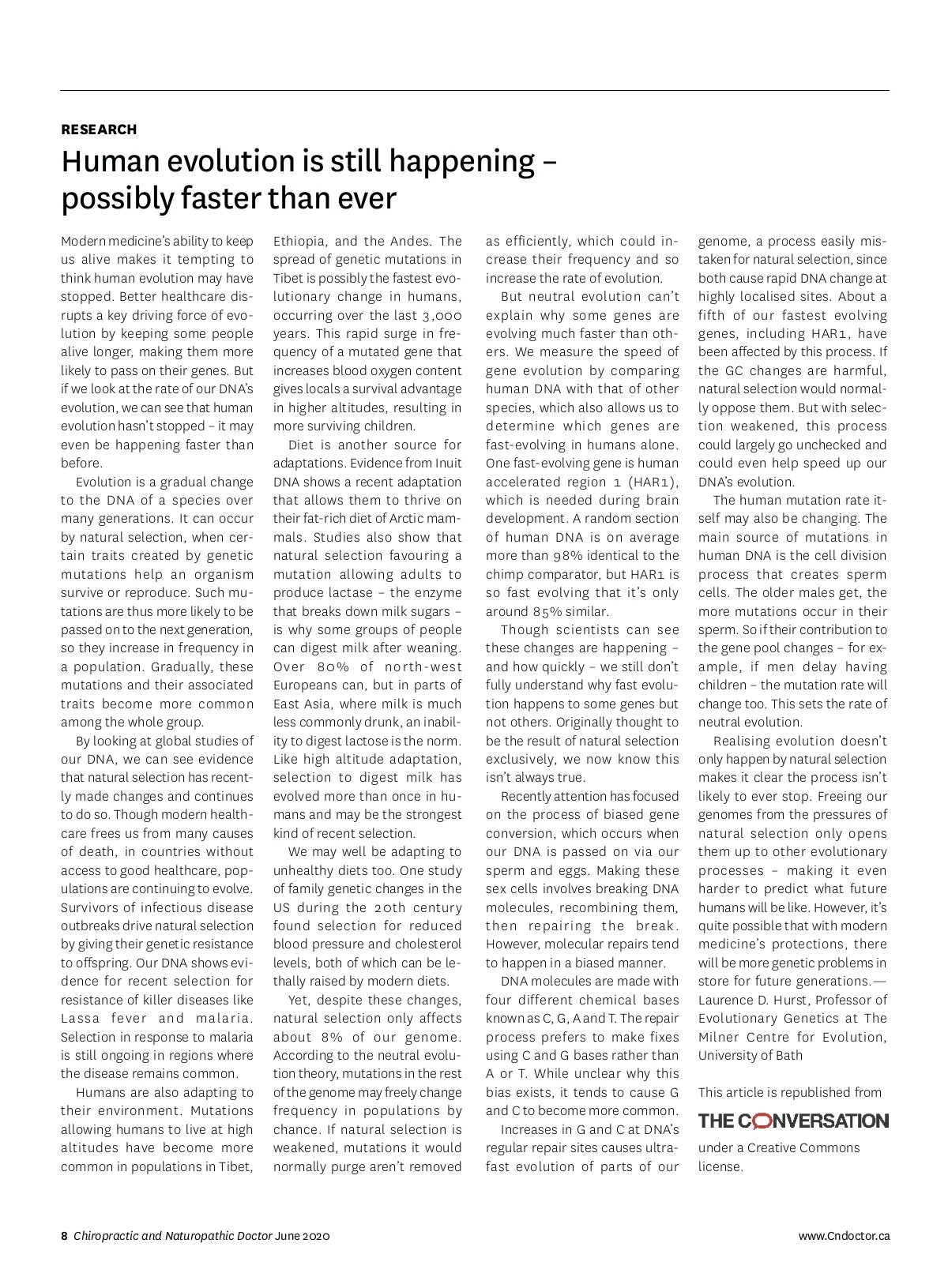
COVID-19 Evidence supports physical distancing, masks, Eating whole and eye protection to help prevent COVID-19 grains could randomized control trials help lower addressing the three corona-viruses but 44 relevant com-diabetes risk parative studies in health-care and non-health-care (community) settings across 16 countries and six conti-nents from inception to early May 2020. The authors noted more global, collaborative, well-conducted studies of different personal protective strategies are needed. For masks, large randomized trials are underway and are urgently needed. The scientific lead is Derek Chu, a clinician scientist in the departments of health research methods, evidence, and impact, and medicine at McMaster and an affiliate of the Research Institute of St. Joe’s Hamilton. “There is an urgent need for all caregivers in health-care settings and non-health-care settings to have equita-ble access to these simple personal protective measures, which means scaling up pro-duction and consideration about repurposing manufac-turing,” said Chu. “However, although dis-tancing, face masks, and eye protection were each highly protective, none made indi-viduals totally impervious from infection and so, basic measures such as hand hy-giene are also essential to curtail the current COVID-19 pandemic and future waves.” The work was funded by the World Health Organiza-tion and involved close col-laboration with the American University of Beirut, Leba-non and many international partners. — McMaster University A new analysis of more than 200,000 people found that eat-ing high-quality carbohydrates, such as whole grains, was associ-ated with a lower risk for type 2 diabetes. “High intake of carbohydrates has been suggested to be associ-ated with a higher risk of type 2 diabetes,” said research team leader Kim Braun, PhD, from Erasmus University Medical Center and Harvard T.H. Chan School of Public Health. Braun and colleagues analyzed data from three studies that fol-lowed health professionals in the U.S. over time. These included 69,949 women from the Nurses’ Health Study, 90,239 women from the Nurses’ Health Study 2 and 40,539 men from the Health Professionals Follow-up Study. Collectively, the studies repre-sented over 4 million years of follow-up, during which almost 12,000 cases of type 2 diabetes cases were documented. The researchers observed a lower risk of type 2 diabetes when high-quality carbohy-drates replaced calories from saturated fatty acids, monoun-saturated fats, polyunsaturated fats, animal protein and vegeta-ble protein. They also found that replacing low-quality carbohy-drates with saturated fats, but not with other nutrients, was associated with a lower risk of type 2 diabetes. “Conducting similar studies in people with various socio-eco-nomic backgrounds, ethnicities and age will provide insight into how applicable these findings are for other groups,” said Braun. — American Society for Nutrition NUTRITION A comprehensive review of existing evidence supports physical distancing of two metres or more to prevent person-to-person transmis-sion of COVID-19, says an international team led by McMaster University and St. Joseph’s Healthcare Hamilton. Face masks and eye pro-tection decrease the risk of infection, too. The systematic review and meta-analysis was commis-sioned by the World Health Organization. The findings were published today in The Lancet. “Physical distancing likely results in a large reduction of COVID-19,” said lead author Holger Schünemann, profes-sor of the departments of health research methods, evidence, and impact, and medicine at McMaster. Schünemann is co-director of the World Health Organi-zation (WHO) Collaborating Centre for Infectious Dis-eases, Research Methods and Recommendations. He also is director of Cochrane Can-ada and McMaster GRADE Centre. “Although the direct evi-dence is limited, the use of masks in the community www.Cndoctor.ca provides protection, and possibly N95 or similar res-pirators worn by health-care workers suggest greater protection than other face masks,” Schünemann said. “Availability and feasibility and other contextual factors will probably influence rec-ommendations that organi-zations develop about their use. Eye protection may provide additional benefits.” The systematic review was conducted by a large, inter-national collaborative of re-searchers, front-line and specialist clinicians, epide-miologists, patients, public health and health policy ex-perts of published and un-published literature in any language. They sought direct evi-dence on COVID-19 and indirect evidence on related coronaviruses causative of Severe Acute Respiratory Syndrome (SARS) and Middle East Respiratory Syndrome (MERS). The team used Cochrane meth-ods and the Grading of Recommendations, Assess-ment, and Evaluation (GRADE) approach which is used world-wide to assess the certainty of evidence. They identified no CARLOS TORRES / Adobe Stock June 2020 Chiropractic and Naturopathic Doctor 9
Chiropractic + Naturopathic Doctor June 2020: Page 9