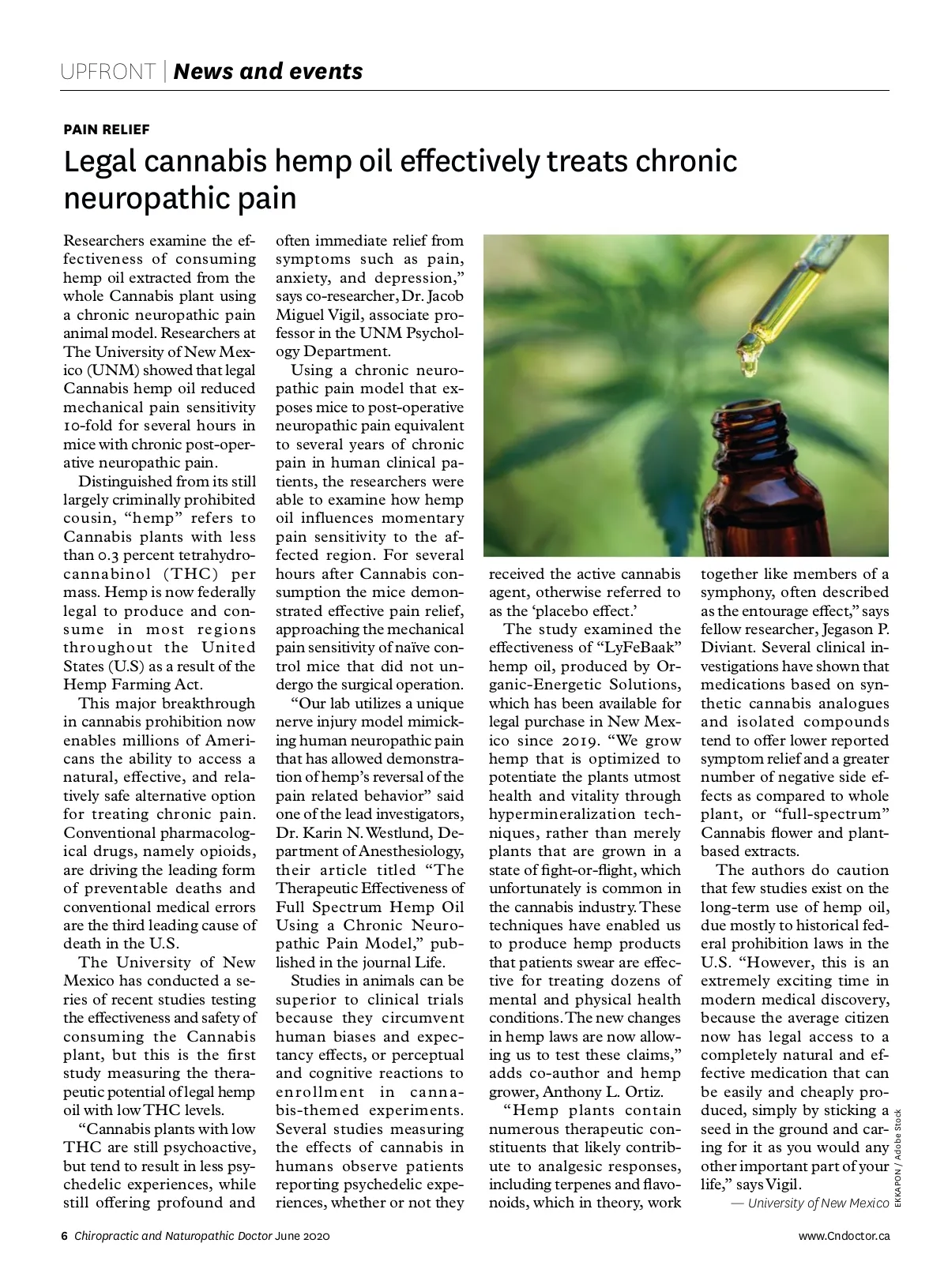
WELLNESS Understanding the role of cardiorespiratory fitness and body composition in brain health A new study led by researchers at the Beckman Institute for Advanced Science and Technology examined how cardiorespiratory fitness and body composition re-late to neuronal health in 290 healthy young adults. The study, “Body mass and cardiorespiratory fitness are associated with altered brain metabolism” was published in Metabolic Brain Disease. The study contributes to a grow-ing body of research suggesting that fitness has beneficial effects for brain health. The study applied magnetic resonance spectroscopy to detect and measure brain me-tabolites, focusing specifically on N-acetyl aspartic acid. “NAA is produced in the neu-rons and is an important bio-chemical marker of energy pro-duction and neuronal health” said Aron Barbey, a University of Illinois psychology professor, who led the research with senior research scientist Ryan Larsen. “Our prior work demonstrates that neuronal health, as measured by NAA, has favorable associations with cogni-tive performance. We were inter-ested in exploring whether modifiable life style factors, such as physical activity and aerobic fitness, are also linked to NAA.” The researchers showed that a lower percentage of body fat is associated with higher NAA in the white matter, and that this rela-tionship largely accounts for the association between NAA and cardiorespiratory fitness. “Our findings suggest that fitter adults benefit from improved structural brain connectivity,” Larsen said. “A central question raised by this work is whether we can modify NAA through physical activity and fitness interventions, providing an effective method to enhance cognitive performance and brain health across the lifespan.” The research team also includ-ed U of I psychology professor Neal Cohen; Northeastern University psychology professors Charles Hillman and Arthur Kramer; and Northeastern University postdoctoral fellow Lauren Raine. — Beckman Institute for Advanced Science and Technology NUTRITION Leaders call for ‘moonshot’ on nutrition research Leading nutrition and food policy experts outline a bold case for strengthening federal nutrition research in a live interactive session as part of NUTRITION 2020 LIVE ONLINE, a virtual confer-ence hosted by the American Society for Nutrition (ASN). Panellists include Former U.S. Senator Tom Harkin, Former U.S. Secretary of Agriculture Dan Glickman and Former Commissioner of the U.S. Food and Drug Administration David Kess-ler, along with a host of top nutrition researchers. The experts together offer a frank accounting of the dire state of Americans’ health--even be-fore the COVID-19 pandem-ic--and a vision for advancing nutrition science and policy. “The time has come for a national ‘moonshot’ on nu-trition research,” said Dari-ush Mozaffarian, MD, DrPH, Dean of the Fried-man School of Nutrition Science and Policy at Tufts www.Cndoctor.ca University, chair of the ses-sion. “A strengthening of federal nutrition research has significant potential to generate new discoveries to improve and sustain the health of all Americans, re-duce healthcare costs, im-prove health disparities, create new businesses and jobs, reinvigorate farms and rural communities, strengthen military readi-ness and optimize use of our natural resources.” Even without COVID-19, about 40,000 Americans die each month from diseases related to poor diets and tens of millions are food in-secure. More Americans are sick than healthy: Half of U.S. adults have diabetes or prediabetes and nearly 3 in 4 are overweight or obese. “COVID-19 pulled back the curtain on so many food and nutrition issues,” said Mozaffarian. “Food is the number one cause of poor health in America, with hundreds of billions of dol-lars spent each year on pre-ventable, diet-related illnesses.” The session draws on a forthcoming white paper, to be published in the American Journal of Clinical Nutrition, that reviews the current state of nutrition research and identifies strategies to bolster and coordinate food and nutrition research and policy at the National Institutes of Health (NIH) and across all federal bodies. The paper outlines two priorities: a new authority for robust cross-governmental coordi-nation of nutrition research; and strengthened authority and investment for nutrition research within the NIH. The session’s first panel, focusing on opportunities for federal coordination of food and nutrition research and policy, features Former U.S. Secretary of Agriculture Dan Glickman; Iowa State Uni-versity professor and Former U.S. Department of Agricul-ture Chief Scientist Cathe-rine Woteki, PhD; and David Kessler, JD, MD, Former Commissioner of the U.S. Food and Drug Administra-tion. The second panel, focus-ing on opportunities for NIH nutrition research, in-cludes Former Senator Tom Harkin (D-IA); U.S. Public Health Service Rear Admi-ral (Ret) Van Hubbard, PhD, MD; and Patrick Stover, PhD, Vice Chancellor and Dean of Agriculture and Life Science at Texas A&M University. “We hope this session, and the forthcoming white pa-per, will spark a broad na-tional conversation around the critical importance of national nutrition research and the very real opportuni-ties before us,” said Mozaf-farian. “We don’t have time to wait.” — American Society for Nutrition June 2020 Chiropractic and Naturopathic Doctor 7
Chiropractic + Naturopathic Doctor June 2020: Page 7