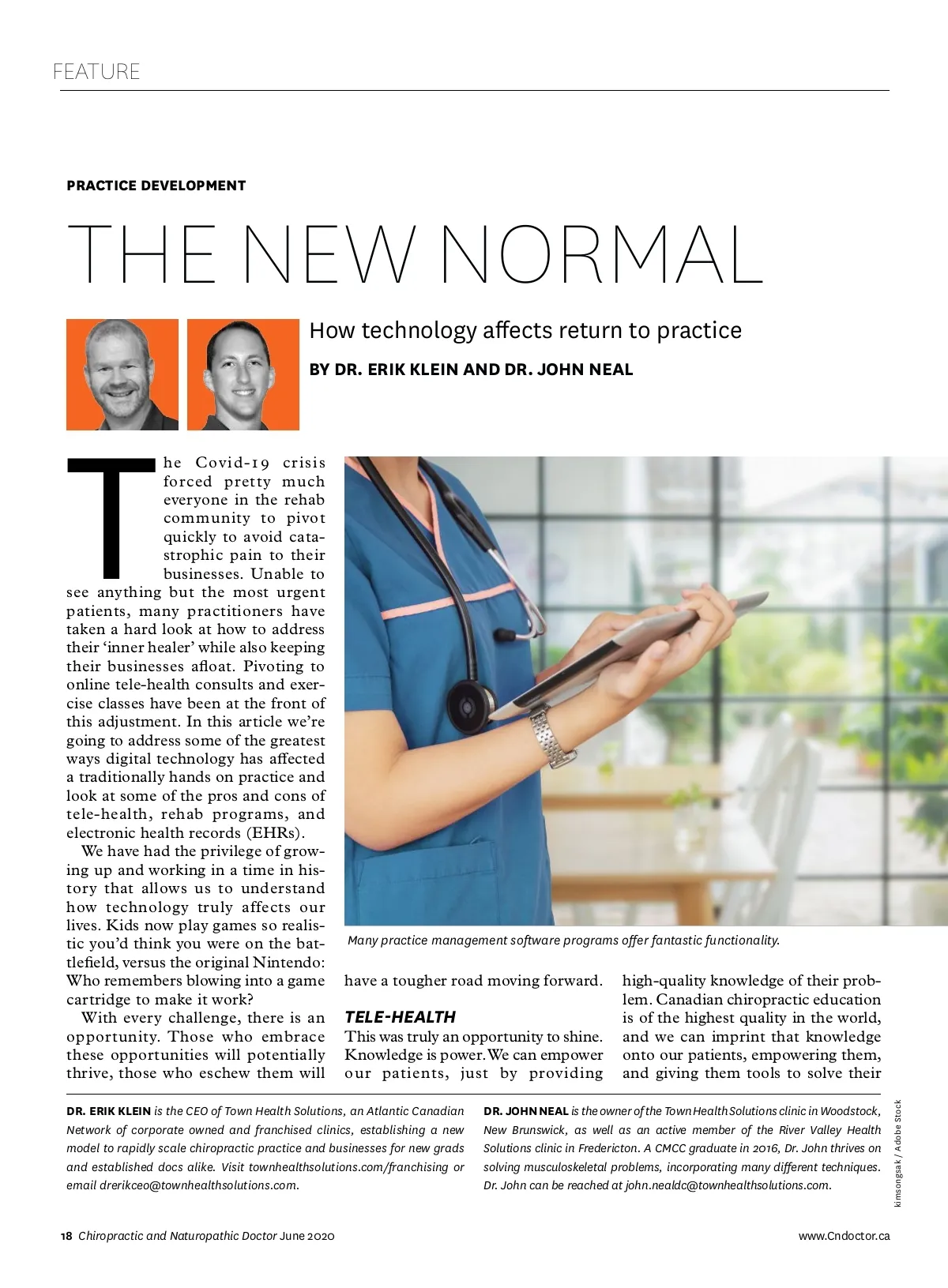
own problems. Tele-health was the answer for this patient empowerment process, and we review some of the most common available programs used over the past few months. Given the increase in video confer-encing over the course of this pan-demic, I imagine some of you reading would immediately think of using Zoom to achieve this service. Unfor-tunately, although it has superior imagery and functionality, Zoom has had some well-publicized security lapses that make it inappropriate for patient engagement at this point in time. Truth be told, Zoom would have been a great stock buy in February! Regulatory bodies wanted to ensure patient information was secure, and legislative requirements were being followed. Most electronic health re-cords systems pivoted themselves to provide secure transmissions that could be recorded in house. Programs used by chiropractors and other HCPs quickly provided this service. Many practice management software programs offer fantastic func-tionality: An easy to share platform, low bandwidth requirements, a chat feature to share images, and videos sent directly to the patient’s email. In some programs, practitioners can also write directly in their patient’s chart while speaking to them. Seamless use of desktop or mobile options adds to the quality of these programs. However, with no hands-on assess-ment, there will always be limitations to how much “physical” assessment you can do. From day one, we were told that the history should give us the diagnosis 70%+ of the time, with the physical exam used to confirm it. This may be less of an issue to practitioners that rely more on movement observation versus those who rely more on palpation. Sea-soned practitioners will be able to make judgements based on a minimal amount of data, while newer practitioners may struggle to make sense without having the entire picture. Most practice management software companies will provide the clinician and patient with an excellent experi-ence and meet most regulatory bodies requirements (at least as far as EHR is concerned). While Zoom is one of the most known programs – and frankly has the most superior functionality – it does not meet the regulatory requirements of our colleges for the purpose of pa-tient engagement. REHABILITATION EXERCISE APPS No matter what your practice style is, we all know that exercise is therapeu-tic. The science has shown that exer-cise benefits essentially all aspects of our health, from the physical to the mental. So, in a remote engagement practice standpoint, exercise is our key home management tool, with er-gonomic advice likely following be-hind. Motion is lotion! Being able to utilize rehabilitation exercise program apps can be a great help to our patient management. Even though our hands on care should be second-to-none, what really sets our www.Cndoctor.ca CC_ContemporaryAcupuncture_June20_CSA.indd 1 June 2020 Chiropractic and Naturopathic Doctor 19 2020-03-05 11:39 AM
Chiropractic + Naturopathic Doctor June 2020: Page 19