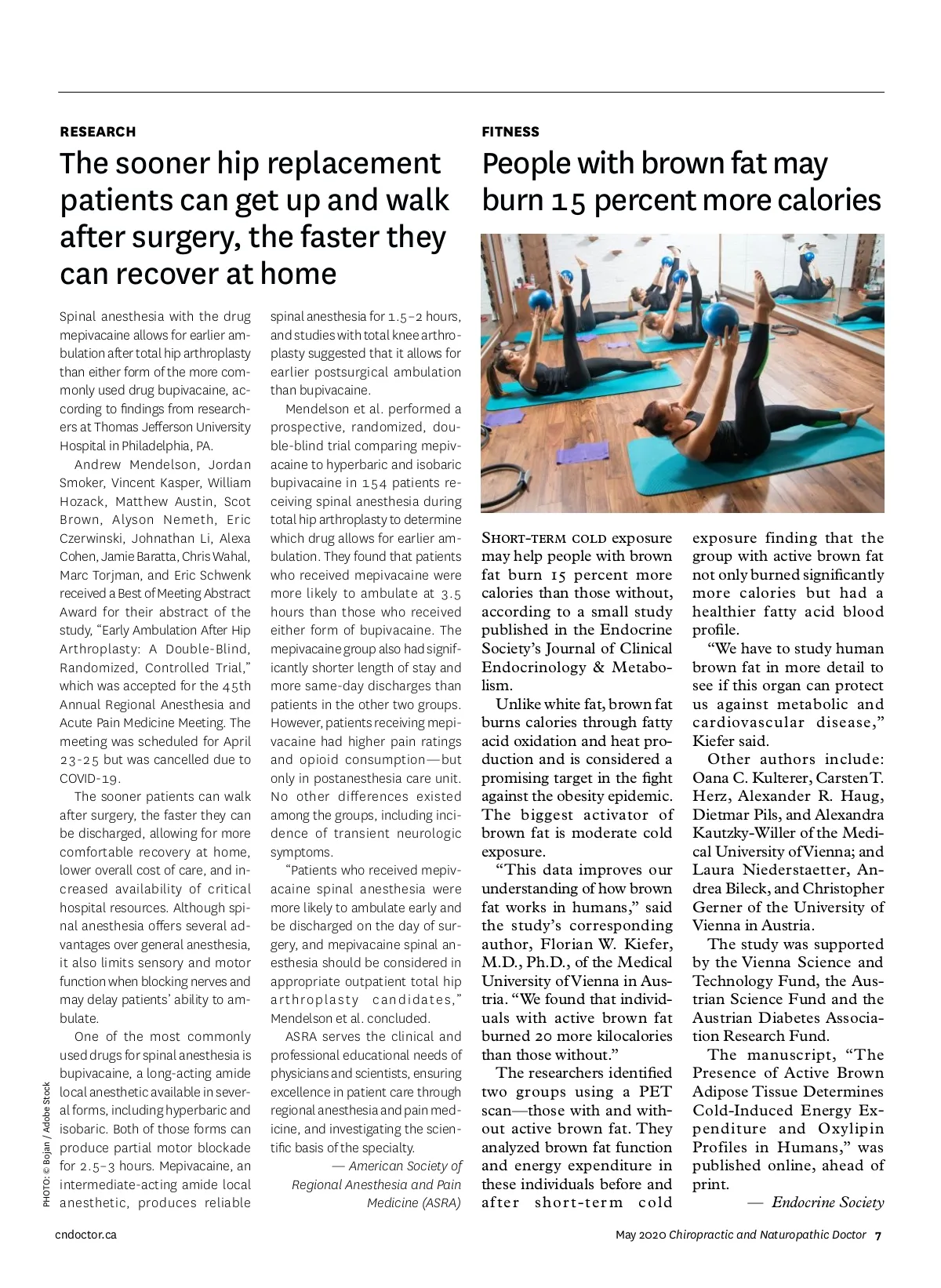
RESEARCH The sooner hip replacement People with brown fat may patients can get up and walk burn 15 percent more calories after surgery, the faster they can recover at home Spinal anesthesia with the drug mepivacaine allows for earlier am-bulation after total hip arthroplasty than either form of the more com-monly used drug bupivacaine, ac-cording to findings from research-ers at Thomas Jefferson University Hospital in Philadelphia, PA. Andrew Mendelson, Jordan Smoker, Vincent Kasper, William Hozack, Matthew Austin, Scot Brown, Alyson Nemeth, Eric Czerwinski, Johnathan Li, Alexa Cohen, Jamie Baratta, Chris Wahal, Marc Torjman, and Eric Schwenk received a Best of Meeting Abstract Award for their abstract of the study, “Early Ambulation After Hip Arthroplasty: A Double-Blind, Randomized, Controlled Trial,” which was accepted for the 45th Annual Regional Anesthesia and Acute Pain Medicine Meeting. The meeting was scheduled for April 23-25 but was cancelled due to COVID-19. The sooner patients can walk after surgery, the faster they can be discharged, allowing for more comfortable recovery at home, lower overall cost of care, and in-creased availability of critical hospital resources. Although spi-nal anesthesia offers several ad-vantages over general anesthesia, it also limits sensory and motor function when blocking nerves and may delay patients’ ability to am-bulate. One of the most commonly used drugs for spinal anesthesia is bupivacaine, a long-acting amide local anesthetic available in sever-al forms, including hyperbaric and isobaric. Both of those forms can produce partial motor blockade for 2.5–3 hours. Mepivacaine, an intermediate-acting amide local anesthetic, produces reliable cndoctor.ca FITNESS spinal anesthesia for 1.5–2 hours, and studies with total knee arthro-plasty suggested that it allows for earlier postsurgical ambulation than bupivacaine. Mendelson et al. performed a prospective, randomized, dou-ble-blind trial comparing mepiv-acaine to hyperbaric and isobaric bupivacaine in 154 patients re-ceiving spinal anesthesia during total hip arthroplasty to determine which drug allows for earlier am-bulation. They found that patients who received mepivacaine were more likely to ambulate at 3.5 hours than those who received either form of bupivacaine. The mepivacaine group also had signif-icantly shorter length of stay and more same-day discharges than patients in the other two groups. However, patients receiving mepi-vacaine had higher pain ratings and opioid consumption—but only in postanesthesia care unit. No other differences existed among the groups, including inci-dence of transient neurologic symptoms. “Patients who received mepiv-acaine spinal anesthesia were more likely to ambulate early and be discharged on the day of sur-gery, and mepivacaine spinal an-esthesia should be considered in appropriate outpatient total hip arthroplasty candidates,” Mendelson et al. concluded. ASRA serves the clinical and professional educational needs of physicians and scientists, ensuring excellence in patient care through regional anesthesia and pain med-icine, and investigating the scien-tific basis of the specialty. — American Society of Regional Anesthesia and Pain Medicine (ASRA) Short-term cold exposure may help people with brown fat burn 15 percent more calories than those without, according to a small study published in the Endocrine Society’s Journal of Clinical Endocrinology & Metabo-lism. Unlike white fat, brown fat burns calories through fatty acid oxidation and heat pro-duction and is considered a promising target in the fight against the obesity epidemic. The biggest activator of brown fat is moderate cold exposure. “This data improves our understanding of how brown fat works in humans,” said the study’s corresponding author, Florian W. Kiefer, M.D., Ph.D., of the Medical University of Vienna in Aus-tria. “We found that individ-uals with active brown fat burned 20 more kilocalories than those without.” The researchers identified two groups using a PET scan—those with and with-out active brown fat. They analyzed brown fat function and energy expenditure in these individuals before and after short-term cold exposure finding that the group with active brown fat not only burned significantly more calories but had a healthier fatty acid blood profile. “We have to study human brown fat in more detail to see if this organ can protect us against metabolic and cardiovascular disease,” Kiefer said. Other authors include: Oana C. Kulterer, Carsten T. Herz, Alexander R. Haug, Dietmar Pils, and Alexandra Kautzky-Willer of the Medi-cal University of Vienna; and Laura Niederstaetter, An-drea Bileck, and Christopher Gerner of the University of Vienna in Austria. The study was supported by the Vienna Science and Technology Fund, the Aus-trian Science Fund and the Austrian Diabetes Associa-tion Research Fund. The manuscript, “The Presence of Active Brown Adipose Tissue Determines Cold-Induced Energy Ex-penditure and Oxylipin Profiles in Humans,” was published online, ahead of print. — Endocrine Society PHOTO: © Bojan / Adobe Stock May 2020 Chiropractic and Naturopathic Doctor 7
Chiropractic + Naturopathic Doctor May 2020: Page 7