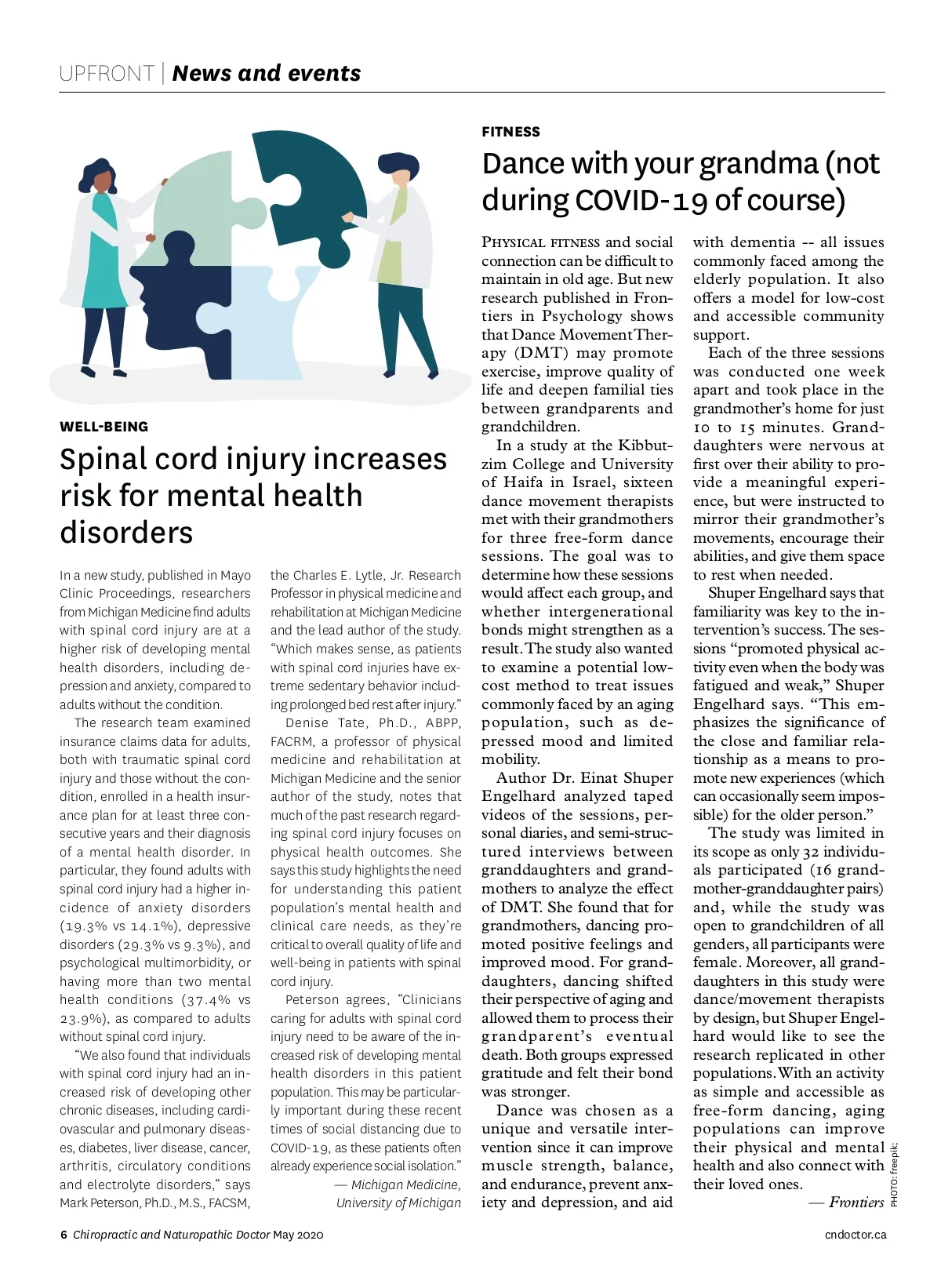
UPFRONT | News and events FITNESS Dance with your grandma (not during COVID-19 of course) Physical fitness and social connection can be difficult to maintain in old age. But new research published in Fron-tiers in Psychology shows that Dance Movement Ther-apy (DMT) may promote exercise, improve quality of life and deepen familial ties between grandparents and grandchildren. In a study at the Kibbut-zim College and University of Haifa in Israel, sixteen dance movement therapists met with their grandmothers for three free-form dance sessions. The goal was to determine how these sessions would affect each group, and whether intergenerational bonds might strengthen as a result. The study also wanted to examine a potential low-cost method to treat issues commonly faced by an aging population, such as de-pressed mood and limited mobility. Author Dr. Einat Shuper Engelhard analyzed taped videos of the sessions, per-sonal diaries, and semi-struc-tured interviews between granddaughters and grand-mothers to analyze the effect of DMT. She found that for grandmothers, dancing pro-moted positive feelings and improved mood. For grand-daughters, dancing shifted their perspective of aging and allowed them to process their grandparent’s eventual death. Both groups expressed gratitude and felt their bond was stronger. Dance was chosen as a unique and versatile inter-vention since it can improve muscle strength, balance, and endurance, prevent anx-iety and depression, and aid with dementia --all issues commonly faced among the elderly population. It also offers a model for low-cost and accessible community support. Each of the three sessions was conducted one week apart and took place in the grandmother’s home for just 10 to 15 minutes. Grand-daughters were nervous at first over their ability to pro-vide a meaningful experi-ence, but were instructed to mirror their grandmother’s movements, encourage their abilities, and give them space to rest when needed. Shuper Engelhard says that familiarity was key to the in-tervention’s success. The ses-sions “promoted physical ac-tivity even when the body was fatigued and weak,” Shuper Engelhard says. “This em-phasizes the significance of the close and familiar rela-tionship as a means to pro-mote new experiences (which can occasionally seem impos-sible) for the older person.” The study was limited in its scope as only 32 individu-als participated (16 grand-mother-granddaughter pairs) and, while the study was open to grandchildren of all genders, all participants were female. Moreover, all grand-daughters in this study were dance/movement therapists by design, but Shuper Engel-hard would like to see the research replicated in other populations. With an activity as simple and accessible as free-form dancing, aging populations can improve their physical and mental health and also connect with their loved ones. — Frontiers cndoctor.ca WELL-BEING Spinal cord injury increases risk for mental health disorders In a new study, published in Mayo Clinic Proceedings, researchers from Michigan Medicine find adults with spinal cord injury are at a higher risk of developing mental health disorders, including de-pression and anxiety, compared to adults without the condition. The research team examined insurance claims data for adults, both with traumatic spinal cord injury and those without the con-dition, enrolled in a health insur-ance plan for at least three con-secutive years and their diagnosis of a mental health disorder. In particular, they found adults with spinal cord injury had a higher in-cidence of anxiety disorders (19.3% vs 14.1%), depressive disorders (29.3% vs 9.3%), and psychological multimorbidity, or having more than two mental health conditions (37.4% vs 23.9%), as compared to adults without spinal cord injury. “We also found that individuals with spinal cord injury had an in-creased risk of developing other chronic diseases, including cardi-ovascular and pulmonary diseas-es, diabetes, liver disease, cancer, arthritis, circulatory conditions and electrolyte disorders,” says Mark Peterson, Ph.D., M.S., FACSM, the Charles E. Lytle, Jr. Research Professor in physical medicine and rehabilitation at Michigan Medicine and the lead author of the study. “Which makes sense, as patients with spinal cord injuries have ex-treme sedentary behavior includ-ing prolonged bed rest after injury.” Denise Tate, Ph.D., ABPP, FACRM, a professor of physical medicine and rehabilitation at Michigan Medicine and the senior author of the study, notes that much of the past research regard-ing spinal cord injury focuses on physical health outcomes. She says this study highlights the need for understanding this patient population’s mental health and clinical care needs, as they’re critical to overall quality of life and well-being in patients with spinal cord injury. Peterson agrees, “Clinicians caring for adults with spinal cord injury need to be aware of the in-creased risk of developing mental health disorders in this patient population. This may be particular-ly important during these recent times of social distancing due to COVID-19, as these patients often already experience social isolation.” — Michigan Medicine, University of Michigan 6 Chiropractic and Naturopathic Doctor May 2020 PHOTO: freepik;
Chiropractic + Naturopathic Doctor May 2020: Page 6