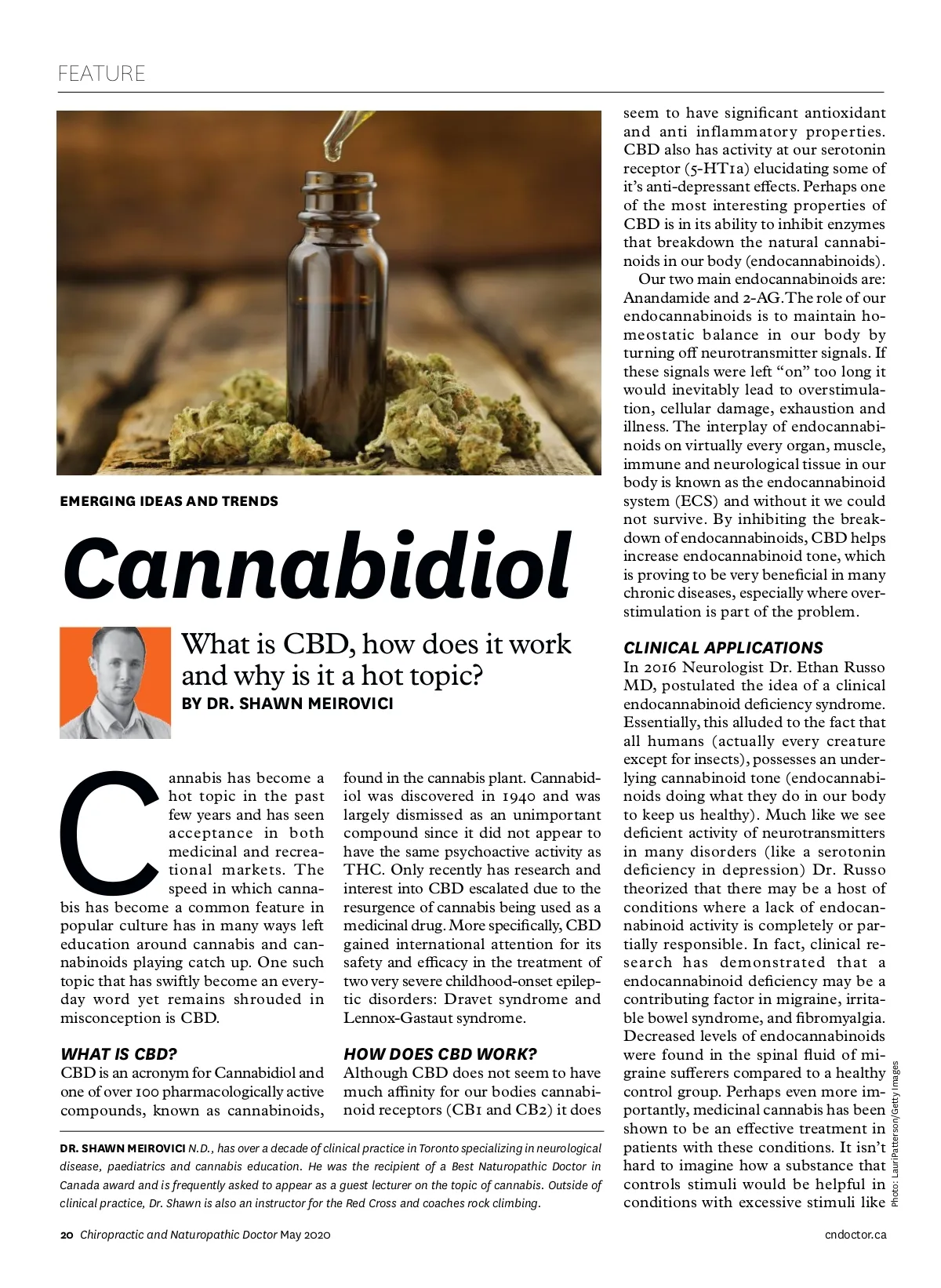
FEATURE seem to have significant antioxidant and anti inflammatory properties. CBD also has activity at our serotonin receptor (5-HT1a) elucidating some of it’s anti-depressant effects. Perhaps one of the most interesting properties of CBD is in its ability to inhibit enzymes that breakdown the natural cannabi-noids in our body (endocannabinoids). Our two main endocannabinoids are: Anandamide and 2-AG. The role of our endocannabinoids is to maintain ho-meostatic balance in our body by turning off neurotransmitter signals. If these signals were left “on” too long it would inevitably lead to overstimula-tion, cellular damage, exhaustion and illness. The interplay of endocannabi-noids on virtually every organ, muscle, immune and neurological tissue in our body is known as the endocannabinoid system (ECS) and without it we could not survive. By inhibiting the break-down of endocannabinoids, CBD helps increase endocannabinoid tone, which is proving to be very beneficial in many chronic diseases, especially where over-stimulation is part of the problem. EMERGING IDEAS AND TRENDS Cannabidiol What is CBD, how does it work and why is it a hot topic? CLINICAL APPLICATIONS C BY DR. SHAWN MEIROVICI annabis has become a hot topic in the past few years and has seen acceptance in both medicinal and recrea-tional markets. The speed in which canna-bis has become a common feature in popular culture has in many ways left education around cannabis and can-nabinoids playing catch up. One such topic that has swiftly become an every-day word yet remains shrouded in misconception is CBD. found in the cannabis plant. Cannabid-iol was discovered in 1940 and was largely dismissed as an unimportant compound since it did not appear to have the same psychoactive activity as THC. Only recently has research and interest into CBD escalated due to the resurgence of cannabis being used as a medicinal drug. More specifically, CBD gained international attention for its safety and efficacy in the treatment of two very severe childhood-onset epilep-tic disorders: Dravet syndrome and Lennox-Gastaut syndrome. CBD is an acronym for Cannabidiol and one of over 100 pharmacologically active compounds, known as cannabinoids, Although CBD does not seem to have much affinity for our bodies cannabi-noid receptors (CB1 and CB2) it does DR. SHAWN MEIROVICI N.D., has over a decade of clinical practice in Toronto specializing in neurological disease, paediatrics and cannabis education. He was the recipient of a Best Naturopathic Doctor in Canada award and is frequently asked to appear as a guest lecturer on the topic of cannabis. Outside of clinical practice, Dr. Shawn is also an instructor for the Red Cross and coaches rock climbing. 20 Chiropractic and Naturopathic Doctor May 2020 cndoctor.ca Photo: LauriPatterson/Getty Images WHAT IS CBD? HOW DOES CBD WORK? In 2016 Neurologist Dr. Ethan Russo MD, postulated the idea of a clinical endocannabinoid deficiency syndrome. Essentially, this alluded to the fact that all humans (actually every creature except for insects), possesses an under-lying cannabinoid tone (endocannabi-noids doing what they do in our body to keep us healthy). Much like we see deficient activity of neurotransmitters in many disorders (like a serotonin deficiency in depression) Dr. Russo theorized that there may be a host of conditions where a lack of endocan-nabinoid activity is completely or par-tially responsible. In fact, clinical re-search has demonstrated that a endocannabinoid deficiency may be a contributing factor in migraine, irrita-ble bowel syndrome, and fibromyalgia. Decreased levels of endocannabinoids were found in the spinal fluid of mi-graine sufferers compared to a healthy control group. Perhaps even more im-portantly, medicinal cannabis has been shown to be an effective treatment in patients with these conditions. It isn’t hard to imagine how a substance that controls stimuli would be helpful in conditions with excessive stimuli like
Chiropractic + Naturopathic Doctor May 2020: Page 20