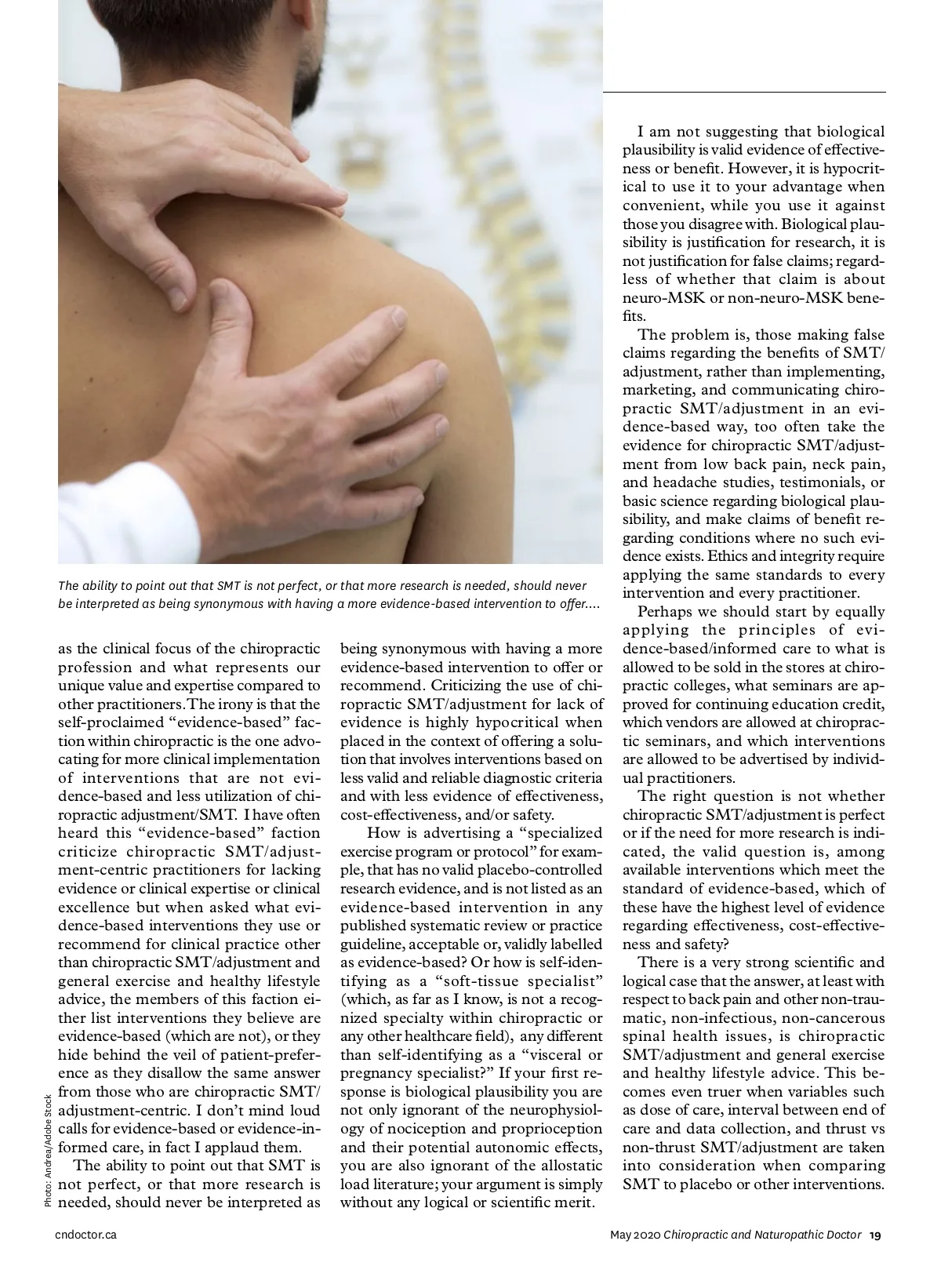
The ability to point out that SMT is not perfect, or that more research is needed, should never be interpreted as being synonymous with having a more evidence-based intervention to offer.... as the clinical focus of the chiropractic profession and what represents our unique value and expertise compared to other practitioners. The irony is that the self-proclaimed “evidence-based” fac-tion within chiropractic is the one advo-cating for more clinical implementation of interventions that are not evi-dence-based and less utilization of chi-ropractic adjustment/SMT. I have often heard this “evidence-based” faction criticize chiropractic SMT/adjust-ment-centric practitioners for lacking evidence or clinical expertise or clinical excellence but when asked what evi-dence-based interventions they use or recommend for clinical practice other than chiropractic SMT/adjustment and general exercise and healthy lifestyle advice, the members of this faction ei-ther list interventions they believe are evidence-based (which are not), or they hide behind the veil of patient-prefer-ence as they disallow the same answer from those who are chiropractic SMT/ adjustment-centric. I don’t mind loud calls for evidence-based or evidence-in-formed care, in fact I applaud them. The ability to point out that SMT is not perfect, or that more research is needed, should never be interpreted as cndoctor.ca being synonymous with having a more evidence-based intervention to offer or recommend. Criticizing the use of chi-ropractic SMT/adjustment for lack of evidence is highly hypocritical when placed in the context of offering a solu-tion that involves interventions based on less valid and reliable diagnostic criteria and with less evidence of effectiveness, cost-effectiveness, and/or safety. How is advertising a “specialized exercise program or protocol” for exam-ple, that has no valid placebo-controlled research evidence, and is not listed as an evidence-based intervention in any published systematic review or practice guideline, acceptable or, validly labelled as evidence-based? Or how is self-iden-tifying as a “soft-tissue specialist” (which, as far as I know, is not a recog-nized specialty within chiropractic or any other healthcare field), any different than self-identifying as a “visceral or pregnancy specialist?” If your first re-sponse is biological plausibility you are not only ignorant of the neurophysiol-ogy of nociception and proprioception and their potential autonomic effects, you are also ignorant of the allostatic load literature; your argument is simply without any logical or scientific merit. Photo: Andrea/Adobe Stock I am not suggesting that biological plausibility is valid evidence of effective-ness or benefit. However, it is hypocrit-ical to use it to your advantage when convenient, while you use it against those you disagree with. Biological plau-sibility is justification for research, it is not justification for false claims; regard-less of whether that claim is about neuro-MSK or non-neuro-MSK bene-fits. The problem is, those making false claims regarding the benefits of SMT/ adjustment, rather than implementing, marketing, and communicating chiro-practic SMT/adjustment in an evi-dence-based way, too often take the evidence for chiropractic SMT/adjust-ment from low back pain, neck pain, and headache studies, testimonials, or basic science regarding biological plau-sibility, and make claims of benefit re-garding conditions where no such evi-dence exists. Ethics and integrity require applying the same standards to every intervention and every practitioner. Perhaps we should start by equally applying the principles of evi-dence-based/informed care to what is allowed to be sold in the stores at chiro-practic colleges, what seminars are ap-proved for continuing education credit, which vendors are allowed at chiroprac-tic seminars, and which interventions are allowed to be advertised by individ-ual practitioners. The right question is not whether chiropractic SMT/adjustment is perfect or if the need for more research is indi-cated, the valid question is, among available interventions which meet the standard of evidence-based, which of these have the highest level of evidence regarding effectiveness, cost-effective-ness and safety? There is a very strong scientific and logical case that the answer, at least with respect to back pain and other non-trau-matic, non-infectious, non-cancerous spinal health issues, is chiropractic SMT/adjustment and general exercise and healthy lifestyle advice. This be-comes even truer when variables such as dose of care, interval between end of care and data collection, and thrust vs non-thrust SMT/adjustment are taken into consideration when comparing SMT to placebo or other interventions. May 2020 Chiropractic and Naturopathic Doctor 19
Chiropractic + Naturopathic Doctor May 2020: Page 19