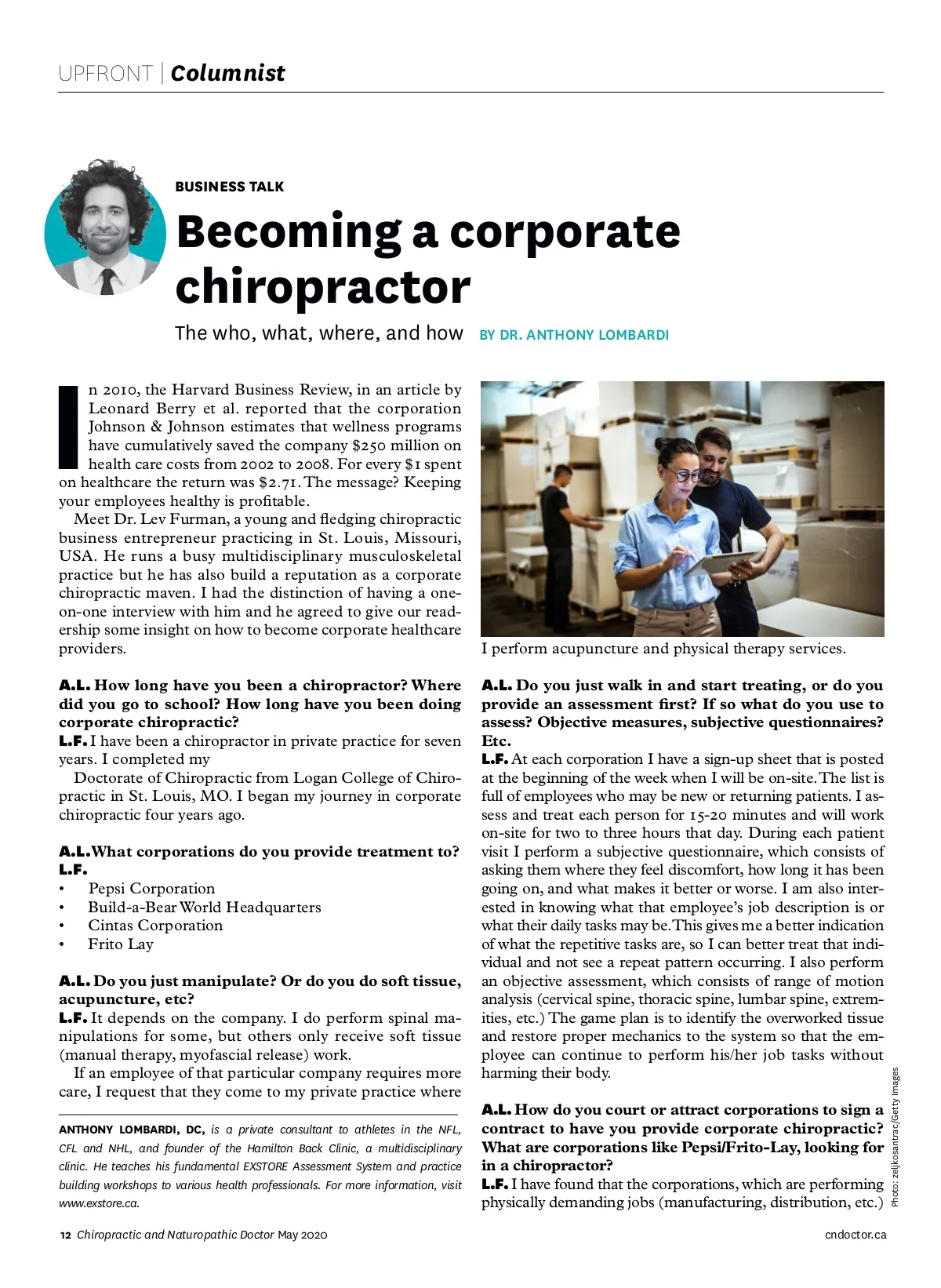
UPFRONT | Columnist BUSINESS TALK Becoming a corporate chiropractor I The who, what, where, and how BY DR. ANTHONY LOMBARDI n 2010, the Harvard Business Review, in an article by Leonard Berry et al. reported that the corporation Johnson & Johnson estimates that wellness programs have cumulatively saved the company $250 million on health care costs from 2002 to 2008. For every $1 spent on healthcare the return was $2.71. The message? Keeping your employees healthy is profitable. Meet Dr. Lev Furman, a young and fledging chiropractic business entrepreneur practicing in St. Louis, Missouri, USA. He runs a busy multidisciplinary musculoskeletal practice but he has also build a reputation as a corporate chiropractic maven. I had the distinction of having a one-on-one interview with him and he agreed to give our read-ership some insight on how to become corporate healthcare providers. I perform acupuncture and physical therapy services. A.L. How long have you been a chiropractor? Where did you go to school? How long have you been doing corporate chiropractic? L.F. I have been a chiropractor in private practice for seven years. I completed my Doctorate of Chiropractic from Logan College of Chiro-practic in St. Louis, MO. I began my journey in corporate chiropractic four years ago. A.L. What corporations do you provide treatment to? L.F. Pepsi Corporation Build-a-Bear World Headquarters Cintas Corporation Frito Lay A.L. Do you just walk in and start treating, or do you • • • • ANTHONY LOMBARDI, DC, is a private consultant to athletes in the NFL, CFL and NHL, and founder of the Hamilton Back Clinic, a multidisciplinary clinic. He teaches his fundamental EXSTORE Assessment System and practice building workshops to various health professionals. For more information, visit www.exstore.ca. 12 Chiropractic and Naturopathic Doctor May 2020 A.L. How do you court or attract corporations to sign a contract to have you provide corporate chiropractic? What are corporations like Pepsi/Frito-Lay, looking for in a chiropractor? L.F. I have found that the corporations, which are performing physically demanding jobs (manufacturing, distribution, etc.) cndoctor.ca Photo: zeljkosantrac/Getty Images A.L. Do you just manipulate? Or do you do soft tissue, acupuncture, etc? L.F. It depends on the company. I do perform spinal ma-nipulations for some, but others only receive soft tissue (manual therapy, myofascial release) work. If an employee of that particular company requires more care, I request that they come to my private practice where provide an assessment first? If so what do you use to assess? Objective measures, subjective questionnaires? Etc. L.F. At each corporation I have a sign-up sheet that is posted at the beginning of the week when I will be on-site. The list is full of employees who may be new or returning patients. I as-sess and treat each person for 15-20 minutes and will work on-site for two to three hours that day. During each patient visit I perform a subjective questionnaire, which consists of asking them where they feel discomfort, how long it has been going on, and what makes it better or worse. I am also inter-ested in knowing what that employee’s job description is or what their daily tasks may be. This gives me a better indication of what the repetitive tasks are, so I can better treat that indi-vidual and not see a repeat pattern occurring. I also perform an objective assessment, which consists of range of motion analysis (cervical spine, thoracic spine, lumbar spine, extrem-ities, etc.) The game plan is to identify the overworked tissue and restore proper mechanics to the system so that the em-ployee can continue to perform his/her job tasks without harming their body.
Chiropractic + Naturopathic Doctor May 2020: Page 12