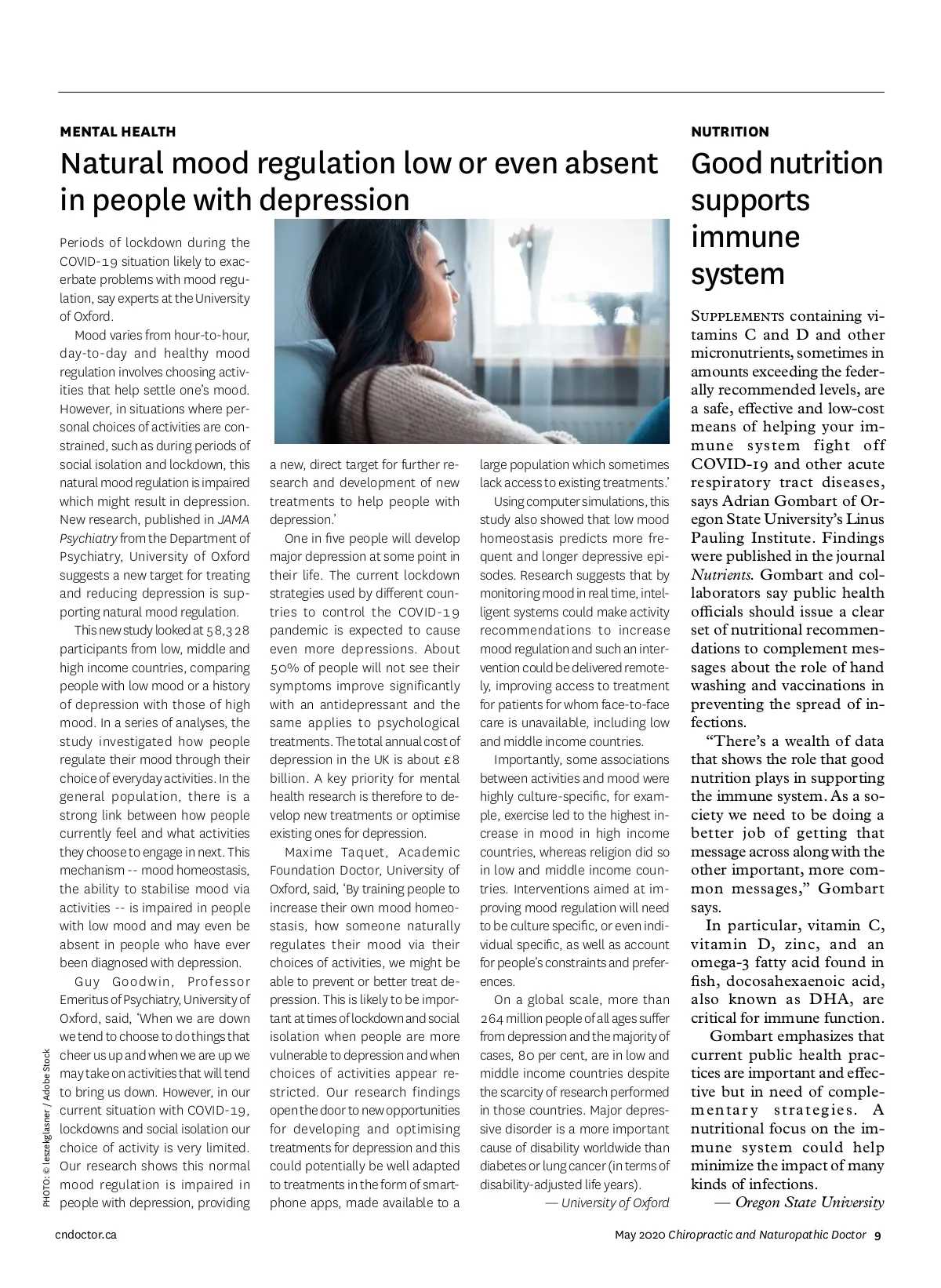
MENTAL HEALTH Natural mood regulation low or even absent Good nutrition in people with depression supports immune Periods of lockdown during the COVID-19 situation likely to exac-system erbate problems with mood regu-lation, say experts at the University of Oxford. Mood varies from hour-to-hour, day-to-day and healthy mood regulation involves choosing activ-ities that help settle one’s mood. However, in situations where per-sonal choices of activities are con-strained, such as during periods of social isolation and lockdown, this natural mood regulation is impaired which might result in depression. New research, published in JAMA Psychiatry from the Department of Psychiatry, University of Oxford suggests a new target for treating and reducing depression is sup-porting natural mood regulation. This new study looked at 58,328 participants from low, middle and high income countries, comparing people with low mood or a history of depression with those of high mood. In a series of analyses, the study investigated how people regulate their mood through their choice of everyday activities. In the general population, there is a strong link between how people currently feel and what activities they choose to engage in next. This mechanism --mood homeostasis, the ability to stabilise mood via activities --is impaired in people with low mood and may even be absent in people who have ever been diagnosed with depression. Guy Goodwin, Professor Emeritus of Psychiatry, University of Oxford, said, ‘When we are down we tend to choose to do things that cheer us up and when we are up we may take on activities that will tend to bring us down. However, in our current situation with COVID-19, lockdowns and social isolation our choice of activity is very limited. Our research shows this normal mood regulation is impaired in people with depression, providing cndoctor.ca NUTRITION a new, direct target for further re-search and development of new treatments to help people with depression.’ One in five people will develop major depression at some point in their life. The current lockdown strategies used by different coun-tries to control the COVID-19 pandemic is expected to cause even more depressions. About 50% of people will not see their symptoms improve significantly with an antidepressant and the same applies to psychological treatments. The total annual cost of depression in the UK is about £8 billion. A key priority for mental health research is therefore to de-velop new treatments or optimise existing ones for depression. Maxime Taquet, Academic Foundation Doctor, University of Oxford, said, ‘By training people to increase their own mood homeo-stasis, how someone naturally regulates their mood via their choices of activities, we might be able to prevent or better treat de-pression. This is likely to be impor-tant at times of lockdown and social isolation when people are more vulnerable to depression and when choices of activities appear re-stricted. Our research findings open the door to new opportunities for developing and optimising treatments for depression and this could potentially be well adapted to treatments in the form of smart-phone apps, made available to a large population which sometimes lack access to existing treatments.’ Using computer simulations, this study also showed that low mood homeostasis predicts more fre-quent and longer depressive epi-sodes. Research suggests that by monitoring mood in real time, intel-ligent systems could make activity recommendations to increase mood regulation and such an inter-vention could be delivered remote-ly, improving access to treatment for patients for whom face-to-face care is unavailable, including low and middle income countries. Importantly, some associations between activities and mood were highly culture-specific, for exam-ple, exercise led to the highest in-crease in mood in high income countries, whereas religion did so in low and middle income coun-tries. Interventions aimed at im-proving mood regulation will need to be culture specific, or even indi-vidual specific, as well as account for people’s constraints and prefer-ences. On a global scale, more than 264 million people of all ages suffer from depression and the majority of cases, 80 per cent, are in low and middle income countries despite the scarcity of research performed in those countries. Major depres-sive disorder is a more important cause of disability worldwide than diabetes or lung cancer (in terms of disability-adjusted life years). — University of Oxford Supplements containing vi-tamins C and D and other micronutrients, sometimes in amounts exceeding the feder-ally recommended levels, are a safe, effective and low-cost means of helping your im-mune system fight off COVID-19 and other acute respiratory tract diseases, says Adrian Gombart of Or-egon State University’s Linus Pauling Institute. Findings were published in the journal Nutrients. Gombart and col-laborators say public health officials should issue a clear set of nutritional recommen-dations to complement mes-sages about the role of hand washing and vaccinations in preventing the spread of in-fections. “There’s a wealth of data that shows the role that good nutrition plays in supporting the immune system. As a so-ciety we need to be doing a better job of getting that message across along with the other important, more com-mon messages,” Gombart says. In particular, vitamin C, vitamin D, zinc, and an omega-3 fatty acid found in fish, docosahexaenoic acid, also known as DHA, are critical for immune function. Gombart emphasizes that current public health prac-tices are important and effec-tive but in need of comple-mentary strategies. A nutritional focus on the im-mune system could help minimize the impact of many kinds of infections. — Oregon State University PHOTO: © leszekglasner / Adobe Stock May 2020 Chiropractic and Naturopathic Doctor 9
Chiropractic + Naturopathic Doctor May 2020: Page 9