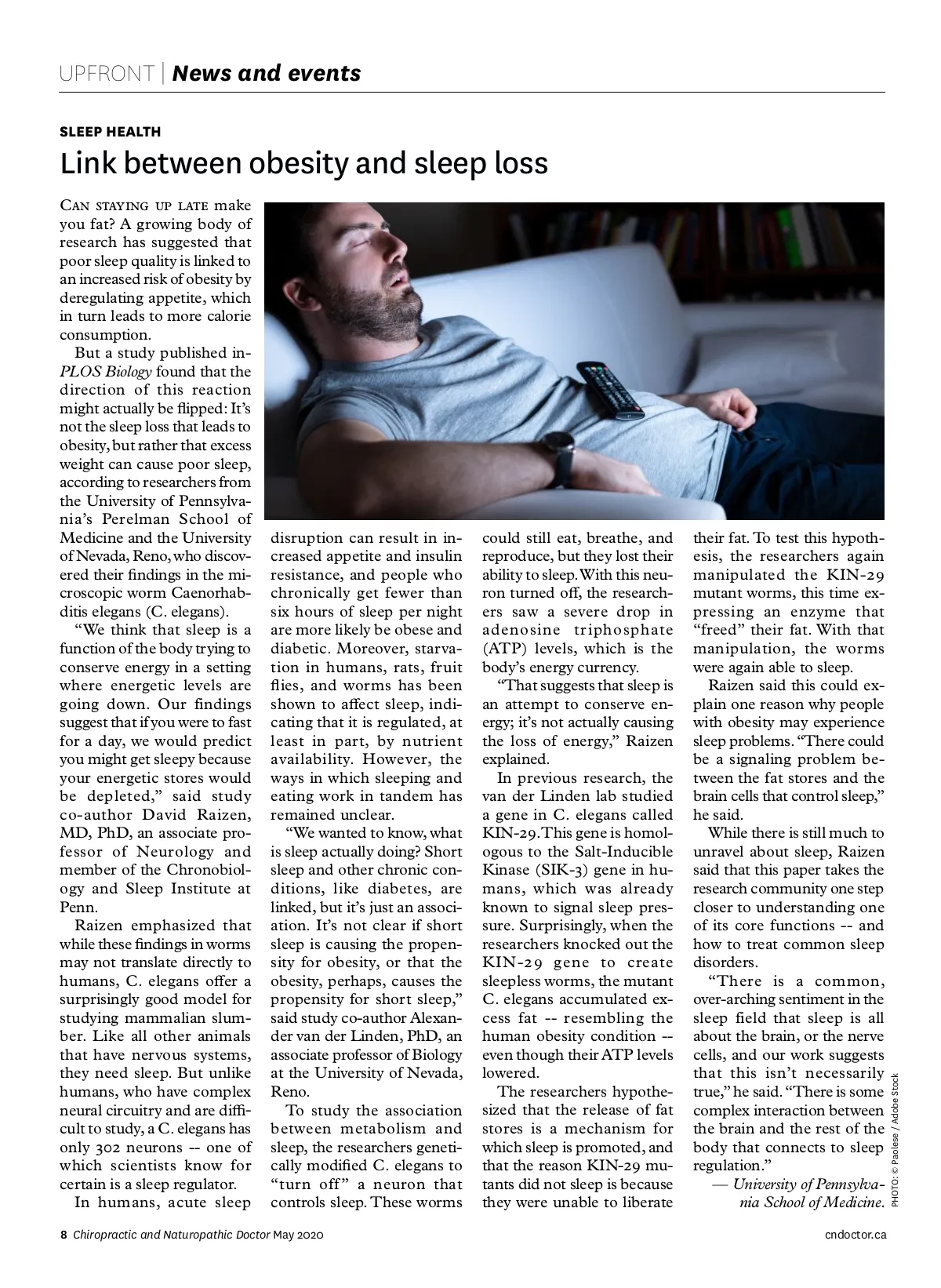
UPFRONT | News and events SLEEP HEALTH Link between obesity and sleep loss Can staying up late make you fat? A growing body of research has suggested that poor sleep quality is linked to an increased risk of obesity by deregulating appetite, which in turn leads to more calorie consumption. But a study published in-PLOS Biology found that the direction of this reaction might actually be flipped: It’s not the sleep loss that leads to obesity, but rather that excess weight can cause poor sleep, according to researchers from the University of Pennsylva-nia’s Perelman School of Medicine and the University of Nevada, Reno, who discov-ered their findings in the mi-croscopic worm Caenorhab-ditis elegans (C. elegans). “We think that sleep is a function of the body trying to conserve energy in a setting where energetic levels are going down. Our findings suggest that if you were to fast for a day, we would predict you might get sleepy because your energetic stores would be depleted,” said study co-author David Raizen, MD, PhD, an associate pro-fessor of Neurology and member of the Chronobiol-ogy and Sleep Institute at Penn. Raizen emphasized that while these findings in worms may not translate directly to humans, C. elegans offer a surprisingly good model for studying mammalian slum-ber. Like all other animals that have nervous systems, they need sleep. But unlike humans, who have complex neural circuitry and are diffi-cult to study, a C. elegans has only 302 neurons --one of which scientists know for certain is a sleep regulator. In humans, acute sleep disruption can result in in-creased appetite and insulin resistance, and people who chronically get fewer than six hours of sleep per night are more likely be obese and diabetic. Moreover, starva-tion in humans, rats, fruit flies, and worms has been shown to affect sleep, indi-cating that it is regulated, at least in part, by nutrient availability. However, the ways in which sleeping and eating work in tandem has remained unclear. “We wanted to know, what is sleep actually doing? Short sleep and other chronic con-ditions, like diabetes, are linked, but it’s just an associ-ation. It’s not clear if short sleep is causing the propen-sity for obesity, or that the obesity, perhaps, causes the propensity for short sleep,” said study co-author Alexan-der van der Linden, PhD, an associate professor of Biology at the University of Nevada, Reno. To study the association between metabolism and sleep, the researchers geneti-cally modified C. elegans to “turn off ” a neuron that controls sleep. These worms could still eat, breathe, and reproduce, but they lost their ability to sleep. With this neu-ron turned off, the research-ers saw a severe drop in adenosine triphosphate (ATP) levels, which is the body’s energy currency. “That suggests that sleep is an attempt to conserve en-ergy; it’s not actually causing the loss of energy,” Raizen explained. In previous research, the van der Linden lab studied a gene in C. elegans called KIN-29. This gene is homol-ogous to the Salt-Inducible Kinase (SIK-3) gene in hu-mans, which was already known to signal sleep pres-sure. Surprisingly, when the researchers knocked out the KIN-29 gene to create sleepless worms, the mutant C. elegans accumulated ex-cess fat --resembling the human obesity condition --even though their ATP levels lowered. The researchers hypothe-sized that the release of fat stores is a mechanism for which sleep is promoted, and that the reason KIN-29 mu-tants did not sleep is because they were unable to liberate their fat. To test this hypoth-esis, the researchers again manipulated the KIN-29 mutant worms, this time ex-pressing an enzyme that “freed” their fat. With that manipulation, the worms were again able to sleep. Raizen said this could ex-plain one reason why people with obesity may experience sleep problems. “There could be a signaling problem be-tween the fat stores and the brain cells that control sleep,” he said. While there is still much to unravel about sleep, Raizen said that this paper takes the research community one step closer to understanding one of its core functions --and how to treat common sleep disorders. “There is a common, over-arching sentiment in the sleep field that sleep is all about the brain, or the nerve cells, and our work suggests that this isn’t necessarily true,” he said. “There is some complex interaction between the brain and the rest of the body that connects to sleep regulation.” — University of Pennsylva-nia School of Medicine. cndoctor.ca 8 Chiropractic and Naturopathic Doctor May 2020 PHOTO: © Paolese / Adobe Stock
Chiropractic + Naturopathic Doctor May 2020: Page 8