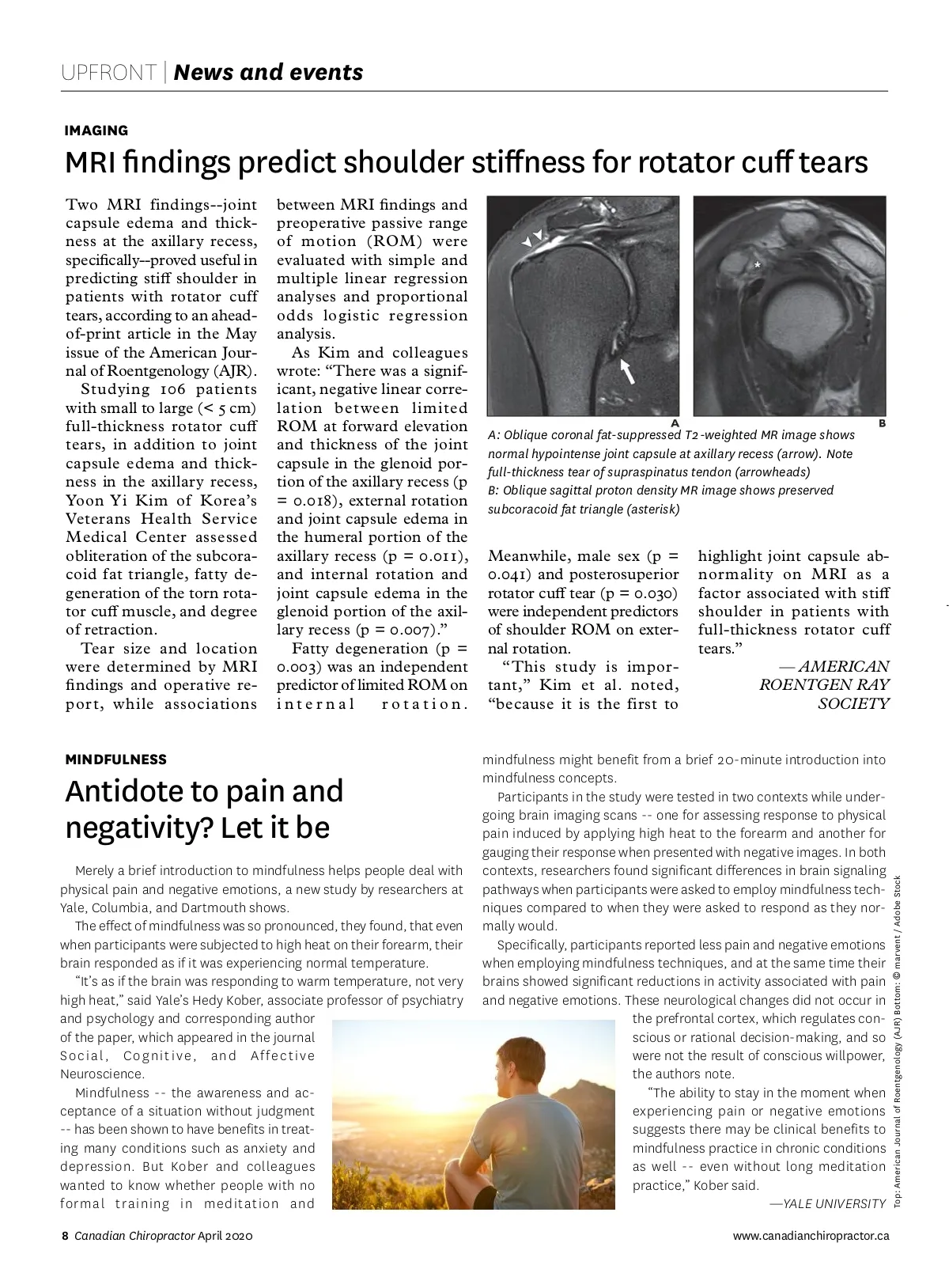
UPFRONT | News and events IMAGING MRI findings predict shoulder stiffness for rotator cuff tears Two MRI findings--joint capsule edema and thick-ness at the axillary recess, specifically--proved useful in predicting stiff shoulder in patients with rotator cuff tears, according to an ahead-of-print article in the May issue of the American Jour-nal of Roentgenology (AJR). Studying 106 patients with small to large (< 5 cm) full-thickness rotator cuff tears, in addition to joint capsule edema and thick-ness in the axillary recess, Yoon Yi Kim of Korea’s Veterans Health Service Medical Center assessed obliteration of the subcora-coid fat triangle, fatty de-generation of the torn rota-tor cuff muscle, and degree of retraction. Tear size and location were determined by MRI findings and operative re-port, while associations between MRI findings and preoperative passive range of motion (ROM) were evaluated with simple and multiple linear regression analyses and proportional odds logistic regression analysis. As Kim and colleagues wrote: “There was a signif-icant, negative linear corre-lation between limited ROM at forward elevation and thickness of the joint capsule in the glenoid por-tion of the axillary recess (p = 0.018), external rotation and joint capsule edema in the humeral portion of the axillary recess (p = 0.011), and internal rotation and joint capsule edema in the glenoid portion of the axil-lary recess (p = 0.007).” Fatty degeneration (p = 0.003) was an independent predictor of limited ROM on internal rotation. A: Oblique coronal fat-suppressed T2-weighted MR image shows normal hypointense joint capsule at axillary recess (arrow). Note full-thickness tear of supraspinatus tendon (arrowheads) B: Oblique sagittal proton density MR image shows preserved subcoracoid fat triangle (asterisk) Meanwhile, male sex (p = 0.041) and posterosuperior rotator cuff tear (p = 0.030) were independent predictors of shoulder ROM on exter-nal rotation. “This study is impor-tant,” Kim et al. noted, “because it is the first to highlight joint capsule ab-normality on MRI as a factor associated with stiff shoulder in patients with full-thickness rotator cuff tears.” — AMERICAN ROENTGEN RAY SOCIETY MINDFULNESS Antidote to pain and negativity? Let it be Merely a brief introduction to mindfulness helps people deal with physical pain and negative emotions, a new study by researchers at Yale, Columbia, and Dartmouth shows. The effect of mindfulness was so pronounced, they found, that even when participants were subjected to high heat on their forearm, their brain responded as if it was experiencing normal temperature. “It’s as if the brain was responding to warm temperature, not very high heat,” said Yale’s Hedy Kober, associate professor of psychiatry and psychology and corresponding author of the paper, which appeared in the journal Social, Cognitive, and Affective Neuroscience. Mindfulness --the awareness and ac-ceptance of a situation without judgment --has been shown to have benefits in treat-ing many conditions such as anxiety and depression. But Kober and colleagues wanted to know whether people with no formal training in meditation and 8 Canadian Chiropractor April 2020 mindfulness might benefit from a brief 20-minute introduction into mindfulness concepts. Participants in the study were tested in two contexts while under-going brain imaging scans --one for assessing response to physical pain induced by applying high heat to the forearm and another for gauging their response when presented with negative images. In both contexts, researchers found significant differences in brain signaling pathways when participants were asked to employ mindfulness tech-niques compared to when they were asked to respond as they nor-mally would. Specifically, participants reported less pain and negative emotions when employing mindfulness techniques, and at the same time their brains showed significant reductions in activity associated with pain and negative emotions. These neurological changes did not occur in the prefrontal cortex, which regulates con-scious or rational decision-making, and so were not the result of conscious willpower, the authors note. “The ability to stay in the moment when experiencing pain or negative emotions suggests there may be clinical benefits to mindfulness practice in chronic conditions as well --even without long meditation practice,” Kober said. —YALE UNIVERSITY www.canadianchiropractor.ca Top: American Journal of Roentgenology (AJR) Bottom: © marvent / Adobe Stock
Chiropractic + Naturopathic Doctor April 2020: Page 8