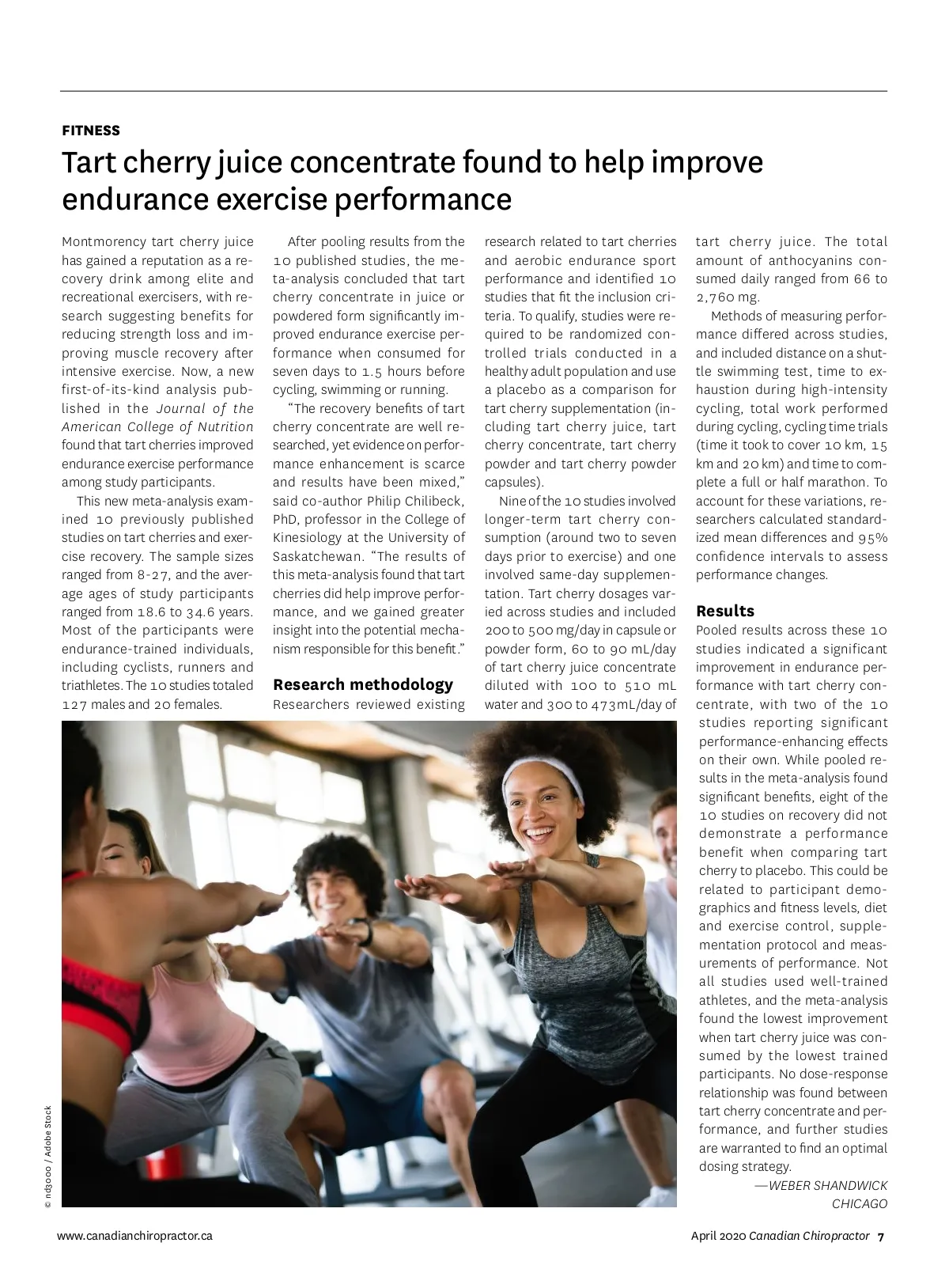
FITNESS Tart cherry juice concentrate found to help improve endurance exercise performance Montmorency tart cherry juice has gained a reputation as a re-covery drink among elite and recreational exercisers, with re-search suggesting benefits for reducing strength loss and im-proving muscle recovery after intensive exercise. Now, a new first-of-its-kind analysis pub-lished in the Journal of the American College of Nutrition found that tart cherries improved endurance exercise performance among study participants. This new meta-analysis exam-ined 10 previously published studies on tart cherries and exer-cise recovery. The sample sizes ranged from 8-27, and the aver-age ages of study participants ranged from 18.6 to 34.6 years. Most of the participants were endurance-trained individuals, including cyclists, runners and triathletes. The 10 studies totaled 127 males and 20 females. After pooling results from the 10 published studies, the me-ta-analysis concluded that tart cherry concentrate in juice or powdered form significantly im-proved endurance exercise per-formance when consumed for seven days to 1.5 hours before cycling, swimming or running. “The recovery benefits of tart cherry concentrate are well re-searched, yet evidence on perfor-mance enhancement is scarce and results have been mixed,” said co-author Philip Chilibeck, PhD, professor in the College of Kinesiology at the University of Saskatchewan. “The results of this meta-analysis found that tart cherries did help improve perfor-mance, and we gained greater insight into the potential mecha-nism responsible for this benefit.” research related to tart cherries and aerobic endurance sport performance and identified 10 studies that fit the inclusion cri-teria. To qualify, studies were re-quired to be randomized con-trolled trials conducted in a healthy adult population and use a placebo as a comparison for tart cherry supplementation (in-cluding tart cherry juice, tart cherry concentrate, tart cherry powder and tart cherry powder capsules). Nine of the 10 studies involved longer-term tart cherry con-sumption (around two to seven days prior to exercise) and one involved same-day supplemen-tation. Tart cherry dosages var-ied across studies and included 200 to 500 mg/day in capsule or powder form, 60 to 90 mL/day of tart cherry juice concentrate diluted with 100 to 510 mL water and 300 to 473mL/day of tart cherry juice. The total amount of anthocyanins con-sumed daily ranged from 66 to 2,760 mg. Methods of measuring perfor-mance differed across studies, and included distance on a shut-tle swimming test, time to ex-haustion during high-intensity cycling, total work performed during cycling, cycling time trials (time it took to cover 10 km, 15 km and 20 km) and time to com-plete a full or half marathon. To account for these variations, re-searchers calculated standard-ized mean differences and 95% confidence intervals to assess performance changes. Results Pooled results across these 10 studies indicated a significant improvement in endurance per-formance with tart cherry con-centrate, with two of the 10 studies reporting significant performance-enhancing effects on their own. While pooled re-sults in the meta-analysis found significant benefits, eight of the 10 studies on recovery did not demonstrate a performance benefit when comparing tart cherry to placebo. This could be related to participant demo-graphics and fitness levels, diet and exercise control, supple-mentation protocol and meas-urements of performance. Not all studies used well-trained athletes, and the meta-analysis found the lowest improvement when tart cherry juice was con-sumed by the lowest trained participants. No dose-response relationship was found between tart cherry concentrate and per-formance, and further studies are warranted to find an optimal dosing strategy. —WEBER SHANDWICK CHICAGO April 2020 Canadian Chiropractor 7 Research methodology Researchers reviewed existing © nd3000 / Adobe Stock www.canadianchiropractor.ca
Chiropractic + Naturopathic Doctor April 2020: Page 7