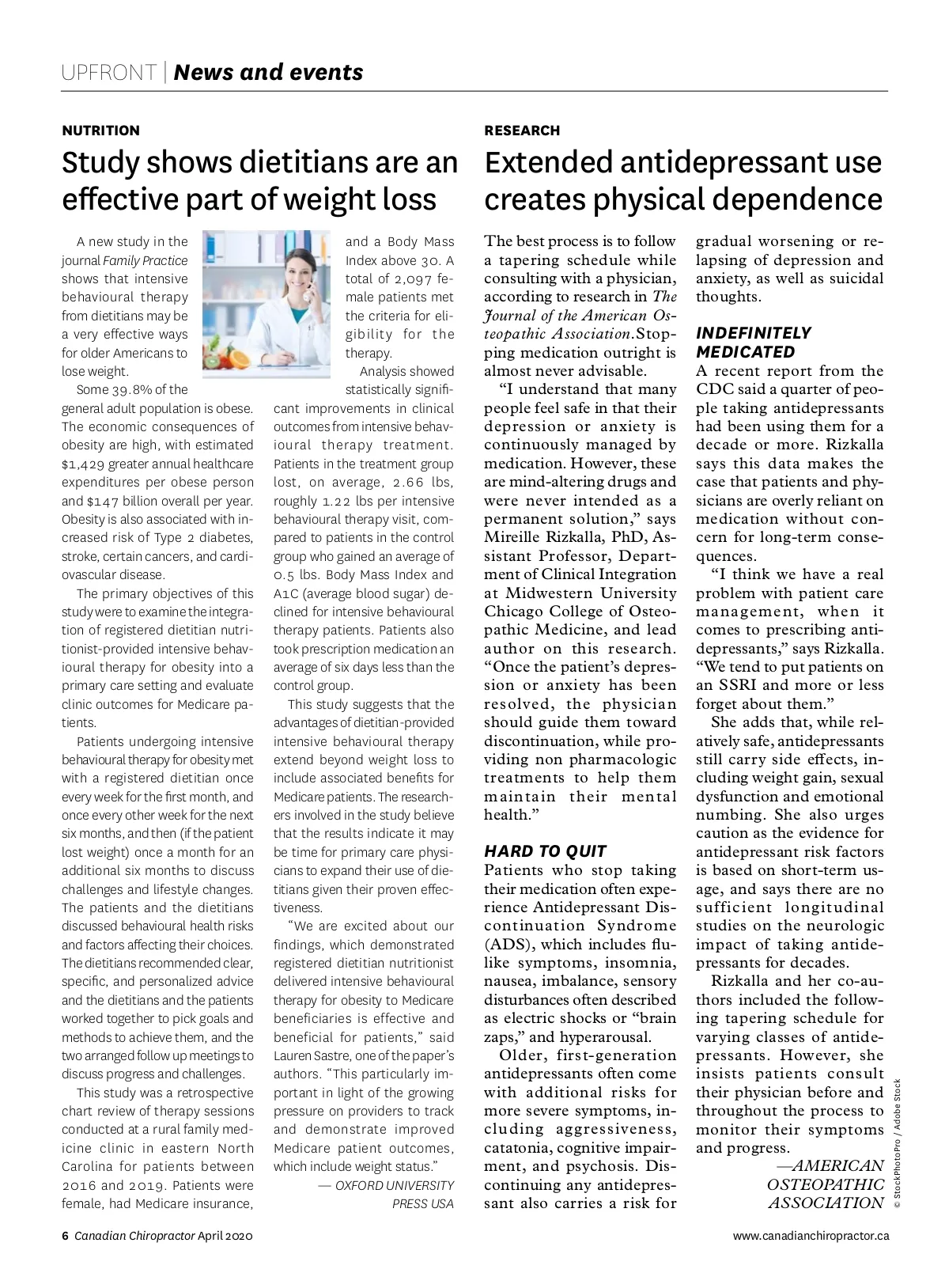
UPFRONT | News and events NUTRITION Study shows dietitians are an Extended antidepressant use effective part of weight loss creates physical dependence A new study in the journal Family Practice shows that intensive behavioural therapy from dietitians may be a very effective ways for older Americans to lose weight. Some 39.8% of the general adult population is obese. The economic consequences of obesity are high, with estimated $1,429 greater annual healthcare expenditures per obese person and $147 billion overall per year. Obesity is also associated with in-creased risk of Type 2 diabetes, stroke, certain cancers, and cardi-ovascular disease. The primary objectives of this study were to examine the integra-tion of registered dietitian nutri-tionist-provided intensive behav-ioural therapy for obesity into a primary care setting and evaluate clinic outcomes for Medicare pa-tients. Patients undergoing intensive behavioural therapy for obesity met with a registered dietitian once every week for the first month, and once every other week for the next six months, and then (if the patient lost weight) once a month for an additional six months to discuss challenges and lifestyle changes. The patients and the dietitians discussed behavioural health risks and factors affecting their choices. The dietitians recommended clear, specific, and personalized advice and the dietitians and the patients worked together to pick goals and methods to achieve them, and the two arranged follow up meetings to discuss progress and challenges. This study was a retrospective chart review of therapy sessions conducted at a rural family med-icine clinic in eastern North Carolina for patients between 2016 and 2019. Patients were female, had Medicare insurance, 6 Canadian Chiropractor April 2020 RESEARCH and a Body Mass Index above 30. A total of 2,097 fe-male patients met the criteria for eli-gibility for the therapy. Analysis showed statistically signifi-cant improvements in clinical outcomes from intensive behav-ioural therapy treatment. Patients in the treatment group lost, on average, 2.66 lbs, roughly 1.22 lbs per intensive behavioural therapy visit, com-pared to patients in the control group who gained an average of 0.5 lbs. Body Mass Index and A1C (average blood sugar) de-clined for intensive behavioural therapy patients. Patients also took prescription medication an average of six days less than the control group. This study suggests that the advantages of dietitian-provided intensive behavioural therapy extend beyond weight loss to include associated benefits for Medicare patients. The research-ers involved in the study believe that the results indicate it may be time for primary care physi-cians to expand their use of die-titians given their proven effec-tiveness. “We are excited about our findings, which demonstrated registered dietitian nutritionist delivered intensive behavioural therapy for obesity to Medicare beneficiaries is effective and beneficial for patients,” said Lauren Sastre, one of the paper’s authors. “This particularly im-portant in light of the growing pressure on providers to track and demonstrate improved Medicare patient outcomes, which include weight status.” — OXFORD UNIVERSITY PRESS USA The best process is to follow a tapering schedule while consulting with a physician, according to research in The Journal of the American Os-teopathic Association. Stop-ping medication outright is almost never advisable. “I understand that many people feel safe in that their depression or anxiety is continuously managed by medication. However, these are mind-altering drugs and were never intended as a permanent solution,” says Mireille Rizkalla, PhD, As-sistant Professor, Depart-ment of Clinical Integration at Midwestern University Chicago College of Osteo-pathic Medicine, and lead author on this research. “Once the patient’s depres-sion or anxiety has been resolved, the physician should guide them toward discontinuation, while pro-viding non pharmacologic treatments to help them maintain their mental health.” gradual worsening or re-lapsing of depression and anxiety, as well as suicidal thoughts. INDEFINITELY MEDICATED HARD TO QUIT Patients who stop taking their medication often expe-rience Antidepressant Dis-continuation Syndrome (ADS), which includes flu-like symptoms, insomnia, nausea, imbalance, sensory disturbances often described as electric shocks or “brain zaps,” and hyperarousal. Older, first-generation antidepressants often come with additional risks for more severe symptoms, in-cluding aggressiveness, catatonia, cognitive impair-ment, and psychosis. Dis-continuing any antidepres-sant also carries a risk for A recent report from the CDC said a quarter of peo-ple taking antidepressants had been using them for a decade or more. Rizkalla says this data makes the case that patients and phy-sicians are overly reliant on medication without con-cern for long-term conse-quences. “I think we have a real problem with patient care management, when it comes to prescribing anti-depressants,” says Rizkalla. “We tend to put patients on an SSRI and more or less forget about them.” She adds that, while rel-atively safe, antidepressants still carry side effects, in-cluding weight gain, sexual dysfunction and emotional numbing. She also urges caution as the evidence for antidepressant risk factors is based on short-term us-age, and says there are no sufficient longitudinal studies on the neurologic impact of taking antide-pressants for decades. Rizkalla and her co-au-thors included the follow-ing tapering schedule for varying classes of antide-pressants. However, she insists patients consult their physician before and throughout the process to monitor their symptoms and progress. —AMERICAN OSTEOPATHIC ASSOCIATION www.canadianchiropractor.ca © StockPhotoPro / Adobe Stock
Chiropractic + Naturopathic Doctor April 2020: Page 6