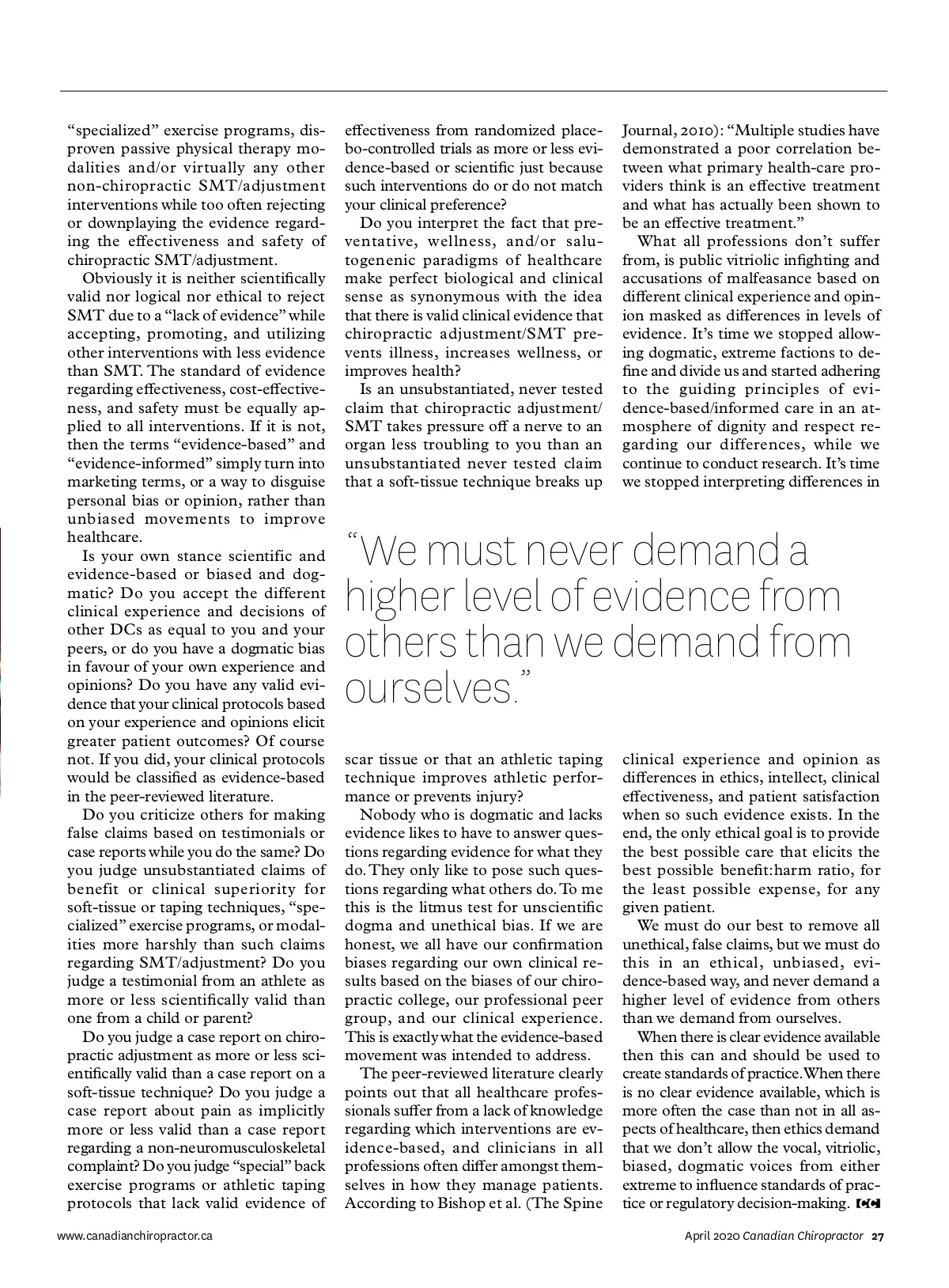
FEATURE PROFESSION UNITING AROUND THE EVIDENCE Guiding principles for practitioners BY DR. JAMES L. CHESTNUT H aldeman and Degenais elegantly describe what being an evi-dence-based/ informed practitioner entails in their 2008 article in The Spine Journal : “The guiding principle be-hind evidence-informed management is that practitioners should be aware of and use research evidence when available, make personal recommen-dations based on clinical experience when it is not available, and be trans-parent about the process used to reach their conclusion.” I would say this principle applies to care directly provided by any given practitioner, and also to care provided via collaboration with, and/or referrals to, other practitioners. How could any ethical healthcare practitioner disagree with this guiding principle? Only when we as a profession, ethi-cally and objectively apply this guiding principle will we unite, express our potential, and earn the cultural author-ity, interprofessional respect, referrals, inclusivity, and reimbursement that the evidence clearly indicates we deserve. The evidence-based care movement is the best thing to ever happen to chiropractic. It has created an even playing field and a demand that care be based on evidence, not unearned cultural authority and monopoly, cre-dentials, or lobbying power. The evidence is on our side but we have refused to allow the available evidence to unite us. Instead, we have allowed two small, vocal, and too often vitriolic extremes within our profes-sion apply the guiding principles of evidence-based care and divided us. Both groups are guilty of bias and dogma.One extreme tends to exagger-ate the evidence and blindly accept any claim regarding the need and benefit of chiropractic SMT/adjust-ment. They will often blindly deny the benefits of other interventions based on a misguided “principle” that chiro-practic practice must always reflect the vision of its founders and only include “straight” chiropractic adjustments and not any other “mixing” interven-tions – even if they are evidence-based. Clearly this is an unscientific, illogical, Is your own stance scientific and evidence-based, or biased and dogmatic? DR. JAMES CHESNUT B.Ed, M.Sc, DC, C.C.W.P., recently developed the Evidence-Based Chiropractic and Lifestyle Clinical Protocols which include evidence-based spinal health exams, reports, and patient education; these protocols are in use in chiropractic offices around the world. Dr. Chestnut also developed, wrote the texts, and still teaches the Evidence-Based Chiropractic and Lifestyle post-graduate certification program accredited through the International Chiropractors Association (ICA). Dr. Chestnut also wrote the book ‘Live Right for Your Species Type’, explaining the relationship between lifestyle, stressors, epigenetics, metabolic adaptation, and states of sickness and health. 26 Canadian Chiropractor April 2020 dogmatic stance. Chiropractic is not a religion or a cult: we follow basic sci-ence, clinical evidence and experience. The chiropractic paradigm of ad-dressing the cause and restoring function rather than treating symp-toms of dysfunction, as well as under-standing the relationship between segmental motion, spinal health, neuromusculoskeletal health, and overall health and quality of life are important in guiding our research and clinical decisions. But we must never use paradigm or philosophy as evidence for the need for care, or as evidence of benefit from care. The other extreme tends to exagger-ate and blindly accept the validity of unproven soft-tissue therapies, www.canadianchiropractor.ca © kasto / Adobe Stock
Chiropractic + Naturopathic Doctor April 2020: Page 26