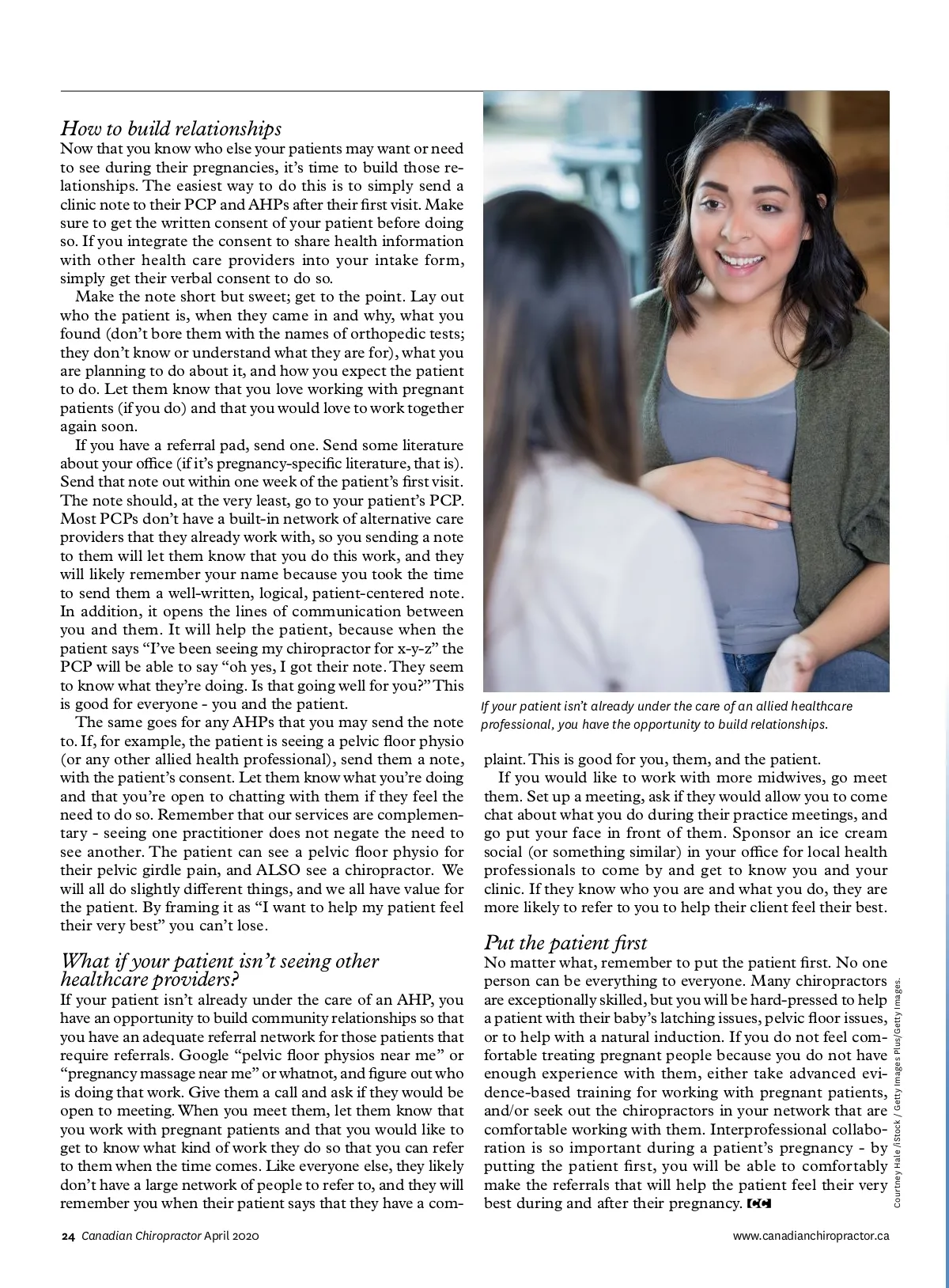
How to build relationships Now that you know who else your patients may want or need to see during their pregnancies, it’s time to build those re-lationships. The easiest way to do this is to simply send a clinic note to their PCP and AHPs after their first visit. Make sure to get the written consent of your patient before doing so. If you integrate the consent to share health information with other health care providers into your intake form, simply get their verbal consent to do so. Make the note short but sweet; get to the point. Lay out who the patient is, when they came in and why, what you found (don’t bore them with the names of orthopedic tests; they don’t know or understand what they are for), what you are planning to do about it, and how you expect the patient to do. Let them know that you love working with pregnant patients (if you do) and that you would love to work together again soon. If you have a referral pad, send one. Send some literature about your office (if it’s pregnancy-specific literature, that is). Send that note out within one week of the patient’s first visit. The note should, at the very least, go to your patient’s PCP. Most PCPs don’t have a built-in network of alternative care providers that they already work with, so you sending a note to them will let them know that you do this work, and they will likely remember your name because you took the time to send them a well-written, logical, patient-centered note. In addition, it opens the lines of communication between you and them. It will help the patient, because when the patient says “I’ve been seeing my chiropractor for x-y-z” the PCP will be able to say “oh yes, I got their note. They seem to know what they’re doing. Is that going well for you?” This is good for everyone -you and the patient. The same goes for any AHPs that you may send the note to. If, for example, the patient is seeing a pelvic floor physio (or any other allied health professional), send them a note, with the patient’s consent. Let them know what you’re doing and that you’re open to chatting with them if they feel the need to do so. Remember that our services are complemen-tary -seeing one practitioner does not negate the need to see another. The patient can see a pelvic floor physio for their pelvic girdle pain, and ALSO see a chiropractor. We will all do slightly different things, and we all have value for the patient. By framing it as “I want to help my patient feel their very best” you can’t lose. If your patient isn’t already under the care of an allied healthcare professional, you have the opportunity to build relationships. plaint. This is good for you, them, and the patient. If you would like to work with more midwives, go meet them. Set up a meeting, ask if they would allow you to come chat about what you do during their practice meetings, and go put your face in front of them. Sponsor an ice cream social (or something similar) in your office for local health professionals to come by and get to know you and your clinic. If they know who you are and what you do, they are more likely to refer to you to help their client feel their best. If your patient isn’t already under the care of an AHP, you have an opportunity to build community relationships so that you have an adequate referral network for those patients that require referrals. Google “pelvic floor physios near me” or “pregnancy massage near me” or whatnot, and figure out who is doing that work. Give them a call and ask if they would be open to meeting. When you meet them, let them know that you work with pregnant patients and that you would like to get to know what kind of work they do so that you can refer to them when the time comes. Like everyone else, they likely don’t have a large network of people to refer to, and they will remember you when their patient says that they have a com-24 Canadian Chiropractor April 2020 www.canadianchiropractor.ca Courtney Hale / iStock / Getty Images Plus/Getty Images. What if your patient isn’t seeing other healthcare providers? Put the patient first No matter what, remember to put the patient first. No one person can be everything to everyone. Many chiropractors are exceptionally skilled, but you will be hard-pressed to help a patient with their baby’s latching issues, pelvic floor issues, or to help with a natural induction. If you do not feel com-fortable treating pregnant people because you do not have enough experience with them, either take advanced evi-dence-based training for working with pregnant patients, and/or seek out the chiropractors in your network that are comfortable working with them. Interprofessional collabo-ration is so important during a patient’s pregnancy -by putting the patient first, you will be able to comfortably make the referrals that will help the patient feel their very best during and after their pregnancy.
Chiropractic + Naturopathic Doctor April 2020: Page 24