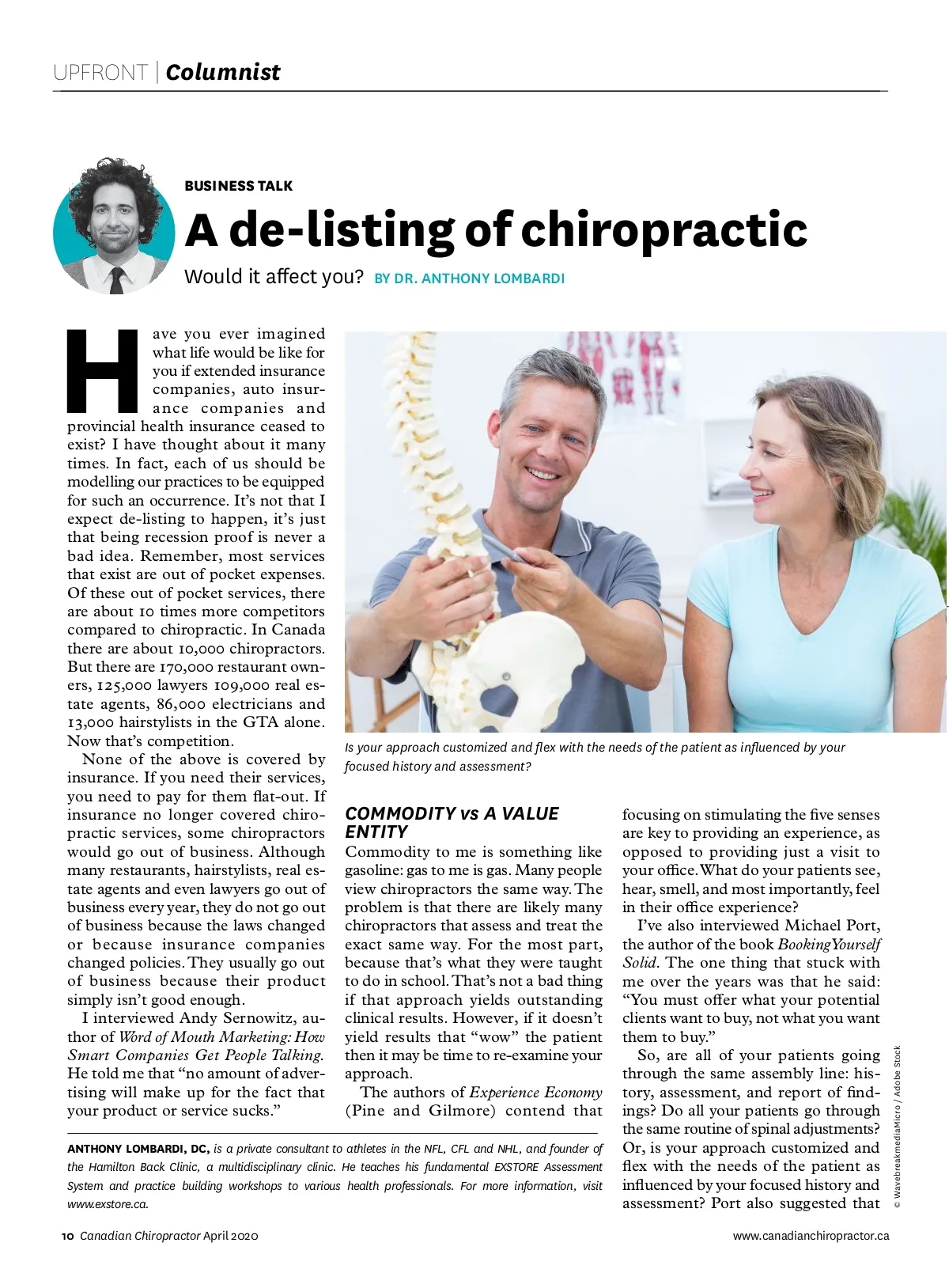
UPFRONT | Columnist BUSINESS TALK A de-listing of chiropractic H Would it affect you? BY DR. ANTHONY LOMBARDI ANTHONY LOMBARDI, DC, is a private consultant to athletes in the NFL, CFL and NHL, and founder of the Hamilton Back Clinic, a multidisciplinary clinic. He teaches his fundamental EXSTORE Assessment System and practice building workshops to various health professionals. For more information, visit www.exstore.ca. 10 Canadian Chiropractor April 2020 www.canadianchiropractor.ca © WavebreakmediaMicro / Adobe Stock ave you ever imagined what life would be like for you if extended insurance companies, auto insur-ance companies and provincial health insurance ceased to exist? I have thought about it many times. In fact, each of us should be modelling our practices to be equipped for such an occurrence. It’s not that I expect de-listing to happen, it’s just that being recession proof is never a bad idea. Remember, most services that exist are out of pocket expenses. Of these out of pocket services, there are about 10 times more competitors compared to chiropractic. In Canada there are about 10,000 chiropractors. But there are 170,000 restaurant own-ers, 125,000 lawyers 109,000 real es-tate agents, 86,000 electricians and 13,000 hairstylists in the GTA alone. Now that’s competition. None of the above is covered by insurance. If you need their services, you need to pay for them flat-out. If insurance no longer covered chiro-practic services, some chiropractors would go out of business. Although many restaurants, hairstylists, real es-tate agents and even lawyers go out of business every year, they do not go out of business because the laws changed or because insurance companies changed policies. They usually go out of business because their product simply isn’t good enough. I interviewed Andy Sernowitz, au-thor of Word of Mouth Marketing: How Smart Companies Get People Talking. He told me that “no amount of adver-tising will make up for the fact that your product or service sucks.” Is your approach customized and flex with the needs of the patient as influenced by your focused history and assessment? COMMODITY vs A VALUE ENTITY Commodity to me is something like gasoline: gas to me is gas. Many people view chiropractors the same way. The problem is that there are likely many chiropractors that assess and treat the exact same way. For the most part, because that’s what they were taught to do in school. That’s not a bad thing if that approach yields outstanding clinical results. However, if it doesn’t yield results that “wow” the patient then it may be time to re-examine your approach. The authors of Experience Economy (Pine and Gilmore) contend that focusing on stimulating the five senses are key to providing an experience, as opposed to providing just a visit to your office. What do your patients see, hear, smell, and most importantly, feel in their office experience? I’ve also interviewed Michael Port, the author of the book Booking Yourself Solid. The one thing that stuck with me over the years was that he said: “You must offer what your potential clients want to buy, not what you want them to buy.” So, are all of your patients going through the same assembly line: his-tory, assessment, and report of find-ings? Do all your patients go through the same routine of spinal adjustments? Or, is your approach customized and flex with the needs of the patient as influenced by your focused history and assessment? Port also suggested that
Chiropractic + Naturopathic Doctor April 2020: Page 10