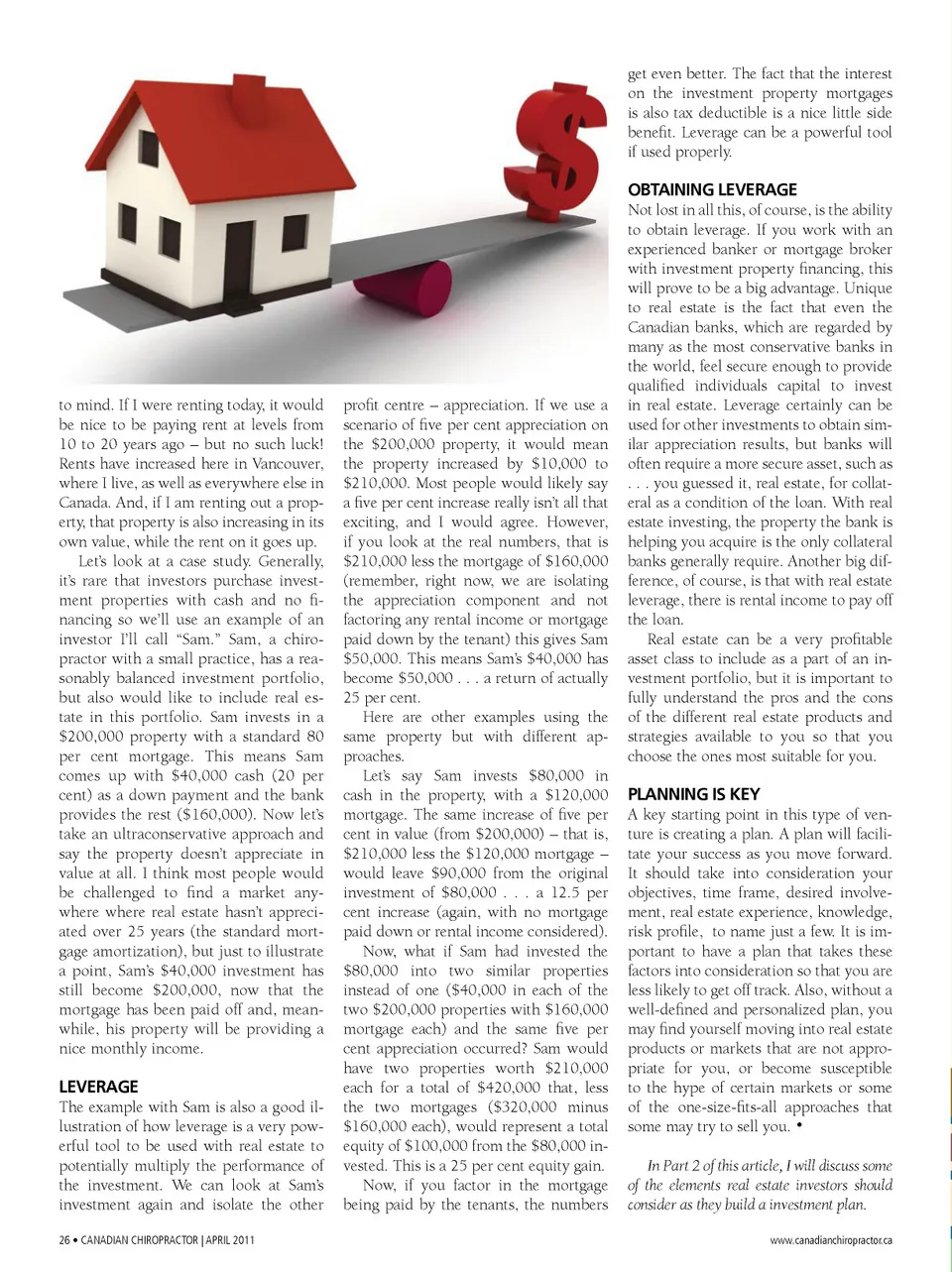
get even better. The fact that the interest on the investment property mortgages is also tax deductible is a nice little side benefit. Leverage can be a powerful tool if used properly. to mind. If I were renting today, it would be nice to be paying rent at levels from 10 to 20 years ago – but no such luck! Rents have increased here in Vancouver, where I live, as well as everywhere else in Canada. And, if I am renting out a prop-erty, that property is also increasing in its own value, while the rent on it goes up. Let’s look at a case study. Generally, it’s rare that investors purchase invest-ment properties with cash and no fi-nancing so we’ll use an example of an investor I’ll call “Sam.” Sam, a chiro-practor with a small practice, has a rea-sonably balanced investment portfolio, but also would like to include real es-tate in this portfolio. Sam invests in a $200,000 property with a standard 80 per cent mortgage. This means Sam comes up with $40,000 cash (20 per cent) as a down payment and the bank provides the rest ($160,000). Now let’s take an ultraconservative approach and say the property doesn’t appreciate in value at all. I think most people would be challenged to find a market any-where where real estate hasn’t appreci-ated over 25 years (the standard mort-gage amortization), but just to illustrate a point, Sam’s $40,000 investment has still become $200,000, now that the mortgage has been paid off and, mean-while, his property will be providing a nice monthly income. LEVERAGE The example with Sam is also a good il-lustration of how leverage is a very pow-erful tool to be used with real estate to potentially multiply the performance of the investment. We can look at Sam’s investment again and isolate the other 26 • CANADIAN CHIROPRACTOR | APRIL 2011 profit centre – appreciation. If we use a scenario of five per cent appreciation on the $200,000 property, it would mean the property increased by $10,000 to $210,000. Most people would likely say a five per cent increase really isn’t all that exciting, and I would agree. However, if you look at the real numbers, that is $210,000 less the mortgage of $160,000 (remember, right now, we are isolating the appreciation component and not factoring any rental income or mortgage paid down by the tenant) this gives Sam $50,000. This means Sam’s $40,000 has become $50,000 . . . a return of actually 25 per cent. Here are other examples using the same property but with different ap-proaches. Let’s say Sam invests $80,000 in cash in the property, with a $120,000 mortgage. The same increase of five per cent in value (from $200,000) – that is, $210,000 less the $120,000 mortgage – would leave $90,000 from the original investment of $80,000 . . . a 12.5 per cent increase (again, with no mortgage paid down or rental income considered). Now, what if Sam had invested the $80,000 into two similar properties instead of one ($40,000 in each of the two $200,000 properties with $160,000 mortgage each) and the same five per cent appreciation occurred? Sam would have two properties worth $210,000 each for a total of $420,000 that, less the two mortgages ($320,000 minus $160,000 each), would represent a total equity of $100,000 from the $80,000 in-vested. This is a 25 per cent equity gain. Now, if you factor in the mortgage being paid by the tenants, the numbers OBTAINING LEVERAGE Not lost in all this, of course, is the ability to obtain leverage. If you work with an experienced banker or mortgage broker with investment property financing, this will prove to be a big advantage. Unique to real estate is the fact that even the Canadian banks, which are regarded by many as the most conservative banks in the world, feel secure enough to provide qualified individuals capital to invest in real estate. Leverage certainly can be used for other investments to obtain sim-ilar appreciation results, but banks will often require a more secure asset, such as . . . you guessed it, real estate, for collat-eral as a condition of the loan. With real estate investing, the property the bank is helping you acquire is the only collateral banks generally require. Another big dif-ference, of course, is that with real estate leverage, there is rental income to pay off the loan. Real estate can be a very profitable asset class to include as a part of an in-vestment portfolio, but it is important to fully understand the pros and the cons of the different real estate products and strategies available to you so that you choose the ones most suitable for you. PLANNING IS KEY A key starting point in this type of ven-ture is creating a plan. A plan will facili-tate your success as you move forward. It should take into consideration your objectives, time frame, desired involve-ment, real estate experience, knowledge, risk profile, to name just a few. It is im-portant to have a plan that takes these factors into consideration so that you are less likely to get off track. Also, without a well-defined and personalized plan, you may find yourself moving into real estate products or markets that are not appro-priate for you, or become susceptible to the hype of certain markets or some of the one-size-fits-all approaches that some may try to sell you. • In Part 2 of this article, I will discuss some of the elements real estate investors should consider as they build a investment plan. www.canadianchiropractor.ca
Chiropractic + Naturopathic Doctor April 2011: Page 26