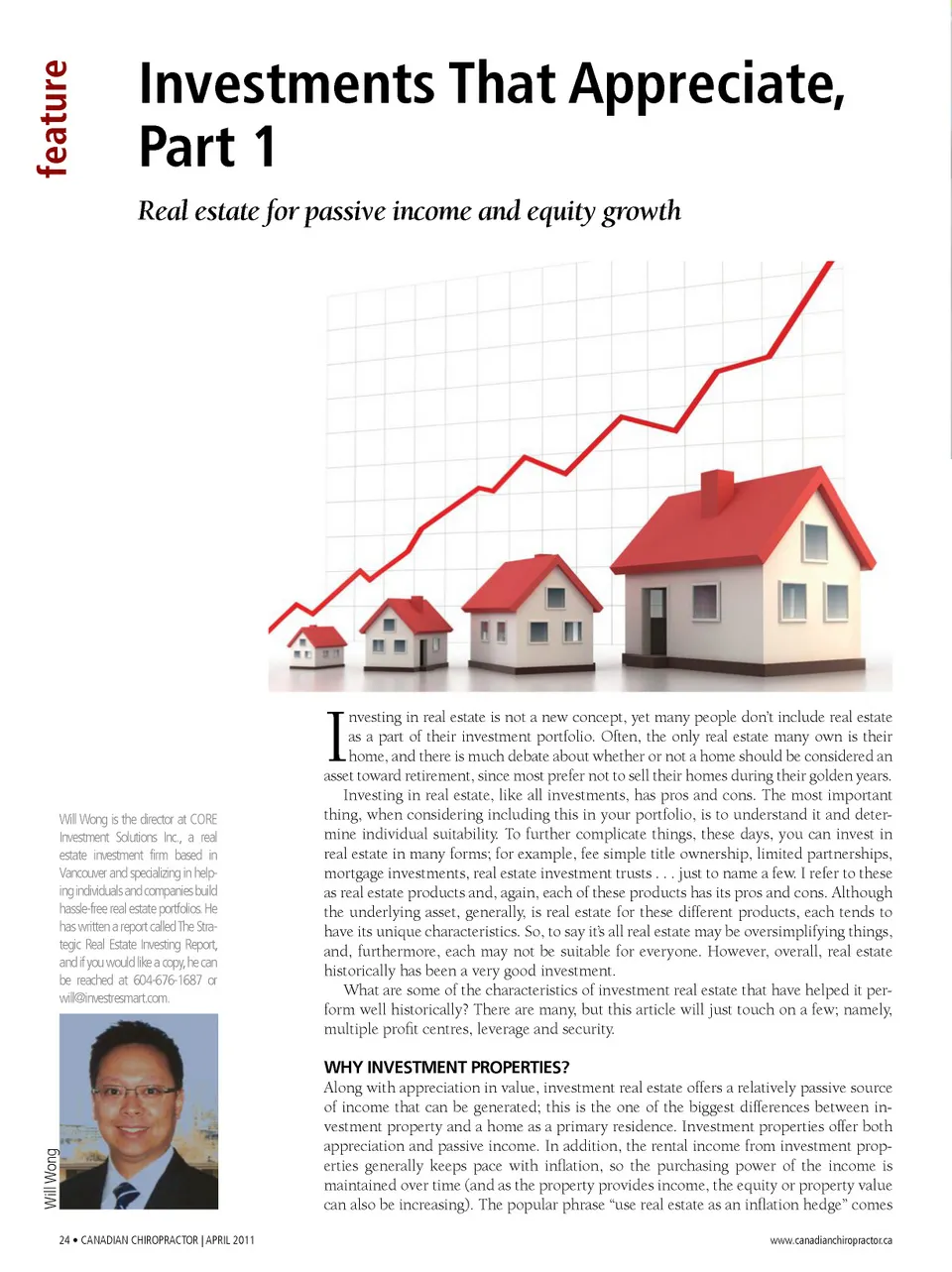
Investments That Appreciate, Part 1 Real estate for passive income and equity growth feature I Will Wong is the director at CORE Investment Solutions Inc., a real estate investment firm based in Vancouver and specializing in help-ing individuals and companies build hassle-free real estate portfolios. He has written a report called The Stra-tegic Real Estate Investing Report, and if you would like a copy, he can be reached at 604-676-1687 or [email protected]. nvesting in real estate is not a new concept, yet many people don’t include real estate as a part of their investment portfolio. Often, the only real estate many own is their home, and there is much debate about whether or not a home should be considered an asset toward retirement, since most prefer not to sell their homes during their golden years. Investing in real estate, like all investments, has pros and cons. The most important thing, when considering including this in your portfolio, is to understand it and deter-mine individual suitability. To further complicate things, these days, you can invest in real estate in many forms; for example, fee simple title ownership, limited partnerships, mortgage investments, real estate investment trusts . . . just to name a few. I refer to these as real estate products and, again, each of these products has its pros and cons. Although the underlying asset, generally, is real estate for these different products, each tends to have its unique characteristics. So, to say it’s all real estate may be oversimplifying things, and, furthermore, each may not be suitable for everyone. However, overall, real estate historically has been a very good investment. What are some of the characteristics of investment real estate that have helped it per-form well historically? There are many, but this article will just touch on a few; namely, multiple profit centres, leverage and security. WHY INVESTMENT PROPERTIES? Along with appreciation in value, investment real estate offers a relatively passive source of income that can be generated; this is the one of the biggest differences between in-vestment property and a home as a primary residence. Investment properties offer both appreciation and passive income. In addition, the rental income from investment prop-erties generally keeps pace with inflation, so the purchasing power of the income is maintained over time (and as the property provides income, the equity or property value can also be increasing). The popular phrase “use real estate as an inflation hedge” comes www.canadianchiropractor.ca Will Wong 24 • CANADIAN CHIROPRACTOR | APRIL 2011
Chiropractic + Naturopathic Doctor April 2011: Page 24