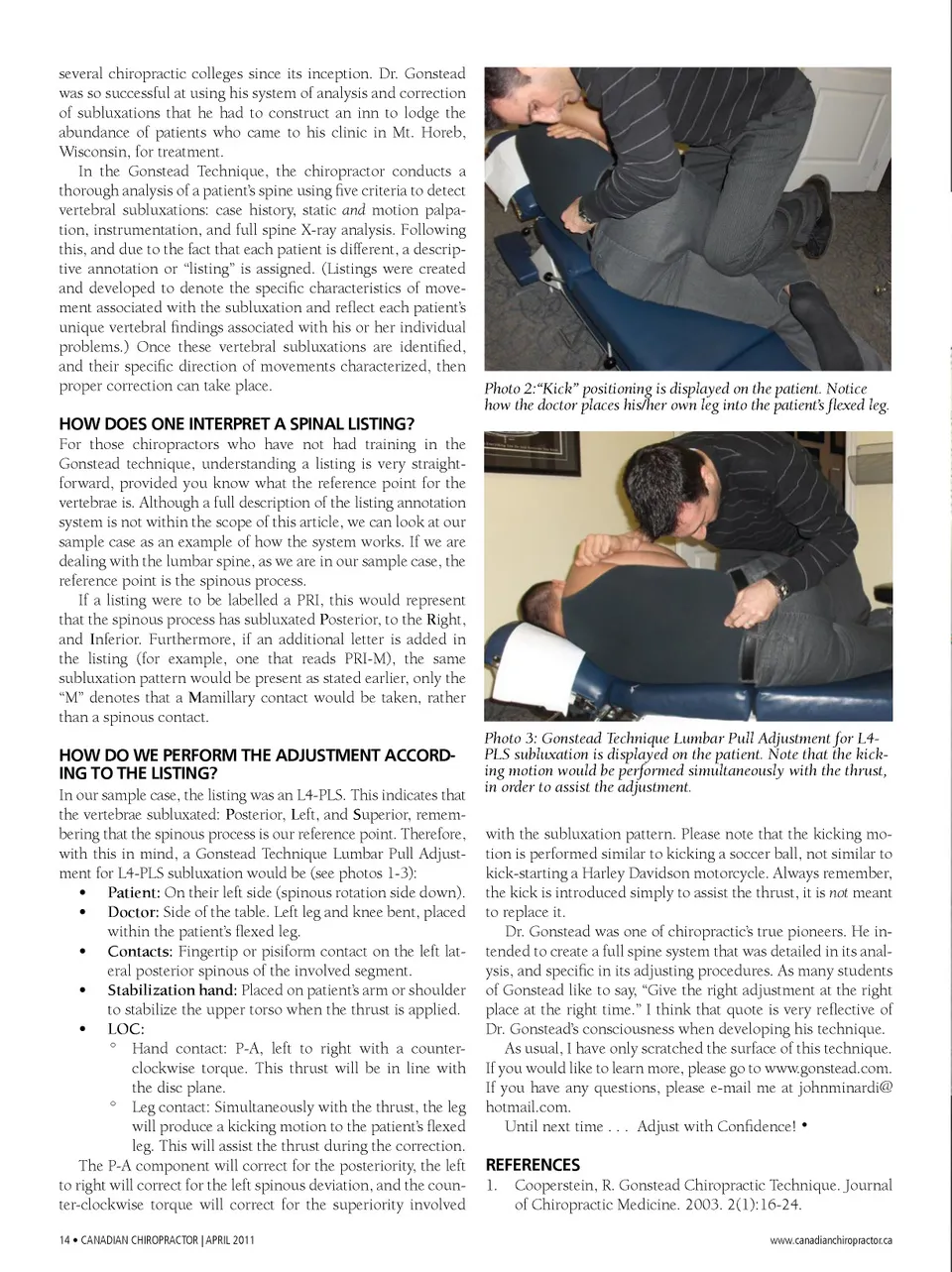
several chiropractic colleges since its inception. Dr. Gonstead was so successful at using his system of analysis and correction of subluxations that he had to construct an inn to lodge the abundance of patients who came to his clinic in Mt. Horeb, Wisconsin, for treatment. In the Gonstead Technique, the chiropractor conducts a thorough analysis of a patient’s spine using five criteria to detect vertebral subluxations: case history, static and motion palpa-tion, instrumentation, and full spine X-ray analysis. Following this, and due to the fact that each patient is different, a descrip-tive annotation or “listing” is assigned. (Listings were created and developed to denote the specific characteristics of move-ment associated with the subluxation and reflect each patient’s unique vertebral findings associated with his or her individual problems.) Once these vertebral subluxations are identified, and their specific direction of movements characterized, then proper correction can take place. HOW DOES ONE INTERPRET A SPINAL LISTING? For those chiropractors who have not had training in the Gonstead technique, understanding a listing is very straight-forward, provided you know what the reference point for the vertebrae is. Although a full description of the listing annotation system is not within the scope of this article, we can look at our sample case as an example of how the system works. If we are dealing with the lumbar spine, as we are in our sample case, the reference point is the spinous process. If a listing were to be labelled a PRI, this would represent that the spinous process has subluxated P osterior, to the R ight, and I nferior. Furthermore, if an additional letter is added in the listing (for example, one that reads PRI-M), the same subluxation pattern would be present as stated earlier, only the “M” denotes that a M amillary contact would be taken, rather than a spinous contact. HOW DO WE PERFORM THE ADJUSTMENT ACCORD-ING TO THE LISTING? In our sample case, the listing was an L4-PLS. This indicates that the vertebrae subluxated: P osterior, L eft, and S uperior, remem-bering that the spinous process is our reference point. Therefore, with this in mind, a Gonstead Technique Lumbar Pull Adjust-ment for L4-PLS subluxation would be (see photos 1-3): • Patient: On their left side (spinous rotation side down). • Doctor: Side of the table. Left leg and knee bent, placed within the patient’s flexed leg. • Contacts: Fingertip or pisiform contact on the left lat-eral posterior spinous of the involved segment. • Stabilization hand: Placed on patient’s arm or shoulder to stabilize the upper torso when the thrust is applied. • LOC: ° Hand contact: P-A, left to right with a counter-clockwise torque. This thrust will be in line with the disc plane. ° Leg contact: Simultaneously with the thrust, the leg will produce a kicking motion to the patient’s flexed leg. This will assist the thrust during the correction. The P-A component will correct for the posteriority, the left to right will correct for the left spinous deviation, and the coun-ter-clockwise torque will correct for the superiority involved 14 • CANADIAN CHIROPRACTOR | APRIL 2011 Photo 2:“Kick” positioning is displayed on the patient. Notice how the doctor places his/her own leg into the patient’s flexed leg. Photo 3: Gonstead Technique Lumbar Pull Adjustment for L4-PLS subluxation is displayed on the patient. Note that the kick-ing motion would be performed simultaneously with the thrust, in order to assist the adjustment. with the subluxation pattern. Please note that the kicking mo-tion is performed similar to kicking a soccer ball, not similar to kick-starting a Harley Davidson motorcycle. Always remember, the kick is introduced simply to assist the thrust, it is not meant to replace it. Dr. Gonstead was one of chiropractic’s true pioneers. He in-tended to create a full spine system that was detailed in its anal-ysis, and specific in its adjusting procedures. As many students of Gonstead like to say, “Give the right adjustment at the right place at the right time.” I think that quote is very reflective of Dr. Gonstead’s consciousness when developing his technique. As usual, I have only scratched the surface of this technique. If you would like to learn more, please go to www.gonstead.com. If you have any questions, please e-mail me at johnminardi@ hotmail.com. Until next time . . . Adjust with Confidence! • REFERENCES 1. Cooperstein, R. Gonstead Chiropractic Technique. Journal of Chiropractic Medicine. 2003. 2(1):16-24. www.canadianchiropractor.ca
Chiropractic + Naturopathic Doctor April 2011: Page 14