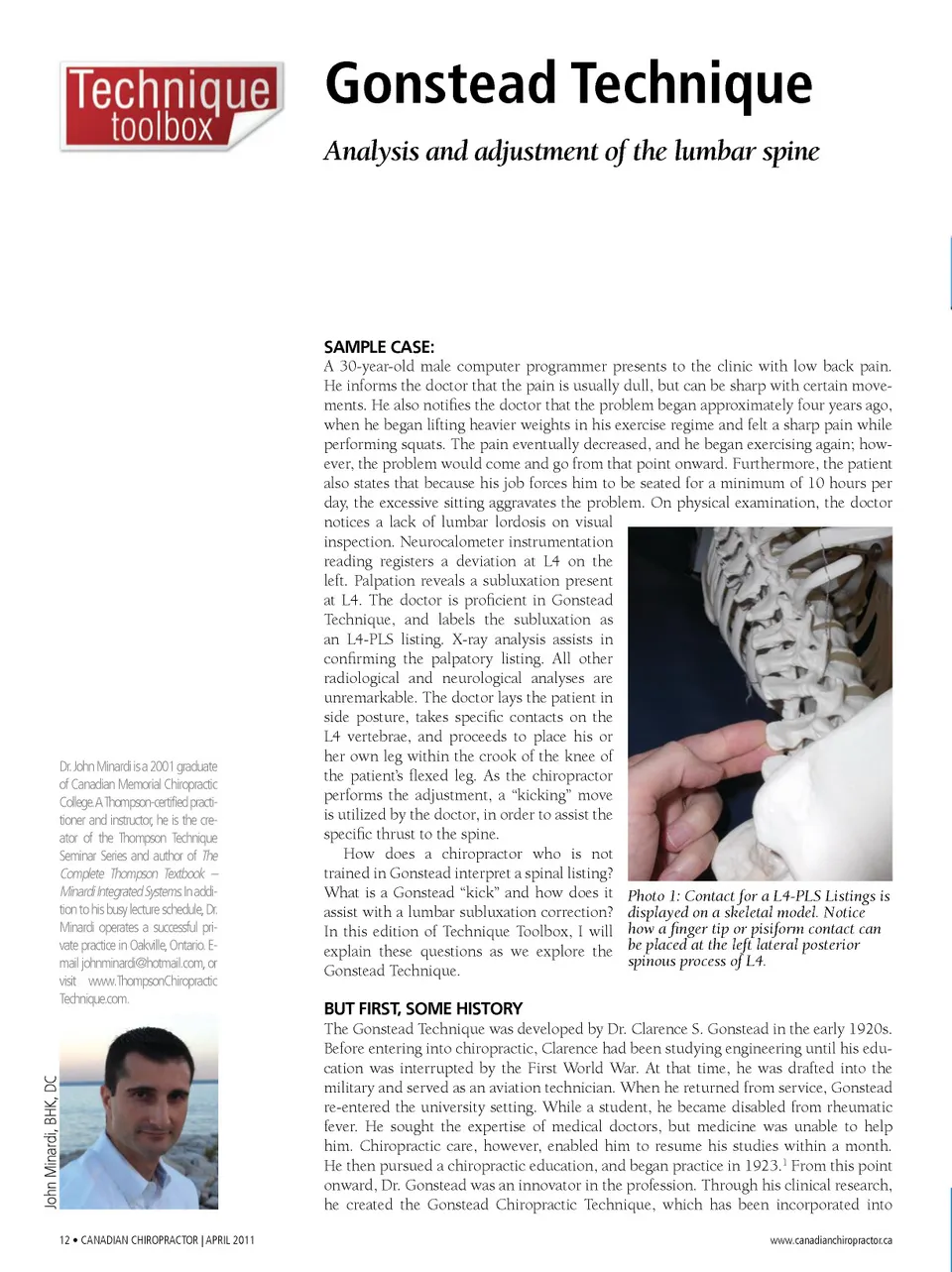
Gonstead Technique Analysis and adjustment of the lumbar spine Dr. John Minardi is a 2001 graduate of Canadian Memorial Chiropractic College. A Thompson-certified practi- tioner and instructor, he is the cre-ator of the Thompson Technique Seminar Series and author of The Complete Thompson Textbook – Minardi Integrated Systems. In addi-tion to his busy lecture schedule, Dr. Minardi operates a successful pri-vate practice in Oakville, Ontario. E-mail [email protected], or visit www.ThompsonChiropractic Technique.com. SAMPLE CASE: A 30-year-old male computer programmer presents to the clinic with low back pain. He informs the doctor that the pain is usually dull, but can be sharp with certain move-ments. He also notifies the doctor that the problem began approximately four years ago, when he began lifting heavier weights in his exercise regime and felt a sharp pain while performing squats. The pain eventually decreased, and he began exercising again; how-ever, the problem would come and go from that point onward. Furthermore, the patient also states that because his job forces him to be seated for a minimum of 10 hours per day, the excessive sitting aggravates the problem. On physical examination, the doctor notices a lack of lumbar lordosis on visual inspection. Neurocalometer instrumentation reading registers a deviation at L4 on the left. Palpation reveals a subluxation present at L4. The doctor is proficient in Gonstead Technique, and labels the subluxation as an L4-PLS listing. X-ray analysis assists in confirming the palpatory listing. All other radiological and neurological analyses are unremarkable. The doctor lays the patient in side posture, takes specific contacts on the L4 vertebrae, and proceeds to place his or her own leg within the crook of the knee of the patient’s flexed leg. As the chiropractor performs the adjustment, a “kicking” move is utilized by the doctor, in order to assist the specific thrust to the spine. How does a chiropractor who is not trained in Gonstead interpret a spinal listing? What is a Gonstead “kick” and how does it Photo 1: Contact for a L4-PLS Listings is assist with a lumbar subluxation correction? displayed on a skeletal model. Notice In this edition of Technique Toolbox, I will how a finger tip or pisiform contact can explain these questions as we explore the be placed at the left lateral posterior spinous process of L4. Gonstead Technique. BUT FIRST, SOME HISTORY The Gonstead Technique was developed by Dr. Clarence S. Gonstead in the early 1920s. Before entering into chiropractic, Clarence had been studying engineering until his edu-cation was interrupted by the First World War. At that time, he was drafted into the military and served as an aviation technician. When he returned from service, Gonstead re-entered the university setting. While a student, he became disabled from rheumatic fever. He sought the expertise of medical doctors, but medicine was unable to help him. Chiropractic care, however, enabled him to resume his studies within a month. He then pursued a chiropractic education, and began practice in 1923. 1 From this point onward, Dr. Gonstead was an innovator in the profession. Through his clinical research, he created the Gonstead Chiropractic Technique, which has been incorporated into www.canadianchiropractor.ca John Minardi, BHK, DC 12 • CANADIAN CHIROPRACTOR | APRIL 2011
Chiropractic + Naturopathic Doctor April 2011: Page 12