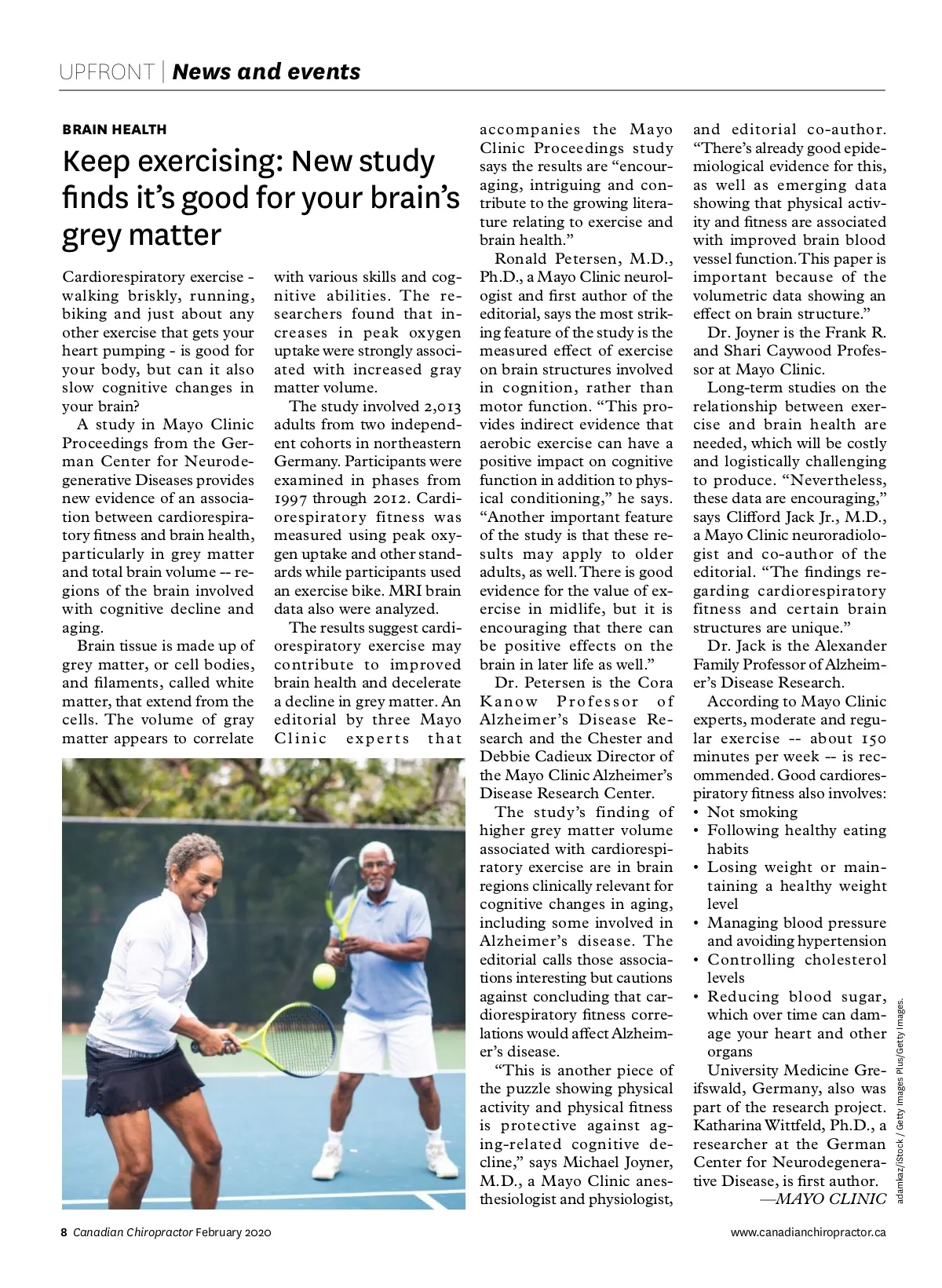
UPFRONT | News and events BRAIN HEALTH Keep exercising: New study finds it’s good for your brain’s grey matter Cardiorespiratory exercise -walking briskly, running, biking and just about any other exercise that gets your heart pumping -is good for your body, but can it also slow cognitive changes in your brain? A study in Mayo Clinic Proceedings from the Ger-man Center for Neurode-generative Diseases provides new evidence of an associa-tion between cardiorespira-tory fitness and brain health, particularly in grey matter and total brain volume --re-gions of the brain involved with cognitive decline and aging. Brain tissue is made up of grey matter, or cell bodies, and filaments, called white matter, that extend from the cells. The volume of gray matter appears to correlate with various skills and cog-nitive abilities. The re-searchers found that in-creases in peak oxygen uptake were strongly associ-ated with increased gray matter volume. The study involved 2,013 adults from two independ-ent cohorts in northeastern Germany. Participants were examined in phases from 1997 through 2012. Cardi-orespiratory fitness was measured using peak oxy-gen uptake and other stand-ards while participants used an exercise bike. MRI brain data also were analyzed. The results suggest cardi-orespiratory exercise may contribute to improved brain health and decelerate a decline in grey matter. An editorial by three Mayo Clinic experts that accompanies the Mayo Clinic Proceedings study says the results are “encour-aging, intriguing and con-tribute to the growing litera-ture relating to exercise and brain health.” Ronald Petersen, M.D., Ph.D., a Mayo Clinic neurol-ogist and first author of the editorial, says the most strik-ing feature of the study is the measured effect of exercise on brain structures involved in cognition, rather than motor function. “This pro-vides indirect evidence that aerobic exercise can have a positive impact on cognitive function in addition to phys-ical conditioning,” he says. “Another important feature of the study is that these re-sults may apply to older adults, as well. There is good evidence for the value of ex-ercise in midlife, but it is encouraging that there can be positive effects on the brain in later life as well.” Dr. Petersen is the Cora Kanow Professor of Alzheimer’s Disease Re-search and the Chester and Debbie Cadieux Director of the Mayo Clinic Alzheimer’s Disease Research Center. The study’s finding of higher grey matter volume associated with cardiorespi-ratory exercise are in brain regions clinically relevant for cognitive changes in aging, including some involved in Alzheimer’s disease. The editorial calls those associa-tions interesting but cautions against concluding that car-diorespiratory fitness corre-lations would affect Alzheim-er’s disease. “This is another piece of the puzzle showing physical activity and physical fitness is protective against ag-ing-related cognitive de-cline,” says Michael Joyner, M.D., a Mayo Clinic anes-thesiologist and physiologist, and editorial co-author. “There’s already good epide-miological evidence for this, as well as emerging data showing that physical activ-ity and fitness are associated with improved brain blood vessel function. This paper is important because of the volumetric data showing an effect on brain structure.” Dr. Joyner is the Frank R. and Shari Caywood Profes-sor at Mayo Clinic. Long-term studies on the relationship between exer-cise and brain health are needed, which will be costly and logistically challenging to produce. “Nevertheless, these data are encouraging,” says Clifford Jack Jr., M.D., a Mayo Clinic neuroradiolo-gist and co-author of the editorial. “The findings re-garding cardiorespiratory fitness and certain brain structures are unique.” Dr. Jack is the Alexander Family Professor of Alzheim-er’s Disease Research. According to Mayo Clinic experts, moderate and regu-lar exercise --about 150 minutes per week --is rec-ommended. Good cardiores-piratory fitness also involves: • Not smoking • Following healthy eating habits • Losing weight or main-taining a healthy weight level • Managing blood pressure and avoiding hypertension • Controlling cholesterol levels • Reducing blood sugar, which over time can dam-age your heart and other organs University Medicine Gre-ifswald, Germany, also was part of the research project. Katharina Wittfeld, Ph.D., a researcher at the German Center for Neurodegenera-tive Disease, is first author. —MAYO CLINIC www.canadianchiropractor.ca 8 Canadian Chiropractor February 2020 adamkaz/iStock / Getty Images Plus/Getty Images.
Chiropractic + Naturopathic Doctor February 2020: Page 8